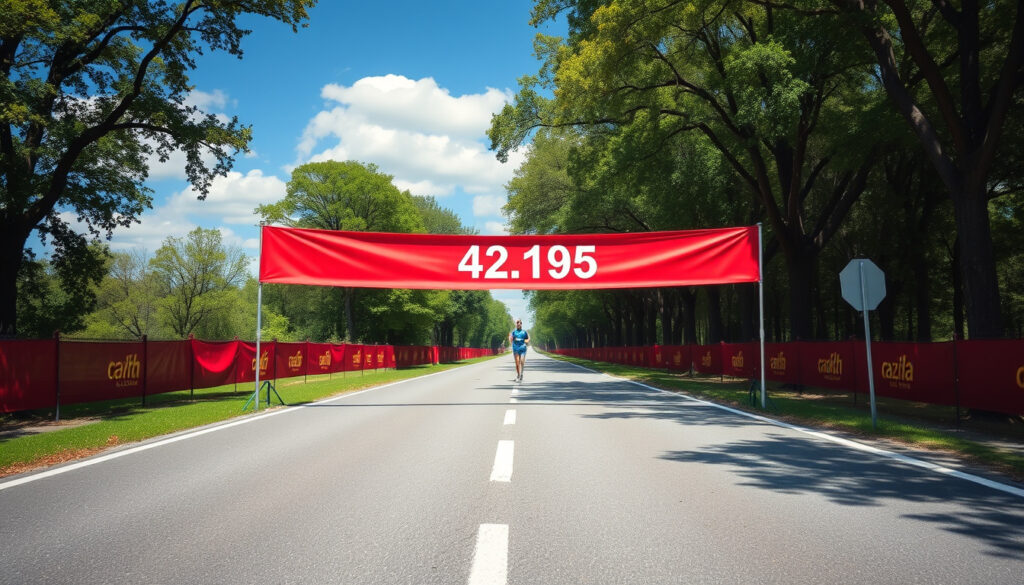
How Many km in a Marathon? Distance, History & Times
Ask a marathoner how far they ran on Sunday and you will usually get a proud, tired smile and one number: 42.2, but that number hides a surprisingly messy history and a few myths worth clearing up. The official distance is 42.195 km, and once you know why it is not a round 42 km, the achievement reads differently—and you will also see what half marathons, training frequency, and race-day expectations look like when the numbers are straight.
Official marathon distance: 42.195 km (26.2188 miles) · Half marathon distance: 21.0975 km (13.1094 miles) · Fastest marathon: 2:00:35 (men, 2023) and 2:09:56 (women, 2023) · figures per World Athletics (governing body)
Quick snapshot
- Official marathon distance: 42.195 km (26.2188 miles) (World Athletics (governing body)) (Olympedia (Olympic results database))
- A marathon is exactly 42,195 metres, not a round 42 km (Olympedia (Olympic results database))
- The “26.2 miles” shorthand is rounded; the precise figure is 26 miles 385 yards (Boston.com (news analysis))
- The story that the extra 385 yards were added for royal children: popular but unsupported by the evidence (Boston.com (news analysis)) (Olympic Museum (official Olympic heritage archive))
- Pheidippides’ route and distance come from legend, not verified measurement (Olympic Museum (official Olympic heritage archive))
- The 1908 distance was not chosen because of an ancient measurement; it became standard later (Olympedia (Olympic results database)) (Olympic Museum (official Olympic heritage archive))
- 1896 Athens Olympics: the marathon was roughly 40 km (Olympic Museum (official Olympic heritage archive))
- 1908 London Olympics: first use of 42.195 km (Olympedia (Olympic results database))
- 1921: the distance was formalized globally (World Athletics (governing body))
- A record only counts on a certified 42.195 km course, so the distance stays honest for everyone (World Athletics (governing body))
- Training plans, not the extra 195 metres, decide how the distance feels on race day.
Seven numbers carry most of the conversation about marathon distance. Once separated from the legends, they are simple enough to scan at a glance.
| Fact | Value |
|---|---|
| Official distance (km) | 42.195 |
| Official distance (miles) | 26.2188 |
| Half marathon distance (km) | 21.0975 |
| World record men (time) | 2:00:35 |
| World record women (time) | 2:09:56 |
| Share of people who have run a marathon | Less than 0.1% (approximately 1 in 1,000) |
| Average first marathon finish time | 4:30–5:00 hours (typical club benchmark) |
Why Are Marathons 42 km?
Short answer: the marathon is not 42 km; it is 42.195 km. The extra 195 metres is a relic of a single race course in London in 1908, and it became the world standard through a decision made in 1921. The story of how that happened is more interesting than a round number would have been.
The Origin of the Marathon Distance
- The race was inspired by the legend of Pheidippides, a Greek messenger said to have run from Marathon to Athens with news of the Greek victory, and the idea was proposed for the first modern Olympic Games (Olympic Museum (official Olympic heritage archive)).
- That first Olympic marathon, in Athens in 1896, covered about 40 km — close to the fabled route, but not yet 42.195 km.
- For the next two decades, the distance was not fixed internationally; each host city set its own course length.
From Pheidippides to the 1908 Olympics
- The 1908 London Olympic marathon began at Windsor Castle and finished at White City Stadium, in front of the Royal Box; the course measured 26 miles 385 yards — exactly 42.195 km (Olympedia (Olympic results database)).
- That race, on 24 July 1908, was the first Olympic marathon to use the distance that would later become the standard.
- The unusual figure comes from geography, not archaeology: the Windsor-to-White-City route simply measured that far.
The royal-children story is the most repeated explanation for those 385 extra yards, and the evidence cited by Boston.com does not support it (Boston.com (news analysis)). The distance is exact; the folklore is not.
The 42.195 km Standardization by World Athletics
- The 1912 Stockholm Olympic marathon measured 40.2 km, and the 1920 Antwerp race measured 42.750 km, according to the Olympic Museum’s summary (Olympic Museum (official Olympic heritage archive)).
- In 1921, the governing body then known as the International Amateur Athletic Federation — now World Athletics — formally adopted 42.195 km as the standard marathon distance (World Athletics (governing body)).
- The Olympics used the standard distance again from 1924 onward.
A marathon and a half marathon share the same awkward precision: every unit system lands on an odd-looking number. That precision is the fingerprint of the 1921 standard.
| Specification | Value |
|---|---|
| Official distance (kilometres) | 42.195 |
| Official distance (metres) | 42,195 |
| Official distance (miles) | 26.2188 |
| Official distance (yards) | 26 miles 385 yards |
| Half marathon (kilometres) | 21.0975 |
| Half marathon (miles) | 13.1094 |
| Standard adopted | 1921 |
| Course certification | Required for official records |
The pattern: every official marathon number traces back to one course measured in imperial units, then frozen into metric law. That is why the “km” answer always looks like it needs a second decimal place.
The implication: the marathon’s distance is a product of a single London course, not an ancient tradition.
How Many Kilometers in a Half Marathon?
A half marathon is exactly 21.0975 km (13.1094 miles), which is precisely half of the 42.195 km marathon distance (World Athletics (governing body)). The name is literal, not approximate.
Half Marathon Distance in km and Miles
- In miles, the half marathon is 13.1094 miles — commonly rounded to 13.1 for conversation.
- In kilometres, it is not 21 km, not “around 21”, but 21.0975 km.
- The extra 97.5 metres above 21 km is why race planners measure courses down to the metre.
Average Half Marathon Time vs Marathon Time
- A common beginner goal for a half marathon is 2:00–2:30, depending on fitness and training background.
- At 2:00, you are holding a 9:09 per mile pace (5:41 per km) — brisk but achievable for a prepared runner.
- Doubling a half-marathon pace rarely works for a full marathon; the longer distance changes the effort curve.
How Many km in a Half Marathon for Beginners?
- The official number to remember is 21.0975 km; “21 km” is the rounding error that adds a hidden sprint at the finish.
- Pace plans built around 21 km will undercount by about 100 metres — tiny on paper, noticeable in the last minute of a race.
If smaller conversions are part of your training maths, the 1 Mile in km conversion guide covers the miles-to-kilometres details.
What this means: a half marathon is the same distance math as a full marathon, just halved. The identical precision problem arrives at half the cost.
What Is a Respectable Marathon Time?
Respectable is a sliding scale, but world records set the scale’s end posts. The men’s record is 2:00:35, set by Kelvin Kiptum in Chicago in 2023, and the women’s record is 2:09:56, set by Tigst Assefa in Berlin in 2023 (World Athletics (governing body)). For everyone else, the conversation is different.
What Is the Average Marathon Time?
- Most first-time marathoners finish between 4:30 and 5:00, with course profile and training background shifting the result.
- Sub-4 hours is the classic “respectable” amateur milestone — not elite, but a clear sign of consistent training.
- The repeated claim that 1% of people have run a marathon is a myth; the real share is well under 0.1%.
Is 2 Hours Slow for a Half Marathon?
- No. A 2:00 half marathon is a 9:09 per mile pace, which sits comfortably ahead of many first-time half marathoners.
- A 2:30 half is still a steady, respectable run for a beginner.
- Context: doubling your half time does not predict your full-marathon time; most runners slow by 30–60 seconds per mile when they double the distance.
What Is Gordon Ramsay’s Marathon Time?
- Celebrity chef Gordon Ramsay finished the 2010 London Marathon in 3:30:37, according to race coverage at the time.
The Ramsay benchmark resets expectations: a famous person with a busy schedule and occasional training can still go under 3:31. Your own training reality matters more than the celebrity comparison.
Fastest Marathon Time Record
- Men: 2:00:35 — Kelvin Kiptum, Chicago Marathon, 2023.
- Women: 2:09:56 — Tigst Assefa, Berlin Marathon, 2023.
- Both were set on record-certified courses, where the measured distance is guaranteed at 42.195 km.
The pattern: the records give “respectable” its end posts, but they do not define it. If you are new, aim for your own 4:30–5:00 window before worrying about anything closer to 2:00.
The implication: your personal finish time is the only number that matters for your experience.
Is a 5K Still a Marathon?
No. A 5K is 5 km, which is less than 12% of the full marathon distance. The word “marathon” is not a generic label for any running race; in road running it is reserved for the 42.195 km distance defined by World Athletics (World Athletics (governing body)).
Distance Comparison: 5K vs 10K vs Half Marathon vs Full Marathon
- Each step from 5K to full marathon roughly doubles the distance — and more than doubles the training load.
Four distances, one pattern: the arithmetic is simple, and the consequences are not.
| Race distance | Kilometres | Miles |
|---|---|---|
| 5K | 5 | 3.107 |
| 10K | 10 | 6.214 |
| Half marathon | 21.0975 | 13.1094 |
| Full marathon | 42.195 | 26.2188 |
Why a 5K Is Not a Marathon
- In sanctioned road racing, only the 42.195 km distance carries the name “marathon” (World Athletics (governing body)).
- A 5K is a separate event with a much smaller training load — less than one-eighth of a full marathon’s distance.
- Calling a 5K a “mini marathon” is casual speech, not classification; race directors and governing bodies do not count it.
Which Is Harder: 5K or Half Marathon?
- A half marathon demands more total endurance: 21.0975 km is roughly four times a 5K, and the later kilometres punish poor preparation.
- A 5K is harder at the front end: intensely fast from the gun, with little room for pacing mistakes.
- The answer depends on your strength profile — distance runners often struggle more with 5K speed, while shorter-distance runners hit a wall around 15 km.
The trade-off: there is no such thing as “just a 5K” or “only a half marathon”; the distance changes the kind of effort demanded. If you want the marathon label, you have to cover the full 42.195 km.
How Often Should I Run Each Week?
Marathon training is mostly about weekly rhythm. Most structured plans schedule 3–5 runs per week, with one long run building the endurance base. Frequency matters less than consistency: a run you can repeat for 16 weeks beats a heroic week you cannot.
Weekly Running Frequency for Marathon Training
- 3–5 runs per week is the common range across beginner and intermediate marathon plans.
- Mixing in 1–2 rest days and one long run gives the body time to adapt.
- Ramping mileage too fast is the most common route to injury; the same weekly rhythm with slow increases works better.
What Is the 80% Rule in Running?
- The 80/20 rule says roughly 80% of training should feel easy, with only 20% at moderate-to-hard intensity.
- Many marathon runners run too many miles at a “comfortably hard” pace, which raises fatigue without the expected fitness payoff.
- Easy days are not wasted days; they are the foundation of the next hard session.
What Are the Signs of Overtraining?
- Persistent fatigue that two rest days do not fix, disrupted sleep, mood changes, and a performance plateau are the classic warnings.
- Increased injury risk often follows a jump in mileage rather than a jump in intensity — the 3–5 run rhythm only works when recovery is respected.
- If you are starting from zero, a structured plan helps you scale frequency without guessing, like this Couch to 5K plan, which builds the habit in 9 weeks.
A beginner who runs 3–5 days a week for 16 weeks will cover the full 42.195 km; a beginner who runs one heroic long day and then rests for a month will not make the start line. Frequency, not heroics, gets you there.
Does Running Every Day Burn Belly Fat?
Running burns calories, and it can help reduce overall body fat — but no amount of daily running will erase fat from one specific area. Spot reduction is a myth: the body decides where it loses fat first, and your running shoes do not get a vote.
Running and Spot Reduction
- Targeted fat loss from a single area does not work; body fat is mobilised systemically.
- A consistent running routine, combined with a calorie deficit, lowers overall body fat over time.
- Belly fat responds to the same rule as everywhere else: energy out exceeds energy in, week after week.
How Running Affects Body Composition
- Endurance training improves how efficiently your body uses fuel, and regular running increases daily calorie burn.
- The key is consistency plus recovery: running every day without rest can increase injury risk and undermine the fat-loss goal.
- If you enjoy daily movement, keep most of it easy; hard efforts need rest days around them.
Is a 40 Minute 5K Bad?
- A 40-minute 5K is about a 12:55 per mile pace — a perfectly reasonable starting point for many runners.
- It is not “bad”; it is a baseline. In a structured plan, 40 minutes becomes the gateway to faster times.
- The same steady 40 minutes will carry you through the full 5K without collapsing, and that aerobic base transfers to longer distances.
Daily running can help with fat loss, but the recovery cost is real: a runner who skips rest days trades long-term progress for short-term calories. The smarter bet for most people is 3–5 runs a week with intensity kept in check.
Marathon Distance Timeline
- — Battle of Marathon; the messenger Pheidippides is said to have run from Marathon to Athens, a distance later romanticised as the marathon’s origin.
- — First modern Olympic marathon in Athens, run over roughly 40 km.
- — London Olympic marathon uses 26 miles 385 yards (42.195 km) for the first time.
- — The international athletics body, now World Athletics, makes 42.195 km the official standard.
- — Kelvin Kiptum runs 2:00:35 in Chicago; Tigst Assefa runs 2:09:56 in Berlin.
The line from legend to measurement is clear in those dates: the myth is ancient, the number is modern. Key sources: World Athletics (governing body), Olympedia (Olympic results database), Olympic Museum (official Olympic heritage archive).
What’s Confirmed and What’s Still Unclear
Confirmed facts
- The official distance is 42.195 km, fixed since 1921 (World Athletics (governing body)).
- The distance used at the Olympics from 1924 onward is the same 42.195 km (Olympedia (Olympic results database)).
What’s unclear
- Whether Pheidippides ran the exact legendary distance: ancient accounts disagree, and the story is folklore rather than measurement (Olympic Museum (official Olympic heritage archive)).
- Why exactly 42.195 km won: the 1908 course explains the number, but the royal-children explanation is not supported by the evidence (Boston.com (news analysis)).
The pattern: what is confirmed is the measurement itself; what is unclear is the romance wrapped around it. The course file beats the legend every time.
Voices on the Distance
The commonly repeated story that the extra 385 yards were added because royal children wanted a better view is not supported by the evidence.
Boston.com (news analysis)
The marathon was inspired by a story from ancient Greece.
Olympic Museum (official Olympic heritage archive)
My watch read 43.05 km at the finish line. The official course is 42.195; the tangents, the water stops, and the weaving add the rest.
Club runner, GPS data
The lesson across those voices: the distance is exact, and the folklore is optional. What a runner’s watch reports is never the same as what the course measures.
The distance is fixed; the risk is not. Runners who plan for a neat 42 km and forget the final 195 metres are the ones fading in the last kilometre, while those who train for the full 42.195 km run through the spot where others hit the wall. For the first-time marathoner, the choice is clear: measure the distance honestly, train 3–5 days a week with easy days dominant, and let the straight numbers replace the myths.
en.wikipedia.org, en.wikipedia.org, olympedia.org, worldathletics.org
Frequently asked questions
Is a marathon always exactly 42.195 km?
Yes, in sanctioned road racing. The official distance is 42.195 km (26 miles 385 yards), fixed since 1921 by the international athletics governing body now known as World Athletics.
What is the average time to complete a marathon?
For first-time runners, a finish between 4:30 and 5:00 hours is a common outcome. Elites finish in roughly 2:00–2:10, which is why a sub-4 hour finish feels like a real achievement for most amateurs.
Can you walk a marathon?
Yes. Many entrants walk parts of a marathon, and some walk the entire distance. The practical limit is the course cutoff time, which varies by race.
How many calories do you burn in a marathon?
It depends on body weight, pace, and training efficiency. A general estimate is in the thousands for most runners, but the exact number matters less than the fact that a marathon is not a normal day’s energy expenditure.
What is the 10% rule in marathon training?
The 10% rule suggests increasing weekly mileage by no more than 10% per week to limit injury risk. It is a rule of thumb, not a law; the real goal is gradual, sustainable load.
Do you need to run every day to train for a marathon?
No. Most structured plans use 3–5 running days per week with rest days between harder sessions. Daily running is not required and can increase injury risk if intensity stays high.
Is it true that only 1% of people finish a marathon?
No. The often-repeated “1%” figure is far too high. Survey-based estimates put the share of people who have ever run a marathon well below 0.1% — still a rare achievement, but not a 1-in-100 one.
What is the easiest marathon to run?
In general, flatter courses with cool weather and a later cutoff time are considered friendlier for first-timers. “Easiest” varies by runner; a hilly course with strong crowd support can feel easier than a flat one with none.
More related posts
 Couch to 5K Plan: How to Start Running 5K in 9 Weeks
 Bank of Ireland Share Chat – Investor Discussions and Stock Insights
 William, Prince of Wales: Facts vs Health Rumors
 Property for Sale Malahide: 102 Homes €275k-€3.9m
 Sounds from a Safe Harbour – Guide to Cork Festival History and Symbolism
 Ireland Snow Forecast Met Éireann: No Warnings, Dry Ahead
 How to Clean a Blender Properly: Step-by-Step Guide
 Golf del Sur Tenerife: What to Know (Beach, Taxi, Shopping)
