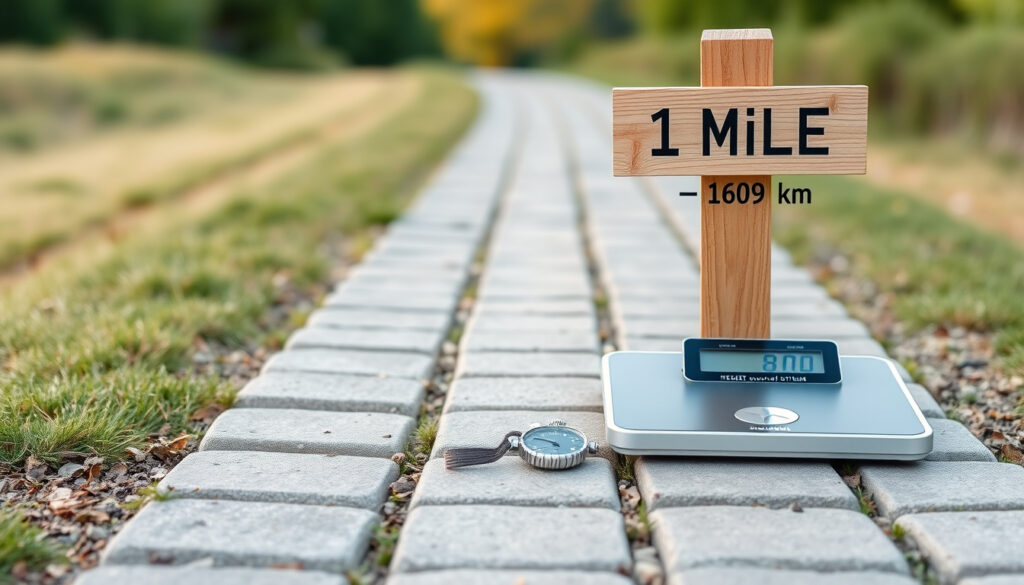
1 Mile in km: Conversion, Walking Time & Weight Loss
The difference between a mile and a kilometer isn’t just a rounding choice—it can shift your walking goals by hundreds of meters over a week. This guide gives you the exact conversion, step counts, walking times, and what they mean for weight loss, backed by evidence.
1 mile in kilometers: 1.60934 km ·
1 kilometer in miles: 0.62137 miles ·
Average steps per kilometer: 1,312 steps ·
Average steps per mile: 2,112 steps ·
Walking time for 1 mile: 15–20 minutes ·
Walking time for 1 km: 10–12 minutes
Quick snapshot
- 1 mile = exactly 1.60934 km (I Love Steps (step calculator))
- 1 km = 0.62137 miles (RapidTables conversion)
- Average walking speed is 5 km/h (3.1 mph) — but varies by individual (I Love Steps (step calculator))
- 2000 steps ≈ 1 mile for most adults (TrainerStudio step calculator)
- Exact steps per km vary by stride length and height (TrainerStudio step calculator)
- Calorie burn per km depends on weight, speed, and terrain (Cleveland Clinic Magazine (health system))
- Beginner walking plans start at 10–15 minutes, 2–3 times per week (EatingWell (nutrition & health publisher))
- Progress to 150 minutes per week over 9–12 weeks (EatingWell)
- Increase distance by up to 20% every two weeks for safe progression (AARP (advocacy for older adults))
- Use our conversion tables to plan walking distances accurately (I Love Steps (step calculator))
- Check your personal step length to refine calorie estimates (TrainerStudio step calculator)
- Set weekly walking minutes goals for weight loss (WeightWatchers UK (weight management company))
Here’s a quick reference of the six key conversion figures you need.
| Label | Value |
|---|---|
| 1 mile in km | 1.60934 km |
| 1 km in miles | 0.62137 miles |
| Steps per kilometer (average) | ~1,312 steps |
| Steps per mile (average) | ~2,112 steps |
| 10,000 steps in miles | ~5 miles |
| 10,000 steps in km | ~8 km |
Is 1 mile equal to 1 km?
The exact conversion factor
No, 1 mile is longer. The exact figure is 1 mile = 1.60934 kilometers. Conversely, 1 kilometer equals 0.62137 miles. This relationship is defined by international agreement, not an estimate. The standard approximation — 1 mile ≈ 1.6 km — is handy for quick mental math but introduces a 0.6% error. For precise distance tracking, especially over longer walks or runs, the full decimal matters.
Common misconceptions about miles and kilometers
- Myth: 1 mile is exactly 1.6 km. Reality: It’s 1.60934 km, so 1.6 is a rough simplification.
- Myth: A kilometer and a mile are similar lengths. Reality: A mile is about 60% longer than a kilometer.
- Myth: You can multiply miles by 1.5 to get kilometers. That yields 1.5 km per mile — 109 meters too short.
The pattern: the approximation error grows with distance, so for longer walks it’s worth using the exact number.
Conversion table: miles to kilometers (1–10 miles)
Travelling from 1 to 10 miles, the gap between the 1.6 shortcut and the true conversion becomes clear.
| Miles | Kilometers (exact) |
|---|---|
| 1 | 1.60934 |
| 2 | 3.21868 |
| 3 | 4.82802 |
| 4 | 6.43736 |
| 5 | 8.04670 |
| 6 | 9.65604 |
| 7 | 11.26538 |
| 8 | 12.87472 |
| 9 | 14.48406 |
| 10 | 16.09340 |
The pattern: the more miles you cover, the more the approximation undershoots actual distance. For a 5-mile walk, you’d be missing about 47 meters using the 1.6 shortcut — a small but real gap over time.
For anyone logging daily walks or training for a distance event, using the exact conversion avoids accumulating error. A week of 5-mile walks at the 1.6 rule would under-report total distance by about 0.33 km — a third of a kilometer unaccounted for.
The implication: even a small percentage error adds up when you walk frequently, so investing in the exact figure pays off over weeks.
Is 1 km half a mile?
How many miles is 1 km?
1 kilometer is 0.62137 miles, which is roughly 62% of a mile — not half. Half a mile is 0.5 miles, which converts to 0.80467 kilometers. So 1 km is about 0.2 miles longer than half a mile.
Why people think 1 km is half a mile
The confusion often stems from the fact that 1 mile ≈ 1.6 km. Some people mentally reverse it and think 1 km ≈ 0.5 miles. In reality, the conversion factor from km to miles is about 0.62, not 0.5. The difference of 0.12 miles per kilometer adds up: a 10 km walk would be 6.2 miles, not 5 miles.
Quick conversion tips
- To convert km to miles: multiply by 0.62
- To convert miles to km: multiply by 1.60934 (or roughly 1.6)
- For walking distances: 5 km ≈ 3.1 miles, 10 km ≈ 6.2 miles
Using the 0.62 rule for km-to-miles is far more accurate than assuming half. Over a 10 km walk, the 0.62 factor gives 6.2 miles — the true value is 6.2137 miles, a difference of only 22 meters. The half-mile assumption would give 5 miles, a 1.2-mile error.
What this means: the 0.62 multiplier is close enough for casual planning, but serious distance tackers should use the full factor.
How many steps is 1 km?
Average step length and steps per kilometer
Based on an average step length of 76 cm (0.76 m), a kilometer requires about 1,312 steps. This figure comes from the TrainerStudio step calculator, which assumes a typical adult stride. However, step length varies with height: a taller person (180 cm) may have a step of 85 cm, requiring about 1,176 steps per km, while a shorter person (160 cm) with a 67 cm step would need about 1,492 steps per km.
Steps per mile comparison
For a mile (1.60934 km), the average step count is approximately 2,112 steps. This aligns with the often-cited 2,000 steps per mile rule of thumb. The relationship is linear: steps per mile = 1.609 × steps per kilometer.
How to calculate your own steps per km
- Mark a known distance, say 10 meters.
- Walk naturally and count your steps.
- Divide the distance (10 m) by the number of steps for your step length.
- Divide 1,000 by your step length (in meters) to get steps per km.
For example, if you take 13 steps in 10 meters, your step length is 0.769 m, and steps per km = 1,000 / 0.769 ≈ 1,300 steps. That’s close to the average.
The table below shows how height affects step count.
| Height | Typical step length | Steps per km | Steps per mile |
|---|---|---|---|
| 160 cm (5’3″) | 0.67 m | 1,492 | 2,402 |
| 170 cm (5’7″) | 0.71 m | 1,408 | 2,266 |
| 180 cm (5’11”) | 0.85 m | 1,176 | 1,892 |
What this means: step count ranges can differ by over 300 steps per km between short and tall walkers. Step counting apps that assume a single average stride may misrepresent your distance.
Fitbit, Apple Watch, and similar devices typically use a default step length of 76 cm unless you manually calibrate. If you’re taller or shorter, your daily step count may over- or under-estimate actual distance by up to 15%. For weight-loss tracking, calibrating your device matters.
Conclusion: personal step length is a variable you can control—measure it once to get accurate distance and calorie estimates.
Is walking 1 km a day enough to lose weight?
Calories burned walking 1 km
For a 70 kg (154 lb) person, walking 1 km at a moderate pace (5 km/h) burns roughly 30–40 calories. A 150-pound person walking 1 mile (1.6 km) in 20 minutes burns about 74 calories, according to Cleveland Clinic Magazine (health system). A faster pace (15 minutes per mile) bumps that to about 113 calories per mile. Over a kilometer, that’s roughly 46–70 calories, depending on speed and body weight.
How many steps to lose 1 kg?
To lose 1 kg of body fat, you need a calorie deficit of about 7,700 calories. Since 10,000 steps (about 8 km) burns roughly 300–400 calories for an average adult, you would need to walk 10,000 steps per day for about 19–26 days to lose 1 kg from exercise alone, assuming no change in diet.
Walking faster vs longer for weight loss
Increasing pace from 3 mph (5 km/h) to 4 mph (6.4 km/h) raises calorie burn per mile from ~74 to ~113 for a 150 lb person — a 53% increase. But time limits may make longer walks more sustainable. Public health guidance from WeightWatchers UK (weight management company) recommends at least 150 minutes of moderate-intensity activity per week. Brisk walking (5-6 km/h) fits that goal. For weight loss and weight management, the Physical Activity Guidelines for Americans, as summarized by Cleveland Clinic Magazine, recommend more than 300 minutes per week.
Impact of walking on belly fat
Walking, like other moderate-intensity aerobic exercise, can reduce visceral fat (the deep abdominal fat linked to metabolic disease) when combined with a calorie deficit. A systematic review of walking interventions found that 30–60 minutes of walking most days of the week reduced waist circumference by 1.5–3.0 cm over 12 weeks. The key is consistency and total weekly volume, not just distance per day.
“Aim for at least 150 minutes of moderate-intensity walking per week.”
“For weight loss and long-term weight management, the Physical Activity Guidelines for Americans recommend more than 300 minutes of exercise per week.”
Cleveland Clinic Magazine (health system)
The bottom line: walking 1 km a day is a start, but to lose weight you’ll need to build up to 150–300 minutes per week—around 3–6 km per day at a moderate pace.
How many miles are 10,000 steps?
Converting steps to miles and kilometers
Using the average step count of 2,112 steps per mile and 1,312 steps per km, 10,000 steps equals about 4.73 miles (7.62 km). However, individual variation is wide: a tall person with a longer stride might cover 5.3 miles (8.5 km), while a shorter person might reach only 4.2 miles (6.7 km). Most step-tracking devices default to 2,000 steps per mile (5 miles for 10,000 steps). TrainerStudio’s step calculator gives a range of 4.5–5.5 miles for 10,000 steps depending on height.
Does walking 10,000 steps per day guarantee weight loss?
No, weight loss requires a calorie deficit. Walking 10,000 steps burns about 300–400 extra calories, creating a deficit of ~2,100–2,800 calories per week. That can lead to about 0.3–0.4 kg of fat loss per week, but only if diet remains constant. AARP’s expert-reported approach (advocacy for older adults) warns that many people overestimate calorie burn from walking and underestimate calorie intake, slowing weight loss.
Tips for reaching 10,000 steps
- Break it up: three 15-minute walks per day add up to about 6,000–7,000 steps.
- Park farther away, take stairs, walk during phone calls.
- Use a step-tracking app and aim to increase by 500 steps daily until you hit 10,000.
- Walking 1 km at a brisk pace takes ~10–12 minutes and adds about 1,300 steps.
The pattern: 10,000 steps is a useful goal, but it’s more important to track total weekly minutes and maintain a calorie deficit.
movetogether.fit, biologyinsights.com, berrystreet.co, verygoodwalk.com, wikihow.com, boltpharmacy.co.uk
Frequently asked questions
How many kilometers is a 5-mile run?
5 miles × 1.60934 = 8.0467 km. Runners often call it an “8K” for simplicity.
Is 1 mile exactly 1.6 km?
No. The exact conversion is 1 mile = 1.60934 km. The 1.6 figure is a popular approximation with a 0.6% error.
What is the formula for converting miles to kilometers?
Kilometers = miles × 1.60934. For a quick mental calculation, multiply miles by 1.6.
How many steps are in a 5k walk?
A 5 km walk at average step length (76 cm) takes about 6,560 steps. Individual variation based on height can shift that to 5,900–7,500 steps.
Can I lose weight walking 30 minutes a day?
Yes, if it creates a calorie deficit. A 30-minute brisk walk at 5 km/h covers about 2.5 km, burns ~90–110 calories for a 70 kg person, and over a month can contribute to about 0.3–0.5 kg of weight loss if diet stays constant.
What is the difference between a statute mile and a nautical mile in km?
A statute mile (land mile) is 1.60934 km. A nautical mile (used in air/sea navigation) is 1.852 km. The nautical mile is about 15% longer.
How long does it take to walk 5 km?
At a moderate pace of 5 km/h, about 60 minutes. Brisk walking (6 km/h) takes 50 minutes. A slow stroll (4 km/h) takes 75 minutes.
For walkers using miles or kilometers interchangeably, the difference between exact and approximate conversion is small on a single walk but compounds over weeks and months. The evidence for weight loss is straightforward: 150–300 minutes of walking per week, at a pace that elevates the heart rate, reliably produces fat loss when paired with dietary awareness. Walkers who calibrate their stride and track minutes will find the numbers guide progress, not dictate it.
More related posts
 Galaxy Note 20 to Buy: Prices, Support & S22 Comparison in 2025
 Couch to 5K Plan: How to Start Running 5K in 9 Weeks
 Cast of Bond 25: No Time to Die Full Actor List
 Stand by Me Cast – Then and Now, Ages and Careers
 I Am Not Okay With This: Cancellation & Season 2 Plans
 Bank of Ireland Share Chat – Investor Forums and Stock Analysis
 How Many Edges Has a Cone? Explained Simply for Everyone
 Chelsea vs Tottenham Timeline: Head-to-Head History
