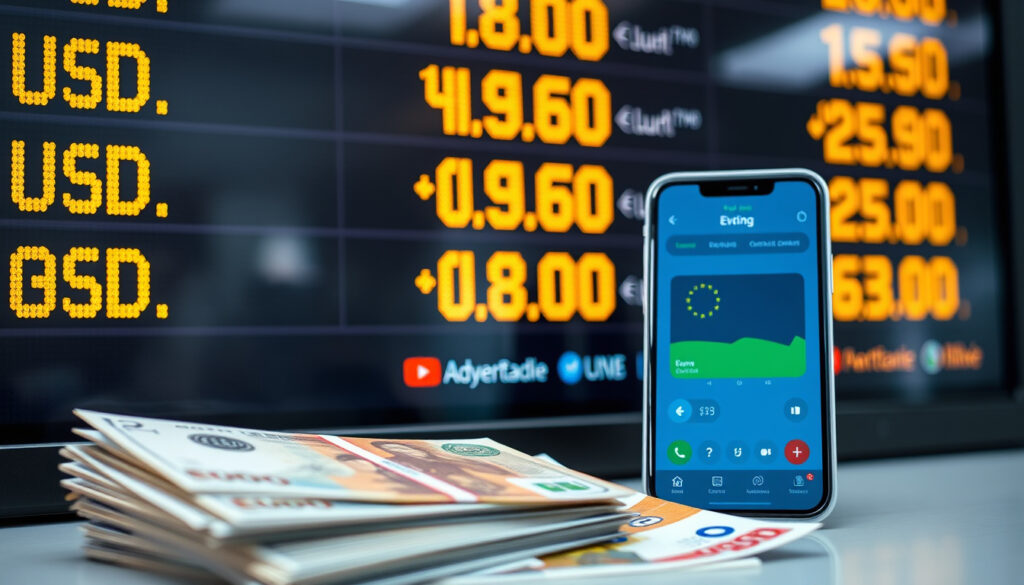
Convert USD to Euro: Current Exchange Rate & Best Deals
Anyone who’s ever transferred money across borders knows that feeling of checking the final amount and wondering where the rest went. When you convert US dollars to euros, the difference between the quoted rate and what you actually get can be surprisingly large.
Mid-market rate: 1 USD ≈ 0.86 EUR (as of 2025-02-22) · Typical bank fee: 3–7% margin · Online service fee: 0–1% margin · Daily trading volume: Over $500 billion
Quick snapshot
- Mid-market rate: ~0.86 EUR per USD (Wise (currency transfer specialist))
- Rate updated continuously 24/5 (European Central Bank)
- Always check live rate before any transfer (Bankrate (personal finance authority))
- Exact fee structure varies by bank and account type (Frex (payment processing guide))
- Future exchange rate movements cannot be predicted with certainty (Rick Steves Europe (travel expert))
- Some “no-fee” providers still charge through an unfavorable spread (Frex)
- Rate moves 24/5 with no single “best time” guarantee (European Central Bank)
- Sensitive to Fed and ECB interest-rate announcements (Federal Reserve (US central bank))
- Geopolitical events can cause sudden swings (Bankrate)
- Compare provider’s rate to the live mid-market rate (Bankrate)
- Choose transparent services (Wise, Revolut) that publish fees upfront (Wise)
- Always select “pay in local currency” when using your card abroad (Recharge.com (digital payment advice))
Eight facts that matter when deciding how to convert USD to EUR, one pattern: the biggest cost is almost never the stated fee—it’s the hidden markup on the exchange rate.
| Fact | Detail |
|---|---|
| Current mid-market rate | 1 USD = 0.8620 EUR (Wise, 2025-02-22) |
| Best online service (fee) | Wise: 0.43% transparent fee |
| Typical bank margin | 5% above mid-market |
| Largest USD/EUR trading volume | London interbank market |
| Credit card foreign transaction fee | 1–3% (Rick Steves Europe) |
| Online specialist margin | 0–1% (Frex) |
| Airport kiosk premium | Often 8–12% above mid-market (Wise) |
| ECB reference rate | Published daily at 16:00 CET (European Central Bank) |
The pattern: transparent providers win on cost, opaque providers win only if you don’t check the math.
What is the current USD to EUR exchange rate?
Mid-market rate vs. retail rate
The mid-market rate—also called the interbank rate—is the real exchange rate that banks and financial institutions trade among themselves. You can find it live on sites like Wise (currency transfer specialist), XE (currency data provider), or the European Central Bank.
The retail rate is what you get from a bank, ATM, or currency exchange booth. It always includes a spread—typically 3–7% above the mid-market rate for banks (Bankrate (personal finance authority)). Airport kiosks often add 8–12% (Wise).
Where to find live rates
- European Central Bank publishes daily reference rates at 16:00 CET (European Central Bank)
- Wise shows the real mid-market rate with no markup (Wise)
- XE provides live rates with an optional paid transfer service (XE)
How to convert USD to EUR?
Online currency converters
Online platforms like Wise and Revolut (digital banking service) let you convert dollars to euros instantly at the mid-market rate, charging only a small transparent fee. Wise’s fee starts at 0.43% (Wise). Revolut offers fee-free conversion up to a monthly limit.
Using a bank or broker
You can walk into any major bank to exchange cash or wire money. Bankrate reports that banks typically add a 3–7% margin onto the mid-market rate (Bankrate). Some also charge a flat fee of $10–$30 for international wire transfers.
Step-by-step conversion process
- Check the current mid-market rate on a site like Wise or XE.
- Compare with your provider’s offered rate to see the markup.
- Choose a provider with transparent pricing—prefer one that uses the mid-market rate.
- Enter the amount and confirm the final payout in euros before sending.
- Select local currency when paying by card abroad to avoid dynamic currency conversion (Recharge.com (digital payment advice)).
Even “no-fee” currency converters make money on the spread. Always compare the offered rate with the mid-market rate—that’s the only way to see the true cost (Frex).
The implication: the cheapest advertised fee means nothing if you don’t check the underlying exchange rate.
What fees are involved in converting USD to EUR?
Spread and margin
Currency exchange costs come from two sources: explicit fees and hidden exchange-rate markups (Frex (payment processing guide)). The biggest losses usually come from the spread—the difference between the mid-market rate and what you actually get. Banks and airport kiosks rely heavily on this margin.
Transfer fees
Online services like Wise charge a low percentage fee (0.43% for USD to EUR) plus a small fixed fee (Wise (currency transfer specialist)). Banks typically charge $10–$50 per wire transfer, on top of the exchange margin.
ATMs and credit card charges
Using a foreign ATM can trigger a flat fee (often $3–$5) plus a 1–3% currency conversion fee from your bank (Rick Steves Europe (travel expert)). Credit cards often add a 1–3% foreign transaction fee, though some travel cards waive it (Recharge.com (digital payment advice)).
A tourist converting $1,000 at an airport kiosk can lose $80–$120 purely on the spread. That same $1,000 sent via Wise loses less than $5 in total fees.
The pattern: the more convenient the service, the higher the hidden markup.
Which is the best service to convert USD to EUR?
Four options, one pattern: transparency is the single biggest predictor of total cost.
| Provider | Exchange rate margin | Transfer fee | Speed | Transparency |
|---|---|---|---|---|
| Bank wire transfer | 3–7% above mid-market | $10–$50 per transfer | 1–3 business days | Low – fee and spread often separated |
| Wise | Mid-market (0% margin) | 0.43% + fixed fee | 1–2 business days | High – shows full breakdown |
| Revolut | Mid-market (up to limit) | Free up to $1,000/month | Instant in-app conversion | High – clear fee schedule |
| XE Transfer | 0.5–1% margin | Free for large amounts | 1–2 business days | Medium – rate not fully disclosed |
| Airport kiosk | 8–12% above mid-market | None explicitly stated | Instant cash | Very low – no written disclosure |
The catch: for small transfers (under $5,000), online specialists clearly beat banks and airports. For large sums, a wire from a bank that offers a negotiated rate may be competitive—if you push for a better margin (Bankrate (personal finance authority)).
What factors influence the USD/EUR exchange rate?
Central bank policies
Interest rate decisions from the Federal Reserve (US central bank) and the European Central Bank directly impact the exchange rate. When the Fed raises rates, the USD typically strengthens against the euro. The ECB’s monetary policy has the opposite effect on the EUR.
Economic indicators
GDP growth, employment figures, and inflation reports move the pair. Stronger-than-expected US job numbers often push USD up, while weak eurozone data weighs on the EUR.
Geopolitical events
Trade disputes, elections, and global risk sentiment can cause short-term volatility. During times of uncertainty, investors often flock to the USD as a safe haven, pushing the rate down.
The implication: the exchange rate you get today isn’t just a number—it’s the result of billions of dollars of decisions made by central bankers, traders, and governments. That’s why locking in a rate when you see a favorable window can be worth it, especially for large transfers.
Confirmed facts
- The mid-market rate is the benchmark used by financial institutions (ECB).
- Most banks charge a margin on top of the mid-market rate (Bankrate).
- Online services like Wise display the real mid-market rate (Wise).
- Currency conversion costs come from explicit fees and hidden markups (Frex).
What remains unclear
- Exact fee structures for specific banks vary by account type and country (Bankrate).
- Future exchange rate movements cannot be predicted with certainty (Federal Reserve).
- Some online providers still add a markup despite advertising “no fees” (Frex).
What travelers and online shoppers need to know
“Comparing the offered rate with the mid-market rate is a practical way to spot hidden conversion costs.”
Frex (payment processing guide)
“Currency providers make money by adding a markup to the exchange rate and sometimes also by charging explicit fees.”
Wise (currency transfer specialist)
“Avoid airports, hotels, and popular tourist areas because they usually offer the worst exchange rates.”
Wise
“Digital platforms such as Revolut or Wise can be transparent about costs and may save money overall.”
Recharge.com (digital payment advice)
The pattern across every source: transparency is rare, and the most expensive option—airport exchange—is also the least transparent. For anyone sending money from the US to Europe, the choice is clear: use a transparent online provider that offers the mid-market rate, or accept losing up to 12% on airport exchange counters.
Frequently asked questions
How much is 1 USD in EUR today?
As of February 22, 2025, the mid-market rate is 1 USD = 0.8620 EUR. Check a live rate site like Wise or ECB for the current number.
What is the best time to convert USD to EUR?
There is no single “best time” because rates move 24/5. However, monitoring the rate for a few days around Fed or ECB announcements can help you lock in a favorable window. Avoid converting at airports or tourist areas at any time.
Can I exchange USD for EUR at any bank?
Most major US banks offer currency exchange, but they typically add a 3–7% margin and may charge a flat fee. Online services usually give you closer to the mid-market rate.
Do online currency converters charge fees?
Yes, but transparent providers like Wise list their fees openly (e.g., 0.43% + fixed). Others hide the fee in an unfavorable exchange rate. Always check both the rate and the fee.
Is it safe to use a currency conversion website?
Reputable platforms like Wise, Revolut, and XE are regulated financial services with strong security. Avoid unknown sites that ask for sensitive data. Stick to well-known providers.
How long does an online USD to EUR transfer take?
Most online transfers complete in 1–3 business days. Some providers, like Revolut, offer instant in-app conversion. Bank wires can take 1–5 days depending on the intermediary banks.
More related posts
 Fried Zucchini Flowers Near Me: Local Sources and Recipes
 How Many Calories in a Chicken Fillet Roll? (2025 Guide)
 Premier Inn Near Croke Park Stadium: Distance & Hotels
 Technological University of the Shannon: Rankings & Facts
 Bank of Ireland Share Chat – Forums, Updates & Stock Analysis
 Saudi Pro League Stats 2025-26: Table, Top Scorers
 When is the Next Bank Holiday in Ireland? 2026 Dates and Calendar
 Bank of Ireland Share Chat – Forums, Price, Dividends and Forecast
