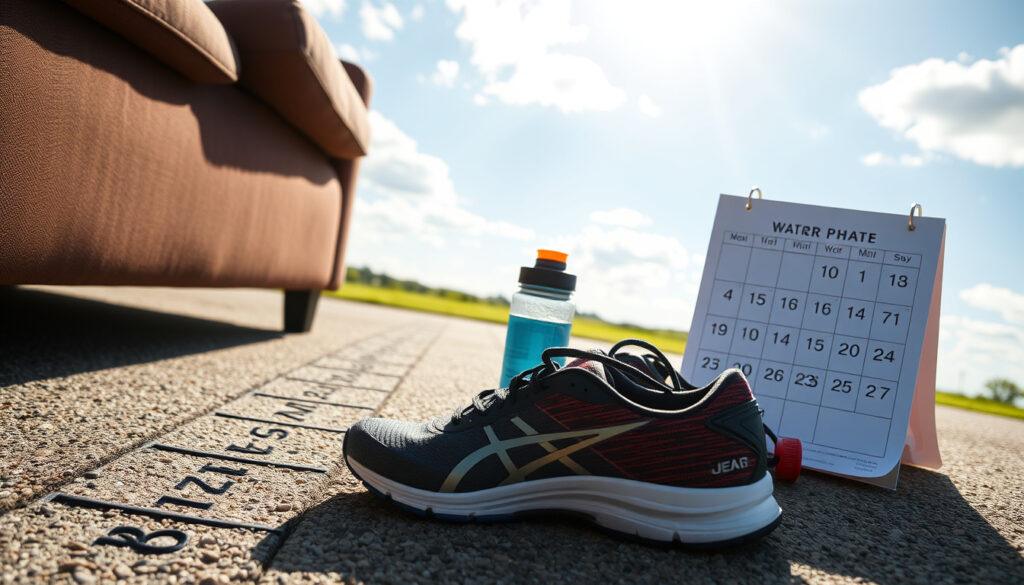
Couch to 5K Plan: How to Start Running 5K in 9 Weeks
You’ve decided you want to run a 5K — maybe for a charity event, maybe just to prove you can. The good news is that a structured plan exists that has helped hundreds of thousands of total beginners cross that finish line.
Plan Duration: 9 weeks ·
Weekly Sessions: 3 times per week ·
Target Distance: 5 kilometers (3.1 miles) ·
Program Origin: NHS (UK’s national health authority) ·
Typical Finish Rate: Around 70% of starters
Quick snapshot
- A 9-week walk-run interval program designed for absolute beginners (NHS Better Health).
- Developed by the NHS in the UK; now used worldwide. (NHS Better Health)
- Goal: to run 5K without stopping by the end of week 9. (NHS Better Health)
- Three sessions per week, each lasting 20–40 minutes (NHS Better Health).
- Each session alternates running and walking intervals. (NHS Better Health)
- Interval lengths gradually increase as the weeks progress. (NHS Better Health)
- People who have never run before or haven’t run in years.
- Individuals looking for a structured, gradual approach.
- Seniors or those with health concerns (with doctor’s approval).
Six key facts, one pattern: the program is designed to be simple and repeatable, with no guesswork.
| Label | Value |
|---|---|
| Program Name | Couch to 5K (C25K) |
| Duration | 9 weeks |
| Frequency | 3 times per week |
| Total Running Time in Week 1 | 8 minutes (as 60-second intervals) |
| Final Week Run Duration | 30 minutes continuous |
| Origin | NHS (National Health Service, UK) |
How long is it realistic to go from Couch to 5K?
Standard 9-week timeline
- The NHS plan runs over 9 weeks and has users run 3 times per week with walking and running intervals (NHS Better Health).
- Week 1 alternates 60 seconds of running with 90 seconds of walking for a total of 20 minutes after a brisk five-minute warm-up walk (Aldridge Running Club PDF reproducing NHS plan).
- Week 2 uses 90 seconds of running and 2 minutes of walking intervals.
- Week 3 introduces longer repetitions: 90 seconds running, 90 seconds walking, 3 minutes running, 3 minutes walking.
- Week 4 includes 3-minute and 5-minute running segments with walking breaks.
- Week 5 includes workouts that progress to a 20-minute continuous run.
- Week 6 includes a 25-minute run session.
- Week 7 is a 25-minute run session.
- Week 8 includes a 28-minute run session.
- Week 9 includes a 30-minute run session.
The pattern: each week builds on the previous one by slightly increasing the total running time. The plan includes rest days in between runs and a fresh schedule each week (NHS Better Health).
Most beginners need at least 8–12 weeks to build safely. The 9-week plan is realistic for many, but the NHS explicitly says users should repeat weeks if they feel they need to (Apple App Store listing for NHS C25K app).
Can you finish sooner? (4-week and 6-week options)
- Shorter plans exist online but may increase injury risk because they skip the gradual buildup.
- No official NHS plan exists for 4 or 6 weeks; the standard is 9 weeks.
- If you already have a base of walking 30 minutes comfortably, you could potentially compress the first few weeks, but the NHS recommends sticking to the schedule.
The catch: rushing the program often leads to burnout or injury. The 9-week structure is already designed to be the minimum safe duration for a sedentary person.
What if you need more time?
- Repeating a week is completely fine — the NHS app and official guidance both encourage it.
- You can extend the plan to 12 or 14 weeks by repeating the hardest weeks (weeks 5–6).
- The goal is to finish, not to break a speed record.
The implication: the plan’s flexibility is its strength. Whether you finish in 9 weeks or 12, the key is consistency.
Is Couch to 5K good for losing weight?
Calories burned during Couch to 5K
- Walking and running intervals burn 200–400 calories per session depending on weight and pace (BBC Sport).
- Consistency (3X/week) combined with a calorie deficit leads to gradual weight loss.
- Exact calorie burn per session varies by weight, pace, and terrain — no single figure fits everyone.
One way to track your calorie deficit is by monitoring your weight; check our Convert kg to stone and pounds – UK weight conversion guide to help log your progress.
Combining diet and running for weight loss
- Running alone without dietary changes typically produces modest weight loss — about 1–2 pounds per week if you maintain a 500-calorie daily deficit.
- For a beginner, the C25K program can help create a routine that supports healthier eating.
- A good pre-run snack can be a banana or toast; avoid high-fat meals before running.
If you’re curious about the caloric content of common foods, see How Many Calories in a Chicken Fillet Roll? (2025 Guide) for a reference.
Belly fat reduction specifics
- Spot reduction of belly fat is not possible; overall fat loss will include the abdomen.
- Running 5K a day can help reduce overall body fat if sustained over months, but the C25K program alone is not a belly-fat solution.
- Most weight loss success with C25K comes from combining the program with a calorie-controlled diet (NHS Better Health).
The trade-off: running burns calories, but diet drives the scale. The program is better as a fitness catalyst than a weight-loss prescription.
Which is the hardest week in Couch to 5K?
Week 5: the big jump
- Week 5 often features the sharpest increase in run duration — from 8-minute runs to a 20-minute continuous run in one session (Aldridge Running Club PDF reproducing NHS plan).
- Many participants find the mental hurdle of longer runs the hardest.
- It is safe to repeat a week before progressing (Apple App Store listing for NHS C25K app).
Why this matters: the jump from 8 minutes to 20 minutes is a 150% increase in continuous running time — the biggest single week-to-week leap in the entire program.
Common struggles and how to push through
- Many runners hit a mental wall around the 12-minute mark. Slowing down your pace can help.
- Use the NHS app’s guided commentary from a celebrity coach to stay motivated (UK Government news release).
- Focus on breathing rhythm: inhale for 3 steps, exhale for 2 steps.
If you cannot complete the 20-minute run in week 5, repeat the previous week’s workout. The NHS app says record numbers completed the program by 2024, indicating that most people do push through with persistence (UK Government news release).
Adjusting the plan if a week feels too hard
- Repeat the week that felt too hard before moving on.
- Reduce your running pace — it’s not a race.
- Consider adding an extra rest day if needed.
The pattern: the hardest week is also the most rewarding. Getting past the 20-minute run is a huge confidence booster.
Can an unfit person run 5k?
Who the Couch to 5K plan is designed for
- The plan is specifically for people who currently do no running (NHS Better Health).
- The first week uses 60-second run intervals with walking recovery.
- Anyone who can walk briskly for 30 minutes can begin the program.
BBC Sport describes Couch to 5K as encouraging novices to run three times each week, with the message that most people can do it (BBC Sport).
Getting medical clearance before starting
- If you have a chronic condition, are over 40 and sedentary, or have joint issues, check with your doctor before starting.
- The plan is designed to be low impact at the start, but individual health conditions need consideration.
Starting with walking intervals even if you cannot run
- The plan’s first week is mostly walking — only 8 minutes of total running broken into 60-second chunks.
- If you cannot run for 60 seconds, walk faster for those intervals.
- Progress is about consistency, not speed.
The implication: the only prerequisite is the ability to walk 30 minutes comfortably. If you can do that, you can start week 1.
Is a 40 minute 5K embarrassing?
What does a 40-minute 5K mean for fitness level?
- A 40-minute 5K is an 8:00 min/km or 12:52 min/mi pace.
- For a beginner just finishing the plan, 35–45 minutes is typical and perfectly respectable.
- The global average recreational 5K time is around 30–40 minutes.
BBC Sport notes that most recreational runners complete a 5K in 30–40 minutes, so a 40-minute finish is squarely in the normal range.
Average 5K times for beginners and recreational runners
- Beginner (first 5K): 35–45 minutes.
- Recreational runner: 25–35 minutes.
- Competitive amateur: 18–25 minutes.
- Top 1%: under 15 minutes for men, under 17 minutes for women.
Focus on completion, not speed
- Finishing any 5K is an achievement — especially if you started from zero.
- Embarrassment about pace is common but unfounded; most people are just focused on their own run.
- The program’s goal is to run 5K without stopping, not to win a race.
New runners often worry about being “too slow,” yet the average 5K finisher is slower than they think. A 40-minute time is not embarrassing — it’s a realistic goal for a beginner. The only embarrassing thing is not trying.
The catch: if you’re worried about being last, remember that most race organizers keep the course open for at least an hour for walkers. A 40-minute 5K is well within the cutoff.
What should I eat before a 5k?
Pre-run meal timing and composition
- Eat a small meal or snack 1–2 hours before running.
- Focus on easily digestible carbohydrates (e.g., banana, toast with jam, oatmeal).
- Avoid high-fat, high-fiber, or high-protein foods immediately before running.
Why this matters: the wrong pre-run meal can cause stomach upset, nausea, or energy crashes. Carbohydrates are the body’s preferred fuel for moderate exercise.
Best snacks for energy before a 5K
- Banana (one medium banana provides about 30g carbs).
- Toast with jam (2 slices: ~40g carbs).
- Oatmeal with a little honey (1 cup: ~50g carbs).
- A sports gel or chews (if you prefer, but not necessary for a 5K).
Optimal pre-run food choice differs from person to person — experiment during training runs, not on race day.
Hydration tips
- Drink 16–20 oz of water 2 hours before, then another 8 oz 15–30 minutes before.
- Avoid sugary sports drinks immediately before running; they can cause a blood sugar spike and crash.
- For a 5K, plain water is sufficient.
The trade-off: eating too close to a run can cause discomfort, but running on an empty stomach can leave you low on energy. A banana or toast is a safe middle ground.
Confirmed facts
- Couch to 5K is a 9-week plan designed by the NHS (NHS Better Health).
- It uses walk-run intervals to gradually build endurance (NHS Better Health).
- Week 5 includes a notable jump in run duration (Aldridge Running Club PDF reproducing NHS plan).
- A 40-minute 5K is a realistic time for many beginners (BBC Sport).
- The plan includes rest days and a fresh schedule each week (NHS Better Health).
What’s unclear
- Exact calorie burn per session varies by weight, pace, and terrain.
- Individual weight loss results depend on diet and total activity level.
- Optimal pre-run food choice differs from person to person.
The pattern: the program is evidence-based for fitness improvements, but weight loss and nutrition details are highly individual and not fully predictable.
What the experts say
“The plan is designed to get you from couch to 5K in 9 weeks, with three runs a week.”
NHS Better Health (UK’s national health authority)
Free download of their Couch to 5K jogging plan, emphasizing gradual progression.
Both sources reinforce the same core message: gradual progression is the key to success.
For anyone starting the Couch to 5K plan, the choice is clear: commit to three sessions per week, trust the gradual buildup, and don’t be afraid to repeat weeks. The program works because it respects your body’s ability to adapt — but only if you show up. For the beginner in the UK or Ireland, the NHS app and the Irish Heart Foundation’s free guide provide all the support you need. The alternative is staying on the couch, and that’s a choice you already know you don’t want to make.
play.google.com, nhs.uk, c25k.com, runningwithhormones.com, rundreamachieve.com, coachweb.com
Frequently asked questions
Will running 5K a day lose belly fat?
Running 5K daily can contribute to overall fat loss, but spot reduction of belly fat is not possible. Fat loss from the abdomen occurs as part of total body fat reduction, which requires a calorie deficit.
What is a top 1% 5k time?
For men, a top 1% 5K time is under 15 minutes; for women, under 17 minutes. These times are achieved by elite competitive runners.
How quickly can Usain Bolt run a 5K?
Usain Bolt is a sprinter, not a distance runner. He has never raced a 5K, but based on his 400m time, an estimated 5K would be around 14–15 minutes — though he would likely struggle with endurance.
Is 5km in 1 hour slow?
A 1-hour 5K (12:00 min/km pace) is a brisk walking pace. It’s fine for walkers or beginning runners, but most runners aim for under 45 minutes.
How fast can Mo Farah run 5k?
Mo Farah’s personal best for 5K is 12:57.94, set in 2015. That is an elite professional time.
Can I walk a 5k in an hour?
Yes. A brisk walking pace of 5 km/h (12:00 min/km) covers 5K in exactly 60 minutes. Most people can walk 5K in 45–60 minutes.
More related posts
 Bank of Ireland Share Chat – Investor Discussions and Stock Insights
 Sports Shops Near Me: Compare Ireland’s Top Retailers
 How Many Calories Does 10,000 Steps Burn? Calculator & Guide
 Storage Boxes with Lids Ireland: Where to Buy & Best Sizes
 Size 41 Shoe UK: Exact EU to UK Conversion for Men & Women
 Donegal Rally 2026 Dates: June 19-21 Event Guide & Timetable
 Ready Made Curtains Ireland: Online, Sales & Stockists
 Olivia Dean & Harry Styles: Did They Ever Date? The Facts
