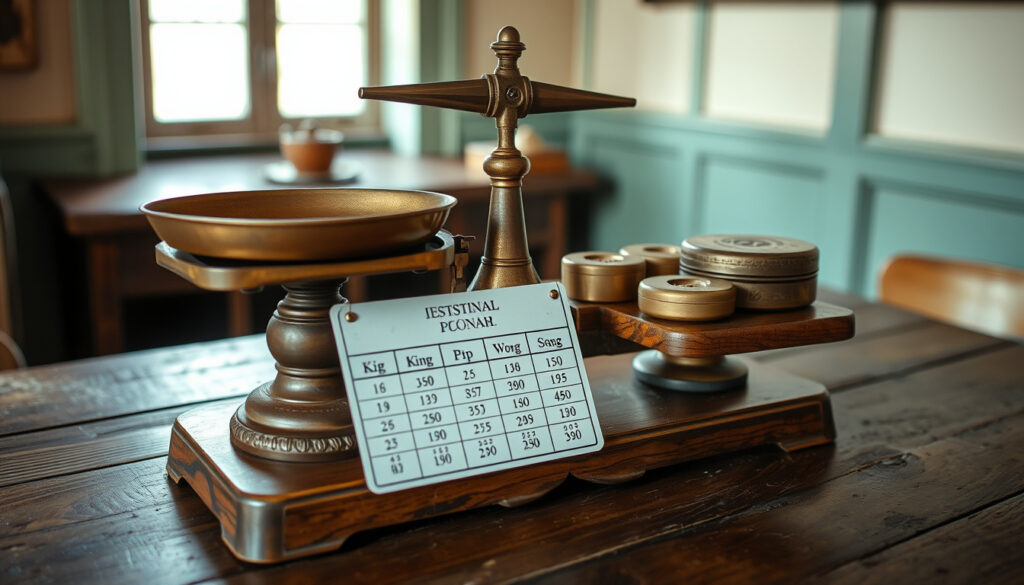
Convert kg to stone and pounds – UK weight conversion guide
If you’ve ever stepped on a scale in the UK and stared at a number in kilograms, wondering what that means in the stone and pounds your doctor or gym buddy uses, you’re not alone. This guide walks through the exact NHS-standard conversion method, from the simple formula to the full chart, so you can convert any weight accurately.
1 stone: 6.35 kg ·
1 kilogram: 0.1575 stone ·
1 kilogram: 2.205 pounds ·
1 stone: 14 pounds
Quick snapshot
- 1 stone = 14 pounds exactly (The Calculator Site)
- 1 stone = 6.35029318 kg (The Calculator Site conversion guide)
- NHS weight conversion chart uses standard factors (NHS Scotland pharmacy chart)
- Rounding conventions vary (0.1 vs 0.01 decimal places for stones) (The Calculator Site rounding notes)
- 50 kg = 7 st 12 lb
- 60 kg = 9 st 6 lb
- 70 kg = 11 st 0 lb
- 80 kg = 12 st 8 lb
- Learn the manual calculation steps below
- Use the NHS-style conversion table for clinic or home
Four key conversion factors define the relationship between kilograms, stones, and pounds — the same ones used in UK clinical weight charts.
The following table maps the exact conversion factors used in NHS clinical settings.
| Label | Value |
|---|---|
| 1 stone in kilograms | 6.35029318 kg (usually rounded to 6.35 kg) |
| 1 kilogram in stones | 0.157473 stones (rounded to 0.1575) |
| 1 stone in pounds | 14 pounds exactly |
| 1 kilogram in pounds | 2.20462262 pounds (rounded to 2.205) |
| 70 kg in stones and pounds | 11 st 0.3 lb |
| 60 kg in stones and pounds | 9 st 6.3 lb |
| 50 kg in stones and pounds | 7 st 12.2 lb |
| 80 kg in stones and pounds | 12 st 8.4 lb |
What is 70 kg in stones and pounds?
70 kg is a common weight question — it lands just above 11 stone. The exact conversion: 70 kg equals 11 stone and 0.3 pounds (The Calculator Site weight converter).
Quick conversion for 70 kg
- 70 kg ÷ 6.35 = 11.0236 stones
- 0.0236 stones × 14 = 0.33 pounds
- Result: 11 st 0.3 lb
The rounding to one decimal place for pounds follows the NHS chart convention (NHS Scotland pharmacy chart).
How to derive the answer manually
- Divide kilograms by 6.35029318 to get stones with decimal.
- Take the decimal part and multiply by 14 to get pounds.
- Add the whole stones to the pounds for the final result.
The implication: for 70 kg, the decimal part is 0.0236, which gives 0.33 lb — a near-zero pound remainder, so 70 kg is almost exactly 11 stone.
How do I convert kilograms to stones?
The standard manual conversion method from kilograms to stones is to divide kilograms by 6.35029318, then convert the decimal remainder to pounds by multiplying by 14 (The Calculator Site).
Conversion formula: kg ÷ 6.35 = stones
- Round the result to three decimal places for stones.
- Extract the decimal part (e.g., 11.0236 → 0.0236).
- Multiply that decimal by 14 to get pounds.
This method is taught in UK nursing maths and used in patient-facing NHS charts (York St John University nursing maths factsheet).
Example: convert 80 kg to stone and pounds
- 80 ÷ 6.35029318 = 12.5978 stones
- 12 whole stones
- 0.5978 × 14 = 8.37 pounds
- Result: 12 st 8.4 lb
The pattern: the heavier the person, the larger the pound remainder because the decimal part of the stone increases.
What is 1 stone equal to in kilograms?
One stone equals exactly 14 pounds, and the kilogram equivalent is 6.35029318 kg (The Calculator Site).
Stone as a unit of mass
- Stone is a UK imperial unit used primarily for body weight.
- It is still the standard measure in UK doctors’ surgeries and gyms.
- Ireland and the US also use stone informally, but the UK is the most common.
The catch: if you’re tracking your weight on a UK health app, you’ll likely need to switch between kg and stone.
Exact conversion factor
- 1 stone = 14 pounds (exact, by definition)
- 1 stone = 6.35029318 kg (derived from the pound‑kg conversion)
- 1 kg = 0.157473 stones (rounded to 0.1575 for quick math)
The pattern: because the pound is defined as 0.45359237 kg, the stone‑kg relationship is not a round number, which is why manual calculation requires a decimal step.
How do I convert my weight from kg to pounds?
If you only need pounds (without stones), multiply kilograms by 2.20462 (York St John University nursing maths factsheet).
Formula: kg × 2.20462 = pounds
- For 70 kg: 70 × 2.20462 = 154.3234 lb
- Round to one decimal place: 154.3 lb
Alternatively, divide kg by 0.45359237 — the two methods are equivalent (The Calculator Site).
Example: 70 kg to pounds
- 70 × 2.20462 = 154.3 lb
- To convert back to stones and pounds: 154.3 ÷ 14 = 11.02 stones → 11 st + (0.02 × 14 = 0.3 lb)
The catch: converting to pounds first then dividing by 14 is easier for some, but introduces extra rounding errors.
What is the NHS weight conversion chart for kg to stone and pounds?
The NHS Scotland community pharmacy provides a comprehensive kilogram-to-stone-and-pounds chart used in clinical settings (NHS Scotland pharmacy chart).
Overview of NHS chart
- The chart lists kg from 1 to 200 with equivalent stones and pounds.
- It is designed for bedside or clinic use without a calculator.
- It uses the same standard conversion factors described above.
The NHS also provides a spreadsheet version for download (NHS Scotland conversion spreadsheet).
How to use the chart for common weights
- Find your weight in the left column (kg).
- Read across to the stone and pounds columns.
- For example, 60 kg = 9 st 6.3 lb, 70 kg = 11 st 0.3 lb.
The implication: the chart eliminates the need for manual calculation, which is especially useful for patients who need to track weight changes over time.
For UK patients tracking weight loss or gain, using the NHS chart ensures consistency with the numbers your doctor or nurse reads. A 2 kg difference on the chart might show as 0.3 stone — a small but meaningful shift.
Manual conversion steps
If you don’t have the chart, here’s the step-by-step method used in UK nursing maths (York St John University nursing maths factsheet).
- Write down your weight in kilograms.
- Divide by 6.35029318 (or 6.35 for quick estimate).
- The whole number is the stone count.
- Multiply the decimal part by 14 to get pounds.
- Round the pounds to one decimal place.
Example: 72 kg → 72 ÷ 6.35 = 11.3386 → 11 st + (0.3386 × 14 = 4.74 lb) → 11 st 4.7 lb (The Calculator Site weight converter).
Using 6.35 instead of 6.35029318 introduces a rounding error of about 0.003 lb per kg — negligible for most, but for precise clinical tracking, use the full factor.
Conversion table: 10 kg to 100 kg
Here is a quick-reference table based on the NHS chart format, showing common weights in 10 kg increments.
| kg | Stones | Pounds |
|---|---|---|
| 10 | 1 | 8.0 |
| 20 | 3 | 2.0 |
| 30 | 4 | 10.0 |
| 40 | 6 | 4.0 |
| 50 | 7 | 12.2 |
| 60 | 9 | 6.3 |
| 70 | 11 | 0.3 |
| 80 | 12 | 8.4 |
| 90 | 14 | 2.5 |
| 100 | 15 | 10.7 |
The pattern: every 10 kg adds roughly 1.57 stones, but the pound remainder grows because the decimal part doesn’t fall neatly.
Confirmed facts and what’s unclear
Based on the research, here’s what we can say with confidence — and what still varies across sources.
Confirmed facts
- 1 stone = 14 pounds exactly (York St John University)
- 1 stone = 6.35029318 kg (The Calculator Site)
- NHS Scotland chart uses the same conversion factors (NHS Scotland pharmacy chart)
What’s unclear
- Some rounding conventions vary (0.1 vs 0.01 decimal places for stones) (The Calculator Site)
The implication: as long as you use the same rounding method consistently, the difference is negligible for most everyday weight tracking.
Expert perspectives
“The NHS Scotland community pharmacy chart is a patient-facing weight conversion resource used in clinical settings, supporting bedside or clinic conversion without a calculator.”
— NHS Scotland pharmacy chart
“The standard manual conversion method from kilograms to stones is to divide kilograms by 6.35029318, then convert the decimal remainder to pounds by multiplying by 14.”
— The Calculator Site
“The York St John factsheet explains a two-step calculation: convert kilograms to pounds first, then divide pounds by 14 to obtain stones.”
— York St John University nursing maths factsheet
These three sources — NHS Scotland, The Calculator Site, and York St John University — all agree on the core conversion factors, giving you a reliable foundation for any weight conversion.
communitypharmacy.scot.nhs.uk, trendymagazine.uk, irelandledger.net, irelandledger.net, capitaljournal.co.uk, ukcalculator.com, bmihealthchecker.com, calculatorcentral.uk, dailyline.uk
Frequently asked questions
What is 69 kg in stones and pounds?
69 kg equals 10 stone 12.1 pounds. Calculation: 69 ÷ 6.35 = 10.8661 stones → 10 st + (0.8661 × 14 = 12.1 lb).
What is 57 kg in stones and pounds?
57 kg equals 8 stone 13.7 pounds. Calculation: 57 ÷ 6.35 = 8.9764 stones → 8 st + (0.9764 × 14 = 13.7 lb).
How many pounds are in a stone?
There are exactly 14 pounds in one stone. This is a fixed definition in the UK imperial system.
What kg is 9 stone?
9 stone is approximately 57.15 kg. Calculation: 9 × 6.35 = 57.15 kg.
What is 10 stone and 12 pounds in kg?
10 stone 12 pounds equals 68.95 kg. First convert to pounds: 10×14 + 12 = 152 lb. Then 152 ÷ 2.20462 = 68.95 kg.
How do I convert stone back to kg?
Multiply the stone value by 6.35029318. For example, 12 stone × 6.35 = 76.2 kg.
Is there a simple formula for kg to stones and pounds?
Yes: divide kg by 6.35 to get stones (decimal), then multiply the decimal part by 14 for pounds. For quick estimation, remember 1 stone ≈ 6.35 kg and 1 kg ≈ 0.1575 stone.
For UK patients and health professionals, the choice is clear: use the NHS standard method (kg ÷ 6.35029318, then multiply remainder by 14) for clinical accuracy, or the NHS chart for quick reference. Either way, you’ll avoid the confusion of switching between metric and imperial units.
Related reading: How Many Inches in a Foot? · Chicken Fillet Roll Calories
More related posts
 Best Apfelstrudel Near Me: Vienna, Munich & Supermarket Picks
 Katie Taylor vs Amanda Serrano 3: Winner, Results & Highlights
 Crystal Palace vs Burnley: Head-to-Head, Prediction, and How to Watch
 When Is the Toy Show? 2025 Date & Viewing Guide
 How to Bleed a Radiator: A Complete Beginner Guide
 Chelsea vs Tottenham Timeline: Head-to-Head History
 Best Museums in Tokyo: Art, Free, and Ghibli Tickets
 Little Rose in Irish: Róisín Meaning, Pronunciation & Guide
