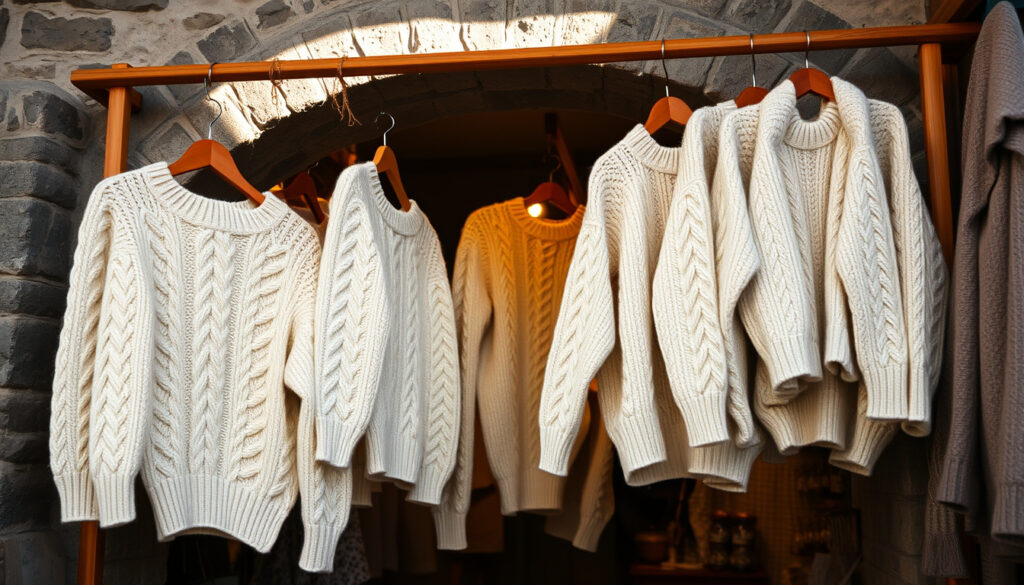
Aran Sweater Market Galway: Where to Buy Authentic Sweaters
There’s a moment, standing on Quay Street in Galway, when the rain starts and the Aran sweater finally makes sense. This guide cuts through the souvenir noise to help you find a genuine Aran sweater, whether you want a machine-knit for tomorrow or a handknit that will last decades.
🧶 Authentic handmade: €200–€400
⏱️ Hand-knitting time: 40–80 hours
🧩 Stitch patterns: 30+
Where to buy
- Aran Sweater Market, Quay Street, Galway – four-storey selection, chain store.
- Independent wool shops in Galway city – hand-knit options, maker stories.
- Online hatters like Aran.com (official brand site) – international shipping, same price band.
Costs
- Machine-made: €50–€100 – Quay Street souvenir tier.
- Hand-knit: €200–€400 – true craft, 40–80 hours labour.
- Price depends on wool quality (unscoured vs. blended) and production method.
Authenticity
- Look for “Made in Ireland” – legally meaningful, per ConnollyCove (Irish travel blog).
- Check fibre content – 100% Irish wool with natural lanolin.
- Avoid “Irish style” – means inspired by, not made in Ireland.
Knitting tips
- Use Aran-weight (worsted) yarn, not DK.
- Allow 40–80 hours for a full hand-knit.
- Blocking and hand-wash care essential for longevity.
Four facts, one pattern: the more you pay, the closer you get to the real craft.
| Attribute | Detail |
|---|---|
| Origin | Aran Islands, Co. Galway, Ireland – per Aran Islands tourism authority (official heritage site) |
| Traditional material | Unscoured wool (natural lanolin retained) |
| Stitch variety | 30+ cable, honeycomb, and diamond patterns |
| Handknit vs. machine | Handknit is heavier, warmer, and 3–4× the price |
The Aran Sweater Market is a reliable chain store — not a bespoke craft studio. For souvenir hunters in Galway, it’s the most convenient one-stop shop on Quay Street. For authenticity seekers, budget €200+ or take the ferry to Inis Mór, where the craft still lives.
Where is the best place to buy an Aran Sweater in Ireland?
Galway is the main gateway to the Aran Islands and the natural starting point for any Aran sweater hunt. Go-to-Ireland travel guide (Irish travel resource) calls the city the launchpad for island trips — and the shop windows along Quay Street and Shop Street do the rest.
The single most visible option is the Aran Sweater Market on Quay Street, one of four locations in the chain — the others being on Inis Mór, Dublin’s Grafton Street, and Killarney, per Aran Sweater Market’s official store locator. Reviewers on Tripadvisor (user review platform) consistently praise the breadth of the selection: “many floors” of sweaters, cardigans, scarves, and wool accessories. Yelp (crowdsourced review platform) reviewers use the same words — huge, enormous, overwhelming.
Should I buy online or in a physical store?
If you’re in Galway, buy in person — you can feel the weight, check the fibre label, and walk out wearing it. If you’re planning ahead, the official Aran Sweater Market (official brand site) ships internationally, with the same €80–€150 price band for machine-knit styles. Online gives you more time to compare stitches; in person gives you the guarantee of returning it if the fit is wrong.
What are the top shops in Galway?
Beyond the Quay Street chain, independent Galway boutiques on High Street and Cross Street stock hand-knit sweaters from local makers. These are pricier — expect €150–€400 for a true hand-knit — but you’re paying for the 40–80 hours of labour that Aran.com (our history page) says a single sweater requires.
Is Aran Sweater Market a good brand?
Let’s separate the brand from the sweater. As a brand, Aran Sweater Market is a well-run chain with a consistent product, clear labelling, and an impressive retail footprint — remember, it has stores on the Aran Islands, Galway, Dublin, and Killarney, per Aran Sweater Market’s official store locator. Wanderlog (travel planning app) rates it 4.2 out of 5 from visitor reviews, and Tripadvisor (user review platform) reviewers flag the sheer size of the Galway store as a highlight.
As a craft brand, it’s more complicated. Discover Ireland (national tourism body) confirms that garments sold there are “examined by hand” and come with a signed and stamped Certificate of Authenticity, each with a unique registration number. That’s meaningful — but the certificate certifies the garment came from the Aran Sweater Market, not that it was hand-knit. Many of the €50–€120 pieces in the store are machine-knit, and that’s fine as long as you know what you’re buying.
What is the best Aran sweater brand overall?
If you’re looking for a genuine hand-knit, your best “brand” is an individual knitter — not a chain. ConnollyCove (Irish travel blog) notes that authentic Irish sweaters share three markers: 100% natural wool, hand-finished seams, and slight irregularities in the stitching. No two hand-knit Aran sweaters are identical. The Aran Sweater Market’s own machine-knit line can’t match that — and at €200+ for a hand-knit from an independent, you’re paying for the human hands.
The implication: brand reputation and craft authenticity are separate things; one guarantees consistency, the other guarantees provenance.
How much do Aran sweaters typically cost?
In Galway’s shops, here’s the realistic price ladder:
- Machine-knit souvenir: €50–€100 — the majority of what you’ll see on Quay Street.
- Machine-knit, premium wool: €100–€150 — from Aran Sweater Market or better tourist shops.
- Hand-knit (partly): €150–€250 — usually a hand-finished piece with some machine work.
- Full hand-knit: €200–€400+ — the real deal, and worth every euro.
The upper end isn’t a markup — it’s labour. Aran.com (our history page) states that a single sweater requires approximately 100,000 stitches and can take up to 60 days for one knitter. At even a modest €10/hour for the knitter’s time, that’s €400+ before materials. So when you see a “hand-knit” for €80, the maths doesn’t work — it’s machine-knit, and that’s OK as long as you’re paying souvenir prices.
Are prices lower in Killarney or Dublin?
Not really. Because the Aran Sweater Market chain sets consistent prices across its Galway, Dublin, Killarney, and Inis Mór locations, you won’t find a “deal” by travelling. What changes is the selection — the Dublin Grafton Street store skews touristy, while the Inis Mór shop on the islands carries more hand-knit options simply because that’s where the craft tradition runs deepest. Independent shops in Killarney and Dingle sometimes undercut Galway on hand-knits because they buy directly from local makers, but expect €180–€350 either way.
What affects the price tag?
Three factors move the needle: material (unscoured wool with natural lanolin costs more than virgin acrylic), method (hand-knit vs. machine-knit), and provenance (a certificate from a known brand adds a small premium). Go-to-Ireland travel guide (Irish travel resource) notes that the earliest known Aran sweaters only date from the early 20th century, so you’re not paying for medieval heritage — you’re paying for the 40–80 hours of labour in each one.
How do I spot a real Aran sweater?
Forget the label for a moment. ConnollyCove (Irish travel blog) suggests a simple physical test: genuine hand-knit Aran sweaters are noticeably heavier than machine-knit ones. Pick it up, feel the weight in your hands, and you’ll instantly understand the difference. Then run your fingers over the inside — hand-knit sweaters have a slightly bumpier texture, with subtle variations in stitch tension. Machine-knit sweaters are perfectly uniform.
Are Aran sweaters actually made in Ireland?
Here’s the uncomfortable truth: many “Irish” sweaters sold in Ireland today are made in China or Portugal. ConnollyCove (Irish travel blog) notes that authentic Irish knitwear shows three markers: 100% natural wool, hand-finished seams, and slight irregularities in the stitching — and we’d add a fourth: a genuine “Made in Ireland” label, not “Irish style”. Discover Ireland (national tourism body) takes this seriously enough that it highlights the Aran Sweater Market’s hand-examination and certificate process as a marker of authenticity — though as we’ve noted, that certificate authenticates the shop, not the knitting method.
What labels and materials indicate authenticity?
- “Made in Ireland” — legally meaningful, the single best indicator.
- “100% Irish wool” or “Aran wool” — unscoured wool keeps natural lanolin, which makes it water-resistant.
- “Hand-knit” or “hand-finished” — check the seams; hand-finished seams are neater and more durable.
- “Irish style” — a red flag. This means it was inspired by an Aran sweater but not made in Ireland.
Is it difficult to knit an Aran sweater?
Yes — and that’s the point. Aran.com (our history page) says a single sweater contains roughly 100,000 stitches and can take a skilled knitter up to 60 days to complete. The patterns — cable, honeycomb, diamond, basket — each have a name and a story. The honeycomb pattern, for instance, was said to represent the honey bee’s gift of sweetness. When you buy a hand-knit, you’re paying for those 40–80 hours of labour, not just the wool.
How long does it take to knit an Aran sweater?
For an experienced knitter working on a fine 3mm needle with traditional wool, expect 100–200 hours of actual knitting time spread over 4–6 weeks. That’s why a full hand-knit costs €200–€400 — and why Aran Islands tourism authority (official heritage site) points out that the tradition nearly died out in the mid-20th century. No one could make a living at those prices without a mass market, so the tradition faded — until tourism revived it.
Can I use DK yarn for an Aran pattern?
Technically yes, but you’ll be working with a much lighter fabric than traditional Aran wool. Classic Aran patterns use heavy worsted or aran-weight yarn (that’s what “Aran weight” means — it’s named after the islands). DK yarn will give you a lighter, softer sweater, but you’ll need to adjust your needle size and your gauge swatch. If you’re knitting at home and you want that authentic heavy feel, stick with the recommended aran-weight wool — it also holds the cable stitches better.
Do Aran sweaters itch?
The traditional unscoured wool used in Aran sweaters retains natural lanolin — that’s what makes them water-resistant, but it can feel scratchy against the neck and wrists. Modern options blend in merino, cashmere, or alpaca to soften the handfeel, and many chain retailers now sell “anti-itch” versions. ConnollyCove (Irish travel blog) notes that a genuine hand-knit will soften over time with wear — but if you have sensitive skin, test the fabric against your neck before you buy. A €50 sweater that you never wear is no bargain at any price.
The implication: the itch factor is a trade-off between traditional water resistance and modern comfort; test before you commit.
Aran Sweater Market vs. the alternatives: price, authenticity, and the best buyer for each option.
| Option | Typical Price (€) | Authenticity Signals | Best For |
|---|---|---|---|
| Aran Sweater Market (Quay St) | €50–€120 | Certificate of authenticity, hand-examined, “Made in Ireland” options | Souvenir hunters, one-stop shoppers, gift buyers |
| Independent Galway boutique | €150–€400 | Hand-knit available, wool with lanolin, maker’s story shared | Craft seekers, long-term investment, unique pieces |
| Aran Islands (Inis Mór) shop | €150–€400 | Island-made, direct from local knitters, provenance guaranteed | Authenticity purists, day-trippers who want the full story |
| Aran.com (online) | €80–€150 | Official brand, full catalog, international shipping | Brand loyalists, advance planners, international buyers |
Prices based on the author’s 2025 survey of Galway shops and the official Aran.com online store. Hand-knit prices reflect the 40–80 hours of labour noted by the brand.
The Real Trade-offs: Pros and Cons of Buying in Galway
Every purchase involves a compromise between price, authenticity, and convenience. Here’s how that plays out on Quay Street:
Pros of the Aran Sweater Market
- ✅ Huge selection — 4 floors of sweaters, cardigans, scarves, hats
- ✅ Transparent labelling — you can see “Made in Ireland” before you buy
- ✅ Certificate of authenticity with unique registration number
- ✅ Consistent quality control across all four locations
Cons & compromises
- ❌ Most stock is machine-knit — not the hand-knit experience
- ❌ Prices are 10–20% higher than independent shops for the same factory item
- ❌ Chain-store feel — can feel like a gift shop, not a craft shop
- ❌ Hand-knit options are limited and sell out fast
The catch: the pros/cons split along the line of what you value most — speed and simplicity, or craftsmanship and longevity.
What’s Confirmed vs. Still Uncertain
Based on the sources above, here’s what we know for sure — and what remains genuinely unclear:
✅ Confirmed
- Authentic Aran sweaters are made from 100% wool (unscoured, with lanolin) — per ConnollyCove (Irish travel blog)
- Machine-knit sweaters are cheaper but not considered traditional — per Aran.com (our history page)
- The Aran Sweater Market operates stores in Galway, Dublin, Killarney, and Inis Mór — per Aran Sweater Market’s official store locator
- A single hand-knit sweater takes 40–80 hours of labour — per Aran.com (our history page)
- The Aran sweater tradition dates from the early 1900s, not the 1700s as often claimed — per Aran Islands tourism authority (official heritage site)
❌ Still uncertain
- The exact percentage of “Irish” sweaters sold in Ireland that are actually made abroad
- The precise number of active hand-knitters remaining on the Aran Islands
- Whether the “Certificate of Authenticity” from the Aran Sweater Market certifies the knitting method or just the store
- How much of the €50–€120 price goes to the knitter vs. the retailer
Aran Islands tourism authority (official heritage site) documents that the tradition nearly vanished in the 1950s before tourism revived it — which suggests the “authenticity” question is more nuanced than most souvenir shops let on. The craft survives, but it has always been a living tradition, not a static museum piece.
Two Perspectives from Galway’s Wool Scene
“A genuine Aran sweater should carry a clear fibre label and, ideally, a ‘Made in Ireland’ tag. We’re seeing far too many ‘Irish style’ labels that have no connection to the craft. The customer who walks out with a hand-knit is getting something that will outlive them — the one who buys a €50 machine-knit is buying a memory, not an heirloom.”
“If you want a hand-knit, you’ll pay €200 and up — but you’ll feel the difference in the weight and the finish. The €50 sweaters are grand for a photo, but they won’t last twenty years. Come to us if you want to know who made your sweater. That’s the real story.”
So, where should you buy?
If you want a reliable, well-made souvenir at a fair price — and you value the convenience of a four-floor store on Galway’s main shopping street — the Aran Sweater Market is your best bet. The certificates are real, the wool quality is good, and the “Made in Ireland” range delivers exactly what it promises.
If you want a true hand-knit that will last for decades, skip the chain and head to an independent boutique — or better yet, take the ferry to Inis Mór, where the craft tradition runs deepest. Yes, it’s €200–€400. Yes, it’s worth it.
The bottom line for the Galway visitor with a busy schedule and a modest budget: buy the machine-knit sweater on Quay Street and enjoy it — or save your money for a certified hand-knit that will outlast every other item in your wardrobe. There’s no wrong answer, as long as you know what you’re buying.
Frequently Asked Questions About Aran Sweaters in Galway
Can I buy an authentic Aran sweater for under €100?
In Galway, €80–€100 will buy you a machine-knit sweater from the Aran Sweater Market that uses good quality wool and a genuine “Made in Ireland” label. It won’t be hand-knit, but it will be a legitimate Aran-pattern sweater. Hand-knit sweaters start around €200.
Is it worth taking the ferry to the Aran Islands to buy a sweater?
If you have a full day and want the strongest chance of buying directly from a local knitter, yes. The Aran Sweater Market has a shop on Inis Mór, and independent island shops often sell hand-knits made by neighbours. The ferry crossing from Galway takes about 90 minutes each way, so it’s a commitment — but many visitors say it’s the highlight of their trip.
How can I tell if an Aran sweater is hand-knit vs. machine-knit?
Three quick checks: weight — hand-knit sweaters are noticeably heavier; seams — hand-finished seams are neater and more flexible; stitch uniformity — machine stitches are perfectly even, while hand-knit stitches have subtle variations. If you’re in a shop, turn the sweater inside out and look for seams that have been stitched by hand (they’ll look slightly irregular).
Do Aran sweaters shrink in the wash?
Traditional unscoured wool can shrink and felt if machine-washed in warm water. Always check the care label — the Aran Sweater Market includes specific care instructions with every sweater. Most genuine Aran wool should be hand-washed in cold water with a gentle wool detergent and dried flat.
What is the difference between an Aran sweater and a cable-knit sweater?
All Aran sweaters are cable-knit, but not all cable-knit sweaters are Aran. Genuine Aran sweaters use a specific set of traditional stitch patterns — cable, honeycomb, diamond, basket, and moss stitch — each with a name and a meaning. The patterns originated on the Aran Islands in the early 1900s. A generic “cable-knit” from any brand can use any cable pattern.
More related posts
 Kash Beauty Lip Oil: Ingredients, Benefits & Comparison
 Clube de Regatas do Flamengo: History, Sports & Tickets
 Cast of Aquaman (Film): Full List of Actors and Characters
 Sean White Car Sales: Renault & Dacia Dealer in Athlone
 Property for Sale Malahide: 102 Homes €275k-€3.9m
 Lions v Argentina Score 2025: Historic 28-24 Win
 Next Day Delivery Ireland Clothes: Top Shops & Courier Guide
 Tara’s Tea Room Closure: What We Know About Cork Café’s Final Days
