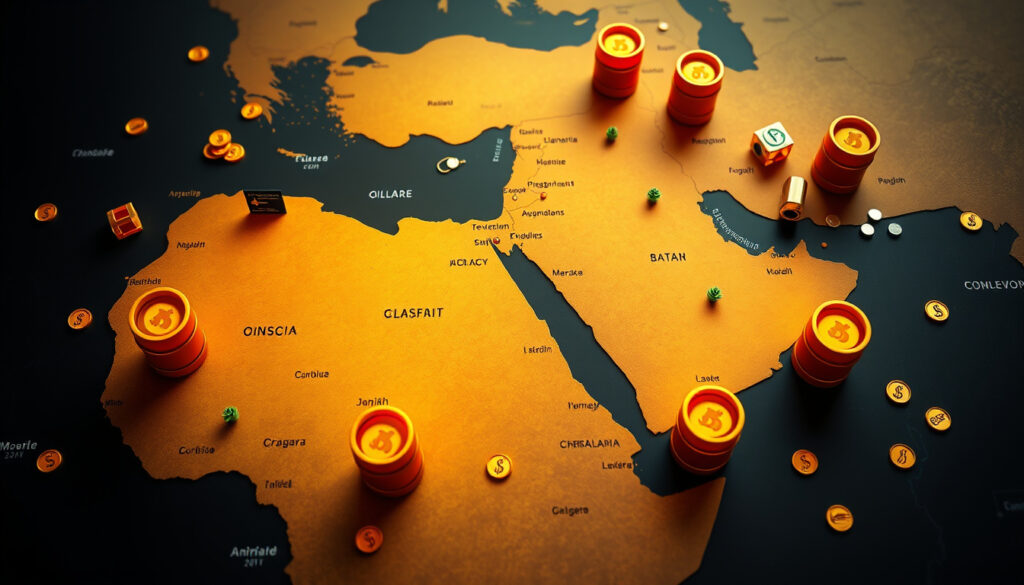
Map of Middle East: Countries, Safety & Wealth Guide
If you’ve ever tried to pin down exactly which countries belong to the Middle East, you’re not alone — the answer changes depending on who you ask. This guide brings together the most frequently asked questions about the region: its 17 commonly listed countries, the richest and safest nations, and the geopolitical alliances that shape it.
Number of countries commonly listed: 17 ·
Largest country by area: Saudi Arabia (approx. 2.15 million km²) ·
Richest country by GDP per capita: Qatar (approx. $112,310) ·
Safest Middle Eastern country (Global Finance 2024): UAE (rank 2)
Quick snapshot
- 17 countries commonly listed (U.S. Department of State travel advisory page)
- Largest by area: Saudi Arabia (U.S. Department of State travel advisory page)
- Richest by GDP per capita: Qatar ($112,310) – IMF World Economic Outlook
- Safest by Global Finance index: UAE (score 4.2043) – Global Finance safest countries ranking
- Exact boundaries of the Middle East vary by source
- Inclusion of Turkey depends on context
- Inclusion of Cyprus and the Sinai peninsula depends on context
- Safety rankings differ between indexes (Global Peace Index vs Global Finance)
- No major border changes in the region since 2011
- Safest country rankings updated annually — 2024 data shows a shift toward Gulf states
- Geopolitical alliances may shift with ongoing conflicts in Gaza and Yemen (State Department page)
- Tourism safety advisories are updated regularly — check the State Department page for current guidance
The following table summarizes the core statistics for the Middle East region.
| Label | Value |
|---|---|
| Total countries listed | 17 |
| Largest country by area | Saudi Arabia (approx. 2.15 million km²) – CIA World Factbook |
| Richest (GDP per capita) | Qatar ($112,310) – IMF World Economic Outlook |
| Safest (Global Finance 2024) | UAE (score 4.2043) – Global Finance safest countries ranking |
| Cleanest (Environmental Performance Index) | UAE |
What are the 17 countries in the Middle East?
While there is no universally accepted definition, most reference sources agree on a core list of 17 countries and territories: Egypt, Iran, Iraq, Israel, Jordan, Kuwait, Lebanon, Oman, Qatar, Saudi Arabia, Syria, Turkey, United Arab Emirates, Yemen, Bahrain, Palestine, and Cyprus. The U.S. Department of State’s Middle East travel advisory page covers many of these, including Bahrain, Egypt, Iran, Iraq, Israel, Jordan, Kuwait, and Lebanon.
The inclusion of Turkey, Cyprus, and the Sinai peninsula varies depending on whether one uses a cultural, linguistic, or purely geographic boundary. Some definitions also include Afghanistan and Pakistan, though they are more commonly grouped with South Asia.
What this means: For anyone researching the region, expecting a single authoritative list is unrealistic — the composition depends on the context.
What are the top 3 biggest countries in the Middle East?
By land area, three countries dominate the region:
- Saudi Arabia – approximately 2.15 million km² (the largest in the region)
- Iran – approximately 1.65 million km²
- Egypt – approximately 1.01 million km²
If Turkey is included in the definition, it would rank second, with an area of about 783,000 km².
The implication: The sheer size of Saudi Arabia and Iran gives them disproportionate geopolitical weight — both in terms of natural resources and strategic depth.
What are the top 5 richest countries in the Middle East?
Oil and gas wealth drives per capita incomes across the region. According to the International Monetary Fund’s World Economic Outlook (April 2026 projection), the top five are:
| Country | GDP per capita (current US$) | Source |
|---|---|---|
| Qatar | 112,310 | IMF (2026 projection) |
| United Arab Emirates | 87,770 | IMF (2026 projection) |
| Saudi Arabia | 78,810 | IMF (2026 projection) |
| Bahrain | 70,160 | IMF (2026 projection) |
| Kuwait | 54,300 | IMF (2026 projection) |
The World Bank also tracks GDP per capita for the Middle East and North Africa region, confirming these trends.
Oil wealth creates a steep income ladder in the Middle East — Qatar and the UAE sit at the top, while Kuwait trails despite its reserves. For investors, the Gulf’s high-income cluster is a distinct market from the rest of the region.
What this means: The wealth ranking is stable for the top tier, but changes in oil prices can shift relative positions over time.
What is the safest Arab country?
Safety matters for travelers and expatriates. Two leading indexes — Global Finance’s safest-country ranking and the U.S. State Department’s travel advisories — provide complementary pictures.
Global Finance’s 2024 safest countries index places the UAE 2nd globally (score 4.2043), Qatar 3rd (score 4.5609), Kuwait 18th (7.6480), Saudi Arabia 19th (7.6917), Oman 25th (8.0631), Israel 23rd (8.0181), and Morocco 24th (8.0539). The U.S. State Department rates the UAE at Level 3 (Reconsider Travel) and Qatar at Level 2 (Exercise Increased Caution).
What is safer, Dubai or Qatar?
- Both are very safe by global standards. Global Finance gives Qatar a slightly lower risk score (4.5609 vs UAE’s 4.2043), but the UAE ranks higher overall (2nd vs 3rd).
- The State Department’s Level 3 advisory for the UAE reflects terrorism concerns, while Qatar remains at Level 2.
- Petty crime is low in both destinations; violent crime is rare.
What is the cleanest Arab country?
The United Arab Emirates consistently ranks as the cleanest Arab country on the Yale Environmental Performance Index, scoring high on air quality and sanitation. Qatar also ranks well in environmental sustainability.
The UAE leads in overall safety and cleanliness, while Qatar leads in wealth. For the traveler choosing between the two, safety and wealth overlap — but the risk profiles differ: the UAE faces a higher terrorism advisory.
What this means: Both Gulf states are top-tier, but the advisory gap signals different risk tolerances for different travelers.
Who supports Iran in war?
Iran maintains a network of allies often called the “Axis of Resistance.” This loosely defined coalition reportedly includes Syria, Hezbollah in Lebanon, Hamas and Palestinian Islamic Jihad, the Houthi movement in Yemen, and various Iraqi Shia militias. The precise list changes with geopolitical developments.
What countries are in the Axis of Resistance?
- Syria — a key state ally of Iran since the 1980s.
- Hezbollah — the Lebanese Shia militant group, founded with Iranian support.
- Hamas and Palestinian groups — receive funding and weapons from Iran.
- Houthi movement — Yemen’s Ansar Allah, backed by Iran during the ongoing civil war.
- Iraqi Shia militias — factions such as Kata’ib Hezbollah and Asa’ib Ahl al-Haq.
Did the Soviet Union support Iran during the Iran-Iraq war?
During the Iran-Iraq War (1980–1988), the Soviet Union reportedly provided limited arms sales and diplomatic support to Iran, though it also sold weapons to Iraq. The extent of Soviet backing is debated; no formal alliance existed.
What this means: The network’s membership is dynamic, so any analysis must account for the latest alignments.
Clarity check
Confirmed facts
- 17 countries are commonly listed as part of the Middle East (U.S. Department of State)
- Saudi Arabia is the largest country by area (CIA World Factbook)
- Qatar is the richest by GDP per capita (IMF World Economic Outlook)
- UAE is the safest by Global Finance 2024 index (Global Finance safest countries ranking)
- The Axis of Resistance includes Iran, Syria, Hezbollah, Hamas, and Houthis (Council on Foreign Relations)
What’s unclear
- Whether Turkey and Cyprus are part of the Middle East
- Which safety index (Global Peace Index vs Global Finance) is more reliable
- Soviet Union’s exact level of support for Iran during the Iran-Iraq war
- Future membership of the Axis of Resistance
The UAE ranks second globally in our safest countries index, reflecting its low crime rate and stable political environment.
— Global Finance, Safest Countries 2024
Qatar’s GDP per capita is projected to reach $112,310 in 2026, the highest in the Middle East.
— International Monetary Fund, World Economic Outlook
The U.S. State Department advises travelers to reconsider travel to the UAE due to terrorism concerns.
— U.S. Department of State Travel Advisory
For a traveler or investor looking at the Middle East, the choice between safety and wealth is not binary — the UAE and Qatar offer both, but with different risk profiles. The pattern is clear: Gulf states dominate the top of every ranking, while conflict-ridden countries like Yemen, Syria, and Iraq remain at the bottom. For anyone planning to visit or do business in the region, the implication is simple: stick to the Gulf, stay informed, and always check the latest travel advisories.
amagicalmess.com, sapa-usa.org, thetimes.com, rutherford.house.gov, globalresidenceindex.com, en.wikipedia.org, instagram.com, reddit.com, travel.state.gov
Readers seeking a more detailed breakdown of the region’s geography and safety rankings may find this detailed Middle East map guide particularly useful.
Frequently asked questions
Which nations form the Axis of Resistance?
The Axis of Resistance is a loose coalition led by Iran, including Syria, Hezbollah (Lebanon), Hamas (Palestine), the Houthi movement (Yemen), and various Iraqi Shia militias. Membership is not fixed.
Did the Soviet Union back Iran in the Iran-Iraq conflict?
The Soviet Union reportedly provided limited arms sales and diplomatic support to Iran during the 1980-1988 war, though it also supplied Iraq. The exact level of support is debated.
Which Arab country is considered the cleanest?
The United Arab Emirates ranks highest among Arab countries on the Yale Environmental Performance Index, excelling in air quality and sanitation.
How do safety levels compare between Dubai and Qatar?
Both are very safe. Global Finance ranks Qatar 3rd and the UAE 2nd globally. The U.S. State Department rates the UAE at Level 3 (Reconsider Travel) and Qatar at Level 2 (Exercise Increased Caution).
What are the main conflicts in the Middle East?
Major ongoing conflicts include the Israeli-Palestinian conflict, the civil war in Yemen, instability in Syria, and tensions between Iran and Israel. Each has regional implications.
What is the largest country in the Middle East?
Saudi Arabia is the largest by area, covering approximately 2.15 million km².
What is the richest country in the Middle East?
Qatar has the highest GDP per capita, at $112,310 according to IMF 2026 projections.
More related posts
 Bank of Ireland Share Chat – Forums Insights and Key Updates
 Bosch Series 6 Washing Machine Review: Pros, Cons & Lifespan
 Corner Sofa Bed Ireland: Prices and Top Retailers for 2025
 On Raglan Road Lyrics Meaning: The Story Behind the Song
 Finley Aaron Love Lockwood: Age, Custody, and Family
 Little Rose in Irish: Róisín Meaning, Pronunciation & Guide
 A Series of Unfortunate Events: Banned, LGBTQ & Age Guide
