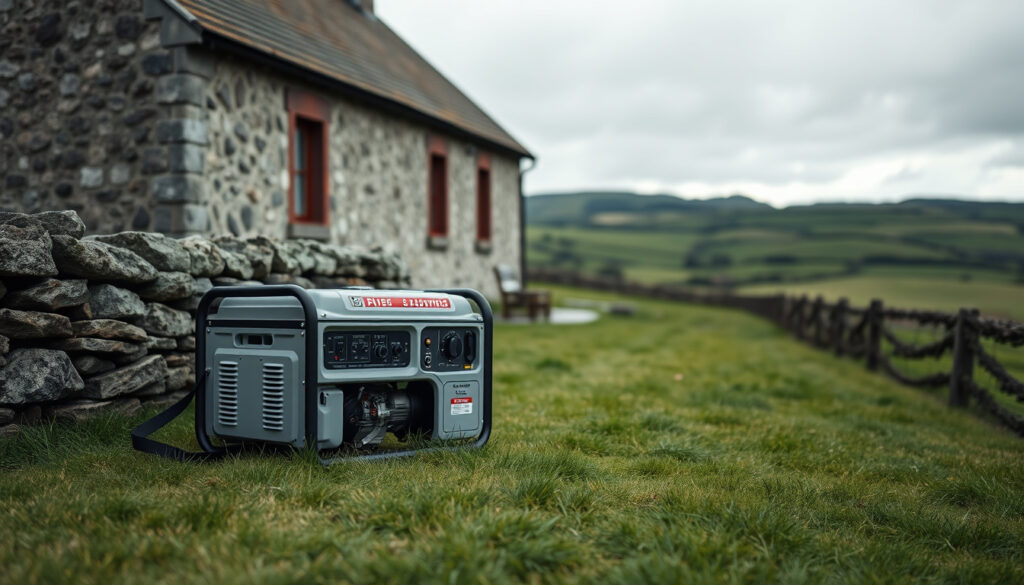
Generators for Sale Ireland: A Complete Guide to Sizing & Buying
Storm season in Ireland has a way of speeding up the generator decision. Whether you’re protecting a farm in Cork or keeping a family home in Galway lit, the right generator depends on sizing, fuel type, and safety setup — and this guide pulls together practical advice from Irish dealers and electrical installers to match the machine to your actual loads.
Typical home size: 10–15 kW (PowerGen Ireland) ·
Fuel types: Petrol, Diesel, PTO, Silent ·
Typical 10 kW price: €2,000 – €5,000 ·
Complete backup system: from €2,150 (DE Energy Hub)
Quick snapshot
- Generators are widely available in Ireland via local dealers and online marketplaces (PowerGen Ireland).
- The 80% rule is recommended to prevent overload (Haven Electrical).
- Generators must be placed outdoors to avoid carbon monoxide poisoning (Haven Electrical).
- Exact fuel efficiency varies by generator model and load profile (DE Energy Hub).
- EU Stage V emissions standards are reshaping diesel generator purchasing for urban and public projects (Machineryline Ireland).
- Silent and PTO generators are gaining ground in rural and residential markets (Machineryline Ireland).
Five numbers sum up the Irish generator market, and one pattern stands out: 10 kW is the practical target for most households.
| Specification | Typical value for Irish homes |
|---|---|
| Average generator size for a house | 10–15 kW (PowerGen Ireland) |
| Whole-house backup threshold | 10 kVA or more (Mchale Agri) |
| Complete backup system with installation | c. €2,150 all-in (DE Energy Hub) |
| Adding 5 kWh battery storage | c. €4,600 total (DE Energy Hub) |
| Silent canopies recommended for residential zones | Yes (Machineryline Ireland) |
| Diesel recommended for long-term use | Yes (PowerGen Ireland) |
What size generator do I need to power my house in Ireland?
Understanding home power requirements
- Small homes in the west of Ireland generally need 3 to 4 kVA.
- Average family homes need 5 to 6 kVA.
- Large rural homes need 7 to 9 kVA.
- Whole-house backup usually needs 10 kVA or more.
According to Mchale Agri (rural equipment specialist), sizing should match the number of circuits you actually need to keep live during a mains failure. CareyTools offers a similar view for typical homes, pegging them at 5,000 to 7,500 watts, while PowerGen Ireland suggests most homes will land in the 5 to 15 kVA range depending on the appliances being powered.
The pattern across both guides is consistent: you need roughly 3 to 7 kVA for limited backup, and 10 to 15 kVA for full-house coverage.
What is the 80% rule for generators?
- Never exceed 80% of a generator’s rated capacity under normal running load.
- Leave headroom for voltage drop and motor starting surges.
- Base the calculation on essential circuits, not the sum of all breaker ratings.
Haven Electrical emphasises that starting current, power factor, and non-linear loads affect generator sizing, so the 80% rule gives you the necessary buffer without overspending on a machine that mostly runs idle.
What is the 20/20 rule for generators?
- An appliance that draws 1,000 running watts can demand 2,000 watts or more for the first few seconds.
- Multiple motor-driven appliances can create a combined surge of 2 to 3 times the running load.
- Apply the 20/20 rule before you connect sensitive or heavy equipment.
This matches Haven Electrical’s guidance on starting current and non-linear loads, and it explains why a generator that seems big enough on paper can still trip when the fridge, oil boiler, and water pump restart together.
Is a 10 kW generator enough to run a house?
- Yes, for most detached and larger rural homes.
- It covers lights, fridge, oil boiler, and home-office equipment comfortably.
- It will not run a large electric shower, heat pump, or 3-phase machinery at the same time.
Mchale Agri puts whole-house backup at 10 kVA or more, making 10 kW the practical sweet spot for Irish buyers who want a single machine that can handle a full outage.
The implication: Irish buyers consistently over-specify. Calculating the essential loads instead of the total connected load can cut your purchase price by a third.
Can you permanently run a house on a generator?
What are the downsides of using a generator?
- Permanent use requires a transfer switch and proper grounding.
- Generators are not designed for continuous 24/7 operation.
- Carbon monoxide risk demands outdoor placement away from windows.
- Night running causes noise disturbance and may violate local ordinances.
DE Energy Hub, an Irish backup power installer, highlights that a complete setup includes a changeover switch, inlet socket, cable, and electrician—components that raise the total cost above the generator price alone. Their complete basic backup system for a Honda EU22i is priced at about €2,150 all-in.
Is it okay to leave my generator running all night?
- Not recommended: fuel costs spike and mechanical fatigue becomes a real risk.
- Noise becomes a problem for neighbours in residential areas.
- A diesel model with a silent canopy is the better fit for overnight use.
Machineryline Ireland notes that soundproofed or silent canopies are strongly advised for residential, urban, or low-noise zones. For longer runtime, PowerGen recommends diesel for its durability and lower running costs.
A complete backup setup—not just the generator—can double your budget once installation and changeover components are factored in.
The trade-off: a permanently installed generator gives you a seamless transition but turns a €500 portable appliance into a €2,500 electrical upgrade.
Can a generator sit outside in the winter?
Does a generator need to be covered from the rain?
- Generators must be placed outdoors in a dry, well-ventilated area.
- Rain covers protect electrical components, but never enclose completely.
- Use winter-grade oil, keep fuel fresh, and clear snow from the intake.
- Never run a generator inside a garage, even with the door open.
Haven Electrical’s guidance on safe placement is clear: a generator needs airflow for cooling and exhaust dispersal, so permanent enclosures are a fire and CO hazard. A weather-resistant cover that sheds rain while allowing airflow is the correct balance.
Why this matters: a €40 rain cover is significantly cheaper than replacing a flooded alternator.
What appliances should not be used with a generator?
- Sensitive electronics like TVs and computers may require an inverter generator for clean power.
- Large motor appliances such as AC units, fridges, and sump pumps need surge capacity up to 2-3 times running watts.
- Never backfeed power into house wiring without a transfer switch.
- Avoid extension cords that are too long or undersized.
Haven Electrical notes that non-linear loads, such as UPS systems and variable speed drives, complicate generator sizing because they introduce harmonics that a basic portable generator may not handle cleanly. For a home office with a UPS, an inverter or silent generator is often the right call.
The catch: the generator that runs your kettle may fry your broadband router. Match the power quality to the load, not just the wattage.
What is the cheapest way to power a house?
- Grid electricity is often cheapest per kWh in Ireland (c. €0.40/kWh).
- Solar PV with battery can lower long-term costs but has a high upfront investment.
- Generator fuel costs are typically 2-3 times the grid price per kWh.
- Cheapest short-term backup: proper sizing and running only essential loads.
DE Energy Hub’s numbers show why the all-in cost matters: a basic backup system for a Honda EU22i costs about €2,150 installed. Adding a 5 kWh battery and inverter-charger raises the total to about €4,600, which changes the economics for anyone considering a generator as their primary backup over batteries.
What this means: for most Irish homes, the cheapest reliable power setup is a hybrid approach—grid for daily use, and a properly sized generator for the few days a year the mains drops.
Generator types and specs: petrol vs diesel vs PTO
Three fuel systems dominate Irish sales, and the choice comes down to one pattern: running cost vs. portability.
| Attribute | Petrol | Diesel | PTO |
|---|---|---|---|
| Typical power range | 1–10 kVA | 5–500+ kVA | 10–50 kVA |
| Best use case | Occasional home backup | Long-term, high-hour, commercial | Farms with tractors |
| Fuel cost | Higher per kWh | Lower running costs | Depends on tractor efficiency |
| Noise | Louder | Silent canopies available | Loud, plus tractor noise |
| Maintenance | Moderate | More substantial parts | Simpler engine, tractor-serviced |
PowerGen outlines the core trade-off: diesel gives you long-term durability and lower running costs, but petrol units are lighter and cheaper to buy. Machineryline adds that silent canopies are the deciding factor for residential and urban noise-sensitive sites.
The pattern: pick petrol for portability, diesel for endurance, and PTO if you already own a tractor.
Pros and cons of owning a generator in Ireland
Upsides
- Keeps lights, heating, and broadband running during mains failures.
- Protects farms and small businesses from weather-related outages.
- Silent models are available for residential and low-noise zones (Machineryline Ireland).
Downsides
- Complete installed systems can cost €2,150 or more (DE Energy Hub).
- Fuel and maintenance add a permanent running cost.
- CO poisoning risk means strict outdoor placement (Haven Electrical).
The verdict: generators are insurance, not utilities. They pay off when the mains fail, not on a kWh-by-kWh basis.
How to buy a generator in Ireland
- List the essential appliances and add their running watts.
- Apply the 80% rule to size the generator set.
- Choose fuel type: petrol for occasional, diesel for heavy use, PTO for farms.
- Decide on silent or open frame based on your neighbours and local noise rules.
- Budget for installation: changeover switch, inlet socket, cable, and electrician.
Following these steps, grounded in Haven Electrical’s sizing guidance and DE Energy Hub’s package pricing, prevents the two most common mistakes: buying too small and forgetting the installation cost.
What we know vs. what’s still uncertain
What’s confirmed
- Generators are widely available in Ireland through local dealers and online marketplaces (PowerGen Ireland).
- The 80% rule is recommended by manufacturers to prevent overload (Haven Electrical).
- Generators must be placed outdoors to avoid carbon monoxide poisoning (Haven Electrical).
What’s unclear
- Exact fuel efficiency varies significantly between generator models and load profiles (DE Energy Hub).
- Future electricity price trends in Ireland will affect the payback math for battery vs. generator.
- Long-term reliability of budget marketplace generators remains an open question.
These uncertainties matter for long-term planning but don’t change the immediate sizing and safety rules.
Expert perspectives on backup power in Ireland
For most homes, sizing is about essential loads, not total connected load. A 5 to 15 kVA unit covers a typical Irish household if you manage what you switch on.
— Generator specialists at PowerGen Ireland
Reducing your demand first is always the cheapest way to power a home. A generator can cover a short outage, but energy efficiency and renewables like solar PV are more sustainable over the long term.
— SEAI (Sustainable Energy Authority of Ireland)
Non-linear loads like UPS systems and variable speed drives change how a generator performs. You can’t just add up the watts.
— Haven Electrical
The bottom line for Irish generator buyers
For Irish buyers, the choice between a cheap portable petrol unit and a fully installed silent diesel system depends on how heavily your home depends on mains power. If you just want the lights on during a storm, a properly sized 10-15 kVA generator bought from a reputable Irish dealer will do the job. If you want a seamless transition and long-term peace of mind, budget for the full package—inlet socket, changeover switch, and electrician—because the cost of doing it wrong is far higher than the €2,150 starting point for a complete backup system.
Related reading: generators for sale in Ireland · buying a generator in Ireland
deenergyhub.ie, careytools.com, generatorsireland.net, macdistributors.ie, mchaleagri.ie, esbnetworks.ie, powergen.ie
Frequently asked questions
How much does a generator cost in Ireland?
A basic portable unit can cost a few hundred euros, while a complete installed backup system for a Honda EU22i costs about €2,150 all-in, according to DE Energy Hub.
What is the best generator brand for Ireland?
Honda and Briggs & Stratton are among the most commonly stocked brands at Irish retailers. For diesel commercial units, buyers often look at PowerGen’s recommendations for long-term durability.
Can I use a generator indoors?
No. Generators must be placed outdoors in a dry, well-ventilated area, away from windows and doors, to avoid carbon monoxide poisoning.
How often should I service my generator?
Service intervals vary by model, but checking oil, spark plugs, and fuel freshness before each season is standard practice. Diesel units with higher running hours need scheduled maintenance on filters and injection systems.
What is a PTO generator and who needs it?
A PTO generator is powered by the tractor’s power take-off shaft. Mchale Agri says these are ideal for farms that already own a tractor and need high-capacity backup for whole-farm or outbuilding loads.
Do I need a transfer switch for my generator?
Yes, for any permanent connection. A changeover switch and inlet socket are essential to connect the generator to your house wiring safely, and DE Energy Hub includes them in its complete backup packages.
What is the difference between petrol and diesel generators?
Petrol units are lighter, cheaper, and fine for occasional use. Diesel units have lower running costs, better durability, and are recommended by PowerGen for long-term or high-hour applications.
These answers cover the most common concerns for Irish generator buyers.
More related posts
 Cast of Selling the OC: Season 4 List, Net Worths & Exits
 Range Rover Price in Ireland 2026: New & Used Models
 Sligo to Galway Bus: Timetable, Prices and Operators
 Leinster Hurling Championship 2025: Schedule, Results, Table
 Night Manager Season 2: Cast, Episodes & Release
 Toyota Corolla for Sale in Ireland: Best & Worst Years
 Brentford vs Man City Timeline: Head to Head Results
