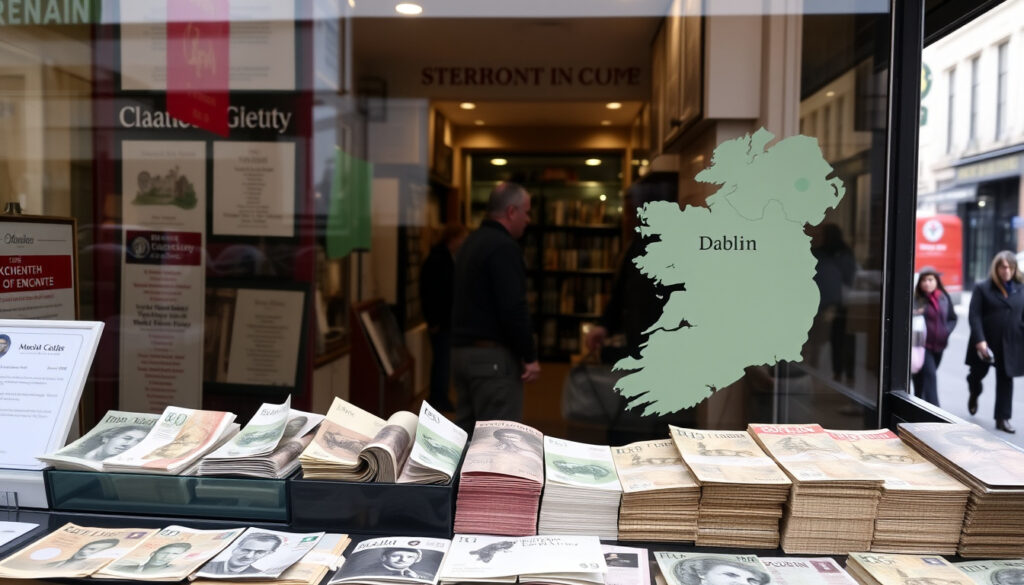
Money Exchange Near Me: Best Places in Dublin, Galway & Ireland
Anyone who’s dashed into a Dublin bureau de change without checking rates has felt that small pang of regret. The good news: Ireland offers several ways to swap your pounds, dollars, or yen for euros — and some are far cheaper than others.
Dedicated currency exchange bureaux in Dublin city centre: Over 15 ·
Typical commission charged by Irish banks for foreign cash: 0% to 3% ·
Exchange rate mark-up at Dublin Airport vs city centre: 5-10% higher ·
Post offices in Ireland offering commission-free exchange: Over 900 locations ·
Currencies available at An Post: 15 major currencies
Quick snapshot
- No1 Currency offers 0% commission at bureau de change locations across Ireland (No1 Currency)
- An Post provides 0% commission on foreign currency cash and a Currency Card with up to 15 currencies (An Post)
- AIB charges 1% commission on foreign cash orders (min €1.27, max €6.35) (AIB)
- Exact real-time exchange rates at individual bureaux fluctuate daily (Vagabond Tours of Ireland)
- Whether non-account holders can exchange at every bank branch; policy varies by branch (Vagabond Tours of Ireland)
- Exchange rates are updated daily; airport rates tend to be 5-10% higher than city centre (Wise)
- Compare rates online before exchanging. Consider currency cards or pre-order for better rates
| Label | Value |
|---|---|
| Best overall value for euro exchange in Dublin | No1 Currency (Westmoreland Street) – 0% commission |
| Cheapest way to get euros in Galway | An Post (commission-free cash) |
| Typical commission at AIB for foreign cash | 1% (min €1.27, max €6.35) |
| Number of commission-free exchange points in Ireland | 900+ (An Post) |
| Currencies available at An Post | 15 major currencies |
| Dublin Airport bureau de change claim | “Competitive exchange rates and fast service” |
Where is the best place to exchange currency in Dublin?
Dublin’s city centre is packed with options. The key is knowing which one gives you the best rate for your specific currency and amount.
Top-rated currency exchange bureaux in Dublin city centre
- No1 Currency (Westmoreland Street) – 0% commission, tight spreads, near Trinity College.
- Fexco Currency – operates via credit unions and offers 0% commission (Fexco Currency).
- An Post – over 900 locations, 0% commission on 15 currencies (An Post).
Banks like AIB and Bank of Ireland also exchange currency but often only for account holders and with commission (AIB).
Comparison of rates at No1 Currency and other specialists
The following table shows how each provider’s fee structure translates into real costs on a typical €100 exchange.
| Provider | Commission | Typical spread on €100 |
|---|---|---|
| No1 Currency | 0% | ~€2–3 less than mid-market |
| An Post | 0% | ~€3–4 less than mid-market |
| AIB | 1% (min €1.27) | ~€4–6 less than mid-market |
| Dublin Airport | 0% (but poor rate) | ~€5–10 less than mid-market |
Rates are sourced from provider websites and Fexco’s comparison page. The spread (gap between buy and sell) is where providers make their money.
Should you exchange at the airport or in the city?
- Dublin Airport’s bureau de change advertises competitive rates (Dublin Airport), but independent comparisons show you lose 5-10% compared to city centre options (Wise).
- Recommendation: Only exchange a small amount at the airport for immediate needs; exchange the rest in the city.
City centre specialist bureaux and An Post consistently beat airport counters and most bank rates for cash exchange. The difference on €500 can be €25–€50.
Do banks in Ireland exchange foreign currency?
Yes, but the rules differ by bank and account status. For non-customers, options become limited.
Which Irish banks offer foreign cash exchange?
- AIB – exchanges foreign cash for customers; online ordering available (AIB).
- Bank of Ireland – provides currency exchange for personal customers; zero payment fees for UK/EEA transfers (Bank of Ireland).
- Ulster Bank – no longer operating branches, but previously offered exchange.
According to a tourist-focused guide, Irish banks generally require you to hold an account to use their currency services.
What are the typical fees and commission at banks?
- AIB: 1% commission on the euro value of foreign cash, min €1.27, max €6.35 (AIB).
- Bank of Ireland: zero payment fees for UK and EEA transfers, but exchange rate mark-up applies (Bank of Ireland).
- An Post (not a bank): 0% commission, but exchange rate still includes a spread (An Post).
Wise notes that a 0% commission label doesn’t guarantee the best total cost because rate mark-ups can still be significant (Wise).
Can non-customers exchange money at a bank?
- Most banks in Ireland restrict currency exchange to account holders. A tourist may be turned away at the counter.
- Specialist bureaux and An Post do not require an account – just walk in with cash or a debit card.
If you don’t have an Irish bank account, your best option is a specialist bureau or post office. Banks may turn you away, and even if they don’t, the commission and rate may be worse.
What this means: For visitors and non-account holders, banks are rarely the best choice. An Post or a specialist bureau is both faster and cheaper.
Is it better to exchange money at a bank?
For account holders, banks can be a convenient option – but convenience often comes at a cost.
Banks vs specialist bureaux: rate and fee comparison
The table below shows how each provider stacks up when exchanging €200.
| Provider | Commission | Effective cost on €200 |
|---|---|---|
| AIB (customer) | 1% (min €1.27) | ~€1.27–€2.00 |
| Bank of Ireland (customer) | 0% transfer fee, rate spread | ~€3–5 |
| No1 Currency | 0% | ~€1–2 |
| An Post | 0% | ~€2–3 |
Sources: AIB, No1 Currency, An Post.
When does a bank offer a better deal?
- For large transfers (€20,000+), Bank of Ireland offers branch assistance with competitive rates (Bank of Ireland).
- For foreign currency cash under €500, specialists and An Post usually win on price and speed.
Pros and cons of using a bank for currency exchange
Upsides
- Convenient if you already have an account
- Large transfers may get better rates
- Online ordering for cash collection
Downsides
- Commission eats into your money
- Limited to account holders
- Exchange rates can be worse than specialists
- Branch hours restrict access
The trade-off: Banks offer trust and convenience for customers, but for pure value, specialists and post offices are the clear winners on cash exchanges under €1,000.
How to get euros in Galway?
Galway city centre has several options, though fewer than Dublin.
- Check An Post locations – Over 900 across Ireland, including Galway, offering 0% commission on euros, GBP, USD, CAD, AUD, and PLN. Most branches can exchange cash without pre-order (An Post; also Wise).
- Visit Western Union on Eglinton Street – Provides currency exchange services for walk-in customers.
- Try Halifax Bank on Eyre Street – May exchange currency for customers; non-account holders likely need to go elsewhere.
- Use a currency card (An Post Currency Card) – Pre-load up to 15 currencies and spend like a debit card anywhere in the eurozone. No commission; exchange rates are competitive (An Post).
- Compare live rates before you go – Use Wise or XE to check the market rate; then compare against the branch’s advertised rate.
What this means: Galway visitors can get euros quickly at An Post or Western Union. Plan ahead and avoid using ATMs with high foreign transaction fees.
Where can I exchange Irish money?
If you’ve inherited old Irish pound notes or coins, you still have options – but they’re limited.
Exchanging old or damaged Irish banknotes
- Central Bank of Ireland (Dame Street, Dublin) – Accepts old Irish banknotes for exchange into euros, but does not exchange coins. The process is standard but can take several weeks for damaged notes.
- The Old Currency Exchange (Blackrock Market) – A private dealer that offers potentially better rates for pre-euro notes, especially rare ones. A Yelp reviewer notes: “Swap your old banknotes and coins at The Old Currency Exchange in Blackrock Market. They will give you more than the Central Bank in Dame Street does!”
- An Post – No longer handles Irish pound conversion.
For collectors, specialist dealers may pay a premium for notes in good condition. Check current exchange rates and compare offers.
Old Irish banknotes still held by many households can be exchanged at the Central Bank, but for rare notes, a specialist dealer might give you a much better deal – potentially hundreds of euros more.
The pattern: Government exchange is safe but conservative. For valuable notes, a specialist dealer can unlock hidden value.
Common questions about money exchange in Ireland
How much does it cost to exchange currency in Ireland?
Costs vary: banks charge 0-3% commission plus a spread; specialist bureaux and An Post charge 0% commission but include a spread (typically 2-4%). Always check both the commission and the exchange rate offered (AIB, An Post).
Can I exchange currency at any post office in Ireland?
Yes – over 900 post offices offer foreign currency exchange. Most carry five global currencies (USD, GBP, CAD, AUD, PLN) and can order others. 0% commission applies (An Post).
What is the best way to get euros before traveling to Ireland?
Order euros online from a specialist bureau (e.g., No1 Currency) or load a currency card (e.g., An Post Currency Card) before you arrive. Avoid airport exchange for large amounts (Wise).
Do I need to show ID to exchange money in Ireland?
Yes – most providers require valid photo ID (passport or driving licence) for exchange transactions over €300-€500. Smaller amounts may not require ID, but policies vary.
Are there any hidden fees in currency exchange?
The biggest hidden cost is the exchange rate spread, which can be 3-5% even with 0% commission. Always compare the final amount you’ll receive, not just the commission (Wise).
How long does it take to exchange old Irish banknotes at the Central Bank?
The Central Bank processes standard exchanges within a few days, but damaged notes may take several weeks. For faster service, consider a specialist dealer.
Is it better to use a currency card or cash when in Ireland?
Currency cards (like An Post’s) combine competitive rates with convenience and safety. Cash is useful for small purchases, but cards often give better rates and eliminate the need to carry large amounts.
For travellers and locals alike, the choice comes down to how much you are exchanging and how quickly you need it. For small sums under €200, any post office will do. For €500 or more, a specialist bureau like No1 Currency in Dublin city centre will put more money in your pocket. And for old Irish banknotes, do not settle for the first offer – compare the Central Bank with a specialist dealer.
Related reading: **Convert USD to Euro: Current Exchange Rate & Best Deals** · **Convert USD to Euro: Best Rates & Avoid Hidden Fees**
More related posts
 Best TV Shows 2025 – Top Rated Series So Far
 Páirc Uí Chaoimh Capacity Guide: Seating Plan & Ireland Rank
 Treadmill For Sale Ireland – Best Deals, Prices and Buying Guide
 Harry and Meghan Latest News: Breaking Updates Today
 Audi Q4 e-tron 2026: Problems, Price, Range & Reliability
 Houses for Sale in Dundalk: Prices, Tips & Listings
 Best Beauty Advent Calendar 2025: Prices & Value
