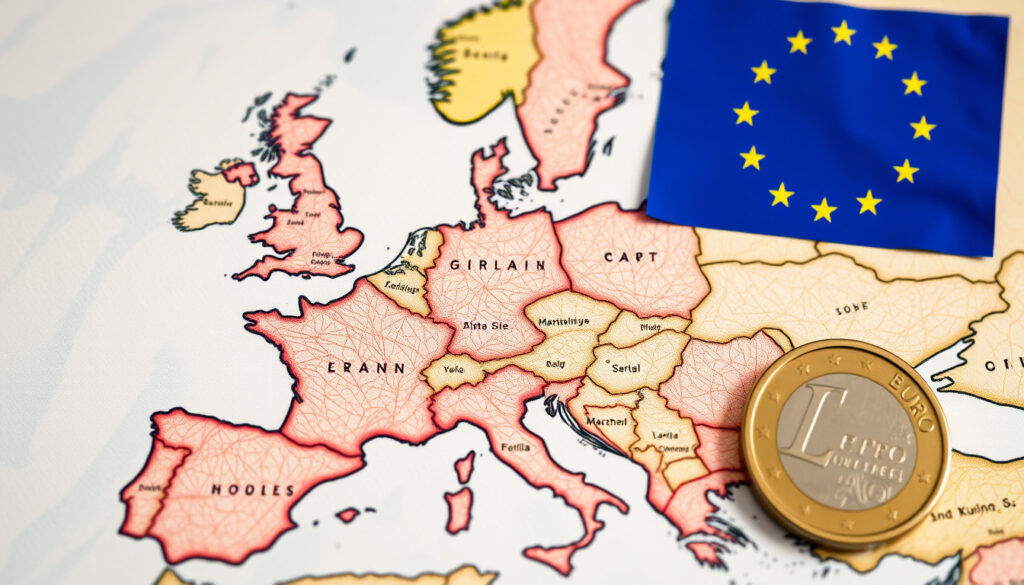
When Did Ireland Join the EU? History, Euro, Schengen
Joining a club is usually about what you gain, not what you leave behind. When Ireland walked into the European Economic Community on 1 January 1973, it was the beginning of a very different relationship with its nearest neighbour — and one that would be tested again nearly 50 years later (83% of Irish voters had approved membership the year before, by the way, so this was hardly a quiet decision).
Joined the EEC: 1 January 1973 ·
Referendum yes-vote: 83% (May 1972) ·
Application submitted: 30 July 1961 ·
Euro member since: 1 January 1999 ·
Schengen member: No
Quick snapshot
- EU member since 1973 (European Union (EU history portal))
- Eurozone member since 1999 (European Central Bank)
- Not in Schengen (Citizens Information (Irish government))
- No fixed entry date exists for any current EU candidate (Council of the EU (accession policy))
- Why the UK “gave up” Ireland is an interpretation; the 1922 settlement was the result of conflict and negotiation, not an act of generosity (European Parliament research service)
- German plans for invading Ireland in WWII remain a matter of historical debate (EHRI (Holocaust research portal))
- 1961 first application · 1972 referendum · 1973 entry (European Parliament research service)
- 1993 EU founded · 1999 euro · 2020 UK leaves, Ireland stays (European Union (EU history portal))
- Candidate countries face years of negotiation; accession needs unanimous approval (Council of the EU (accession policy))
- Ireland’s open border with the UK continues to shape its EU opt-outs (Citizens Information (Irish government))
A quick-reference view of the key facts, one pattern: the referendum did the heavy lifting before the paperwork was ever signed.
| Label | Value |
|---|---|
| EEC entry date | 1 January 1973 (European Union (EU history portal)) |
| Membership referendum | May 1972 – 83% yes (Houses of the Oireachtas) |
| Application lodged | 30 July 1961 (European Parliament research service) |
| Euro area | Since 1 January 1999 (European Central Bank) |
| Schengen Area | No (Citizens Information (Irish government)) |
| Capital city | Dublin – in the EU as Ireland’s capital since 1973 |
When Did Ireland Join the EU?
Ireland joined the European Economic Community on 1 January 1973 — one of the three countries, alongside Denmark and the United Kingdom, that brought the original six-member Community to nine (European Union (EU history portal)). The 1973 accession was the first enlargement in the Community’s history (European Parliament research service).
What did the 1972 accession referendum decide?
Ireland signed the Treaty of Accession at the Egmont Palace in Brussels on 22 January 1972 (European Commission in Ireland). Then, on 10 May 1972, Irish voters went to the polls in a constitutional referendum (Houses of the Oireachtas). The result was emphatic:
- Around 83% of voters supported joining the European Communities (European Commission in Ireland).
- The official result was recorded as 83.09% in favour (Houses of the Oireachtas).
- Turnout reached 70.3% — a high figure by Irish standards (European Commission in Ireland).
Who joined the EEC with Ireland in 1973?
The second enlargement bid moved together: Ireland, the United Kingdom, and Denmark all became members on the same day (European Union (EU history portal)). That joint entry is one reason the 1973 decision was so consequential — Ireland was not signing up to a club dominated by London, but to a European structure with its own institutions and member states. Membership also triggered a constitutional change: Ireland’s constitution was amended so that European Community law could take effect in the state.
The 83% vote was rarely a passionate embrace of European federalism. It was Ireland’s declaration of independence from a single-market dependence on Britain — a sovereignty strategy wrapped in a trade agreement.
Does Ireland Come in the European Union?
Yes. Ireland is a full EU member state, and has been continuously since 1 January 1973 — the 1973 entry predates the formal creation of the European Union itself (the Maastricht Treaty took effect on 1 November 1993 and renamed the European Communities as the European Union, with Ireland automatically a founding member of the new structure).
Is Dublin in the EU?
Dublin is Ireland’s capital and one of the EU’s major cities. Being the capital of an EU member state means Dublin hosts EU offices, sends representatives to the European Parliament and Council, and is fully within EU jurisdiction (Citizens Information (Irish government)).
Is Ireland in the euro area?
Ireland adopted the euro on 1 January 1999, when the euro was introduced as an accounting currency for banking and electronic payments (European Central Bank). Euro banknotes and coins followed on 1 January 2002, replacing the Irish pound.
Are Irish people EU citizens?
Every Irish citizen is automatically an EU citizen. That means Irish people can live, work, study, and retire in any other EU member state without a work permit — a right that did not exist before 1973 (Citizens Information (Irish government)).
The implication: Ireland is not a semi-detached member. It is inside the single market, inside the euro, and part of the EU’s legal order. The only significant opt-out is border policy — and that is exactly where the UK relationship sits.
What Are the Requirements to Join the EU?
Joining the EU is a demanding, multi-stage process, and the rules were formalised after Ireland joined in 1973. Candidate countries must meet the Copenhagen criteria, which require:
- Stable democratic institutions, the rule of law, and protection of human rights;
- A functioning market economy able to cope with competitive pressure inside the EU;
- The capacity to take on all EU obligations and implement EU law in practice (Council of the EU (accession policy)).
Negotiations start only after the European Commission assesses a candidate’s readiness, and every stage is screened chapter by chapter. The final act is political: accession requires unanimous approval by all existing member states (Council of the EU (accession policy)). That unanimity rule is why “which countries are joining the EU soon” is a much harder question than it looks — no candidate has a confirmed accession date in the Council’s published timetable.
For Ireland in the 1970s, the bar was lower and the politics simpler. For modern candidates, the criteria are stricter, the rule-of-law checks more demanding, and the politics of enlargement more contested — but the signature step is still a national one: a referendum, in most member states, and a candidate’s own parliament too.
Which countries are joining the EU soon?
The EU officially recognises Albania, North Macedonia, Montenegro, Serbia, Türkiye, Ukraine, Moldova, Georgia, and Bosnia and Herzegovina as candidates or potential candidates (status varies). None has a fixed entry date. The Council’s enlargement page notes that the pace of negotiations depends on each country’s progress in meeting the Copenhagen criteria — which means “soon” is measured in years, not months (Council of the EU (accession policy)).
How do EU accession negotiations work?
Accession talks are divided into policy chapters, screened by the European Commission. A negotiating framework is agreed, then each chapter is opened and closed only when the country is seen as aligned with EU law. The final step is a treaty between the existing member states and the candidate, followed by ratification in every member state (Council of the EU (accession policy)).
Is Ireland Part of the EU After Brexit?
Yes — and that was the whole point. When the UK left the EU on 31 January 2020, Ireland remained a member (European Union (EU history portal)). The departure came 47 years after Ireland and the UK walked in together, but the two countries now have different international positions.
Did Brexit change Ireland’s EU membership?
No. Ireland’s membership is an independent legal commitment, not a side effect of the UK’s. The EU Treaties continue to apply in full to Ireland, and Irish citizens keep EU citizenship rights (Citizens Information (Irish government)).
What is Northern Ireland’s relationship with the EU after Brexit?
Northern Ireland is part of the United Kingdom, so it is not an EU member. But the EU and UK agreed in the Protocol on Ireland/Northern Ireland — now operating through the Windsor Framework — that Northern Ireland continues to apply EU rules for goods travelling across the Irish border, precisely to avoid a hard border on the island of Ireland (Council of the EU (EU-UK withdrawal agreement)). This means Northern Ireland follows EU standards for goods while remaining under UK sovereignty — an arrangement with no parallel elsewhere.
What is the Common Travel Area?
The Common Travel Area (CTA) is a separate, older agreement between Ireland and the UK that allows free movement of people between the two countries — including British citizens in Ireland and Irish citizens in Britain (Citizens Information (Irish government)). It is not part of EU law, which is why Ireland could keep it even after the UK left.
Ireland’s 1973 EU membership is now the thing keeping its border with the UK open — without the EU’s goods rules, there would be no Windsor Framework and no frictionless Irish border.
When Did Ireland Join the Euro?
Ireland joined the euro at the currency’s launch: 1 January 1999 (European Central Bank). Euro banknotes and coins entered circulation across the eurozone, including in Ireland, on 1 January 2002. Before that, Ireland used the Irish pound, which was pegged to the British pound until 1979 — a reminder that even Ireland’s currency once depended on London (European Commission in Ireland).
Was 1999 the start of the euro?
Yes. The euro was formally introduced at midnight on 1 January 1999, initially as an accounting currency for banking and electronic payments, with national currencies including the Irish pound fixed at irrevocable exchange rates (European Central Bank).
When did euro cash appear in Ireland?
The first euro banknotes and coins appeared in Irish wallets on 1 January 2002, and the Irish pound was fully withdrawn within a few weeks (European Central Bank).
The implication: adopting the euro made Ireland’s monetary policy European, not British — a decision that would have been inconceivable before 1973.
Is Ireland in the Schengen Area?
No. Ireland is an EU member and a eurozone member, but it operates the Schengen opt-out and is not part of the border-free Schengen Area (Citizens Information (Irish government)).
Why is Ireland not in Schengen?
Ireland’s opt-out protects the Common Travel Area with the UK. Because the UK was never in Schengen either, the CTA could continue as long as Ireland stayed outside the Schengen border regime (Citizens Information (Irish government)).
Do travellers to Ireland have passport checks with EU countries?
Yes. Although Ireland is in the EU’s single market, arrivals from other EU countries can still be subject to passport and identity checks at Irish ports and airports — because Ireland is not in the Schengen travel zone (Citizens Information (Irish government)).
The takeaway: Schengen is the one EU club Ireland deliberately skipped, and the reason is the same one that brought Ireland into the EU in the first place — the relationship with Britain.
Why Did the UK Give Up Ireland?
The phrase “gave up Ireland” is a simplification. In late 1921, after the War of Independence, British and Irish negotiators signed the Anglo-Irish Treaty, which established the Irish Free State as a self-governing dominion — formally coming into force in December 1922 (European Parliament research service). Britain did not voluntarily surrender Ireland; Irish independence was won through political conflict, then negotiated under the threat of resumed war. Six counties in the northeast (Northern Ireland) remained part of the UK, which is why the island is still divided today.
When did Ireland gain independence?
The Irish Free State was created in 1922, but the state’s path to full sovereignty ran through the 1937 Constitution and the Republic of Ireland Act in 1949, which ended the remaining British role. The 1973 EU vote was a further exercise of that hard-won sovereignty — a small state choosing its own allies (European Parliament research service).
What did Churchill say about Ireland in WWII?
Ireland remained neutral in WWII, refusing to join the Allies despite pressure from Winston Churchill. Churchill’s wartime broadcasts criticised the refusal, while Irish leader Éamon de Valera defended neutrality as the right of a small nation. The episode shaped Anglo-Irish relations for decades, and it is the reason Irish independence — and Ireland’s later EU choice — must be read as assertions of sovereignty, not acts of rebellion (EHRI (Holocaust research portal)).
Why this matters: each step — 1922, neutrality in WWII, 1973 EEC membership, the post-Brexit settlement — was the same move played differently: Ireland finding a way to stand independently beside its much larger neighbour.
Timeline: Ireland and the European Union, 1961–2020
Six dates, one pattern: a referendum created the political mandate and the treaty did the legal work.
| Date or period | Event | Source |
|---|---|---|
| 30 July 1961 | Ireland formally applies for European Communities membership | European Parliament research service |
| May 1972 | Irish voters approve EEC membership by 83% | Houses of the Oireachtas |
| 1 January 1973 | Ireland joins the EEC along with the UK and Denmark | European Union (EU history portal) |
| 1 November 1993 | Maastricht Treaty takes effect; the European Union is established, with Ireland a member from the start | European Union (EU history portal) |
| 1 January 1999 | Ireland adopts the euro | European Central Bank |
| 31 January 2020 | UK leaves the EU; Ireland remains a member | European Union (EU history portal) |
The gap between 1961 and 1973 was not an Irish delay — it was a British one. When the UK’s application was blocked in the 1960s, Ireland’s application was effectively tied to it. The lesson for today’s candidates: joining the EU depends as much on the convergence of other member states’ politics as on a country’s own readiness.
The pattern: from first application to accession took 12 years, and every later step — the euro, the Schengen opt-out, the post-Brexit settlement — was the same sovereignty strategy in different form.
Confirmed Facts and What’s Still Unclear
Here is the honest balance sheet — what is settled and what remains open or interpretative.
Confirmed facts
- Ireland joined the EEC on 1 January 1973 (European Commission in Ireland).
- The May 1972 referendum approved membership with 83% in favour (Houses of the Oireachtas).
- Ireland is in the EU and eurozone but not in Schengen (Citizens Information (Irish government)).
- Ireland remained in the EU after Brexit (European Union (EU history portal)).
What’s unclear
- Which countries will join the EU “soon” has no fixed accession date in the EU’s published plans (Council of the EU (accession policy)).
- German plans regarding an invasion of Ireland in WWII are debated by historians (EHRI (Holocaust research portal)).
- Why the UK “gave up” Ireland is an interpretative phrase; the 1922 outcome was the product of armed conflict and negotiation, not a gift.
The pattern: the hard facts of Ireland’s EU membership are unusually well documented — it is one of the best-recorded accession processes in the Union’s history. What stays open is interpretation: whether the UK “gave up” or lost Ireland, and whether the EU will ever again enlarge as quickly as it did in 1973.
What Key Sources Say About Ireland’s Accession
The first enlargement of the European Economic Community took place in 1973, with Denmark, Ireland and the United Kingdom joining the six founding members.
European Union (EU history portal)
Ireland’s membership of the European Union has been a transformative journey for the country over the last 50 years.
European Commission in Ireland
Both quotes circle the same point: joining was a national decision taken democratically — a referendum, a treaty, a legislature — and that democratic foundation is why Irish membership has survived every political storm since, including Brexit.
What 50 Years of EU Membership Have Meant for Ireland
Fifty years is long enough to see the consequences clearly. Ireland entered the EEC in 1973 as a relatively small, agricultural economy on the edge of Europe; it is now a deeply integrated member, using the euro, exporting freely into a single market that counts the EU’s other member states, and holding EU citizenship for every Irish national (European Commission in Ireland). The Commission’s own record of Ireland’s membership describes it as a transformative half-century — and the direction of travel has been steady, from a state leaning on Britain for trade to a state that sits at the EU table in its own right.
The next decade will stress-test that transformation differently. For the EU, Ireland’s status as the only English-speaking member fully inside the eurozone makes it a bridge between the continent and the English-speaking world. For Ireland, the trade-off is a border with the UK that runs through EU law itself — protected by the same European rules that once reduced its dependence on London. That is the quieter legacy of 1973: a small country that joined a club of six so it could stop being a satellite of one (IIEA (Irish foreign policy think tank)).
For Irish citizens, the choice made in May 1972 is now woven into everyday life — the euro in their pockets, the freedom to work in any EU state, and an external border that exists only because the EU and UK agreed it should. For the EU’s next candidates, the lesson is simpler: ratification is the easy part; the hard part is building the institutions, the market, and the political consensus that make a “yes” possible in the first place. That was true for Ireland in 1972 — and it is still true for every country waiting at the door.
Related reading: Ireland’s EU membership · European Union enlargement
Frequently Asked Questions
Why did Ireland join the EEC in 1973?
Ireland joined to secure access to European markets and to reduce its heavy economic dependence on the UK. The May 1972 referendum approved the move by 83%, and the European Commission’s record of membership describes the decision as the start of a transformative relationship with Europe (European Commission in Ireland).
What is the difference between the EEC and the EU?
The EEC (European Economic Community) was the organisation Ireland joined in 1973. The European Union was established later by the Maastricht Treaty, which took effect on 1 November 1993, building on the EEC and adding political cooperation in areas such as foreign policy and justice (European Union (EU history portal)).
Has Ireland ever voted to leave the EU?
No. Ireland has never held a referendum on leaving the EU. Since joining the EEC in 1973, the only EU-related referendum was the one that approved the 1972 accession itself — and later treaty referendums in the 2000s concerned EU amendments, not withdrawal. Every national vote on Europe in Ireland has been about deepening membership, not ending it.
How did EU membership change Ireland’s economy?
EU membership transformed Ireland from a small, agricultural economy on Europe’s edge into an integrated member of the single market and the eurozone. Membership provided access to European markets, structural funds for development, and — decades later — a position at the centre of the EU’s digital and financial economy. The European Commission’s official record of Ireland’s membership describes it as a transformative 50-year journey (European Commission in Ireland).
Can Irish citizens live and work in other EU countries?
Yes. Irish citizens are EU citizens, and EU free-movement rules give them the right to live, work, study, and retire in any other EU member state without a work permit (Citizens Information (Irish government)).
The takeaway: Ireland’s practical relationship with the EU is settled — membership, euro, opt-outs — and each FAQ answer traces back to the same strategic choice made in 1972.
More related posts
 Chitty Chitty Bang Bang – True Story Behind the Flying Car
 its4women Phone Number Ireland 0800: Correct Contacts & Support
 Car Insurance Quote Ireland: Compare & Find the Cheapest Quotes
 Houses for Sale in Kells: Verified Prices & Listings
 Lucknow Super Giants vs Rajasthan Royals Timeline & Head-to-Head
 Páirc Uí Chaoimh Capacity Guide: Seating Plan & Ireland Rank
 Tour de France 2025 Standings: Final GC Results and Key Takeaways
 Royal Mail International Tracking: How to Track Your Package
