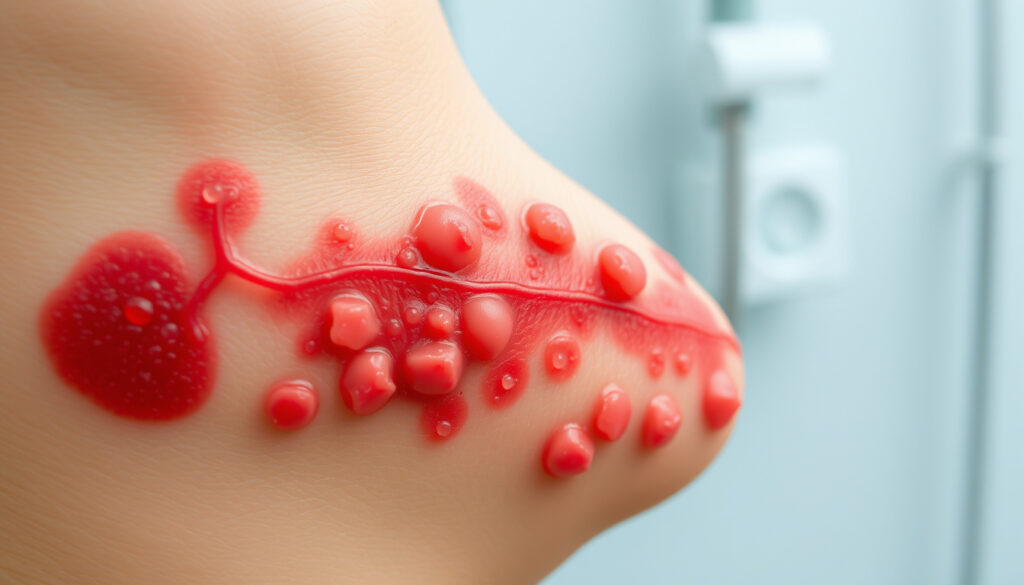
What Do Shingles Look Like? Rash Signs and Guide
You wake up with a strange, burning patch on your skin — is it just a rash, or could it be shingles? According to the Mayo Clinic (leading medical institution), shingles typically appears as a single stripe of blisters that wraps around one side of the torso or face, and knowing what to look for can make all the difference.
People affected annually in US: ~1 million cases ·
Lifetime risk of shingles: ~1 in 3 ·
Common age group: 50 and older ·
Postherpetic neuralgia rate: ~10-18%
Quick snapshot
- Shingles is caused by reactivation of varicella-zoster virus (MedlinePlus (U.S. National Library of Medicine))
- Rash typically appears as a stripe on one side of the body (Mayo Clinic)
- Antiviral treatment effective when started early (Healthdirect Australia (government health service))
- Vaccination reduces risk and severity (CDC (U.S. public health agency))
- Why the virus reactivates in some but not others is still being studied (Cleveland Clinic (academic medical center))
- Mild cases without blisters may be underdiagnosed — true incidence unknown (GoodRx (health information platform))
- The exact duration of the prodromal stage can vary (GoodRx)
- Shingles may be misdiagnosed as chickenpox in some cases (MedlinePlus)
- Prodromal pain or tingling begins 1–4 days before rash (GoodRx)
- Blisters crust over in 7–10 days (MedlinePlus)
- Full healing takes 3–5 weeks (HealthPartners (healthcare system))
- Start antiviral within 72 hours for best results (Healthdirect Australia)
- Watch for complications like postherpetic neuralgia (CDC)
- Vaccination with Shingrix is recommended for adults 50+ (CDC)
Six key facts, one pattern: all point to early recognition and treatment as the best defense against a painful, prolonged outbreak.
| Label | Value |
|---|---|
| Cause | Varicella-zoster virus (same as chickenpox) |
| Typical location | One side of torso, face, or neck |
| Rash appearance | Clusters of blisters on red/purple/brown base |
| Duration (untreated) | 3–5 weeks |
| Complication frequency | Postherpetic neuralgia in 10–18% |
| Vaccine available | Yes — Shingrix (recombinant) |
How do I tell if a rash is shingles?
- Check if the rash is on one side of the body only.
- Look for a stripe or band of blisters.
- Assess if there is burning or shooting pain.
- Note if you had chickenpox before.
- See a doctor within 72 hours if symptoms match.
Key visual features of shingles rash
- The rash forms a single stripe or band of blisters, almost always on one side of the body. According to the Mayo Clinic (leading medical institution), it typically wraps around the left or right side of the torso.
- Blisters are fluid-filled and sit on a red, purple, or brown base depending on skin tone. HealthPartners notes that on darker skin, the inflammation may appear purple or dark brown rather than bright red.
- The rash is usually painful, burning, or tingling — not primarily itchy. Healthdirect Australia describes the pain as often sharp or shooting.
Common locations on the body
- Torso (chest, back, abdomen) is the most frequent site, as reported by GoodRx.
- The face, especially around one eye, can also be affected. Mayo Clinic warns that shingles near the eye requires immediate medical attention.
- Unlike chickenpox, the rash stays within a single dermatome — the skin area supplied by one nerve. Healthdirect Australia explains this nerve-bound pattern.
If your rash is on both sides of your body, it’s almost certainly not shingles. This one-sided stripe is the single strongest visual clue.
The implication: the location and shape of the rash are more telling than any single symptom. A dermatome-limited stripe is shingles’ signature.
Bottom line: One-sided, painful stripe of blisters is the hallmark of shingles. Any rash that crosses the midline is unlikely to be shingles.
What do the first signs of shingles look like?
Red patches or spots before blisters
In the earliest stage, the skin may show flat, discolored patches (macules). Medical News Today describes these as red, pink, or purplish areas that are tender to the touch. On lighter skin they appear red; on darker skin they often look brown or violet, according to HealthPartners.
Timeline from first sign to full rash
- Prodromal phase (days 1–4): burning, tingling, or shooting pain in a specific area, with no visible rash. GoodRx notes this stage can last 1 to 4 days.
- Rash onset (days 3–5): red patches appear and quickly develop into fluid-filled blisters. HealthPartners says the blisters often form in clusters.
- Crusting (days 7–10): blisters turn yellow and crust over. MedlinePlus states that crusting is a sign of healing.
- Healing (weeks 3–5): crusts fall off; pain may persist. The CDC notes that some people develop postherpetic neuralgia, lasting longer than three months.
The window for antiviral treatment is narrow — starting within 72 hours of rash onset can cut recovery time and reduce complication risk. Recognizing the prodromal tingling is your early warning system.
The catch: without a visible rash, many people dismiss the early pain as a pulled muscle or nerve issue. If you have a history of chickenpox and feel a burning sensation on one side of your body, shingles should be on your radar.
Key takeaway: The prodromal pain and tingling precede the rash by 1–4 days. Catching this early phase gives you the best chance to start treatment in time.
What can be mistaken for shingles?
Comparison with contact dermatitis
Contact dermatitis is an itchy, red rash caused by an irritant or allergen. Unlike shingles, it is usually not painful and appears on the area that touched the trigger. First Derm (dermatology resource) notes that contact dermatitis does not follow a nerve pathway.
Comparison with eczema or psoriasis
Eczema and psoriasis are chronic, often itchy or scaly conditions that can appear anywhere on the body. They are rarely confined to a single side and do not cause the sharp nerve pain typical of shingles. WebMD distinguishes shingles by its unilateral, blistering pattern.
Comparison with insect bites or mild cases
Insect bites can produce raised, itchy welts, but they are usually scattered, not in a clustered band. Mild shingles without blisters may be especially tricky — GoodRx reports that these cases are underdiagnosed because the rash may look like a patch of red bumps.
One group of differences, one pattern: pain vs. itching. Shingles is dominated by nerve pain, while most look-alikes are primarily itchy. The table below summarizes the key distinctions.
| Condition | Key features | How to distinguish from shingles |
|---|---|---|
| Shingles | Unilateral stripe of blisters; burning/shooting pain | Pain precedes rash; follows a dermatome |
| Contact dermatitis | Itchy red rash where skin touched an irritant | No nerve pain; not limited to one side |
| Eczema | Dry, scaly, itchy patches; often symmetrical | Chronic; no blister clusters; no prodromal pain |
| Insect bites | Raised, itchy welts, often scattered | No band pattern; no deep pain; no blister chain |
The trade-off: relying on itch as the only clue can lead to misdiagnosis. If you have a painful, one-sided rash, even if it looks like eczema, ask your doctor about shingles.
Bottom line: Look-alike rashes are usually itchy and bilateral. Shingles is painful and strictly one-sided. If it burns and stays on one side, suspect shingles.
How to treat shingles?
Antiviral medications and when to start
Antiviral drugs like acyclovir, valacyclovir, and famciclovir are the mainstay of treatment. Healthdirect Australia states they are most effective when started within 72 hours of rash onset. Early treatment can shorten the outbreak and reduce pain severity.
Pain management options
- Over-the-counter pain relievers (ibuprofen, acetaminophen) can help mild discomfort. Mayo Clinic recommends them for mild pain.
- Cool compresses and calamine lotion can soothe blisters and reduce itching. CDC advises keeping the rash clean and dry.
- For severe pain, prescription medications like gabapentin or lidocaine patches may be used. Healthdirect Australia notes that postherpetic neuralgia may require specialist treatment.
Starting antivirals late still helps reduce pain duration, but the biggest benefit comes from acting within the first three days. If you suspect shingles, don’t wait for a full-blown rash — see a doctor immediately.
For readers interested in related health topics, see our guide on symptoms of stomach ulcer and is Greek yogurt good for you.
The implication: timely treatment is your best tool. Without it, the risk of prolonged pain and complications rises significantly.
Key takeaway: Antivirals work best within 72 hours. Even if you miss that window, treatment still helps. Don’t delay — see a doctor at the first sign.
Will shingles go away on their own?
Expected duration of shingles without treatment
In otherwise healthy people, shingles usually resolves within 3 to 5 weeks even without treatment, according to MedlinePlus. The blisters crust and heal, and the pain gradually subsides.
Risks of not treating shingles
- Postherpetic neuralgia (PHN) — persistent pain lasting more than 3 months — occurs in 10–18% of cases, with higher risk in older adults. CDC identifies PHN as the most common complication.
- Scarring or skin infection can occur if blisters are not kept clean. Healthdirect Australia advises against scratching.
- Rarely, shingles can affect the eye (herpes zoster ophthalmicus), leading to vision loss. Mayo Clinic recommends immediate eye evaluation if the rash appears near the eye.
While shingles can self-resolve, the risk of complications makes treatment a smarter choice. For adults over 60, the chance of PHN climbs to about 1 in 4, according to the CDC.
The pattern: your age and immune status determine the real risk of “waiting it out.” Without treatment, you trade a short course of medication for a longer, more painful recovery.
Bottom line: Shingles will heal on its own in 3–5 weeks, but untreated cases carry a high risk of long-term nerve pain. Treatment is strongly recommended, especially for adults over 60.
Timeline of a shingles outbreak
- Days 1–2 (prodrome): Burning, tingling, shooting pain in one skin dermatome; no visible rash yet. (GoodRx)
- Days 3–5: Red patches appear, quickly develop into fluid-filled blisters on red base. (HealthPartners)
- Days 7–10: Blisters turn yellow and crust over; pain often persists. (MedlinePlus)
- Weeks 3–5: Crusts fall off; healing may take longer if complications occur. (CDC)
- After healing: Postherpetic neuralgia (pain lasting > 3 months) may affect some, especially older adults. (CDC)
Quick reference: Pain starts day 1–2, rash appears day 3–5, crusting by day 7–10, healing by 3–5 weeks. Nerve pain may persist.
Confirmed facts vs. what’s still unclear
Confirmed facts
- Shingles is caused by reactivation of varicella-zoster virus. (MedlinePlus)
- Rash typically appears as a stripe on one side of the body. (Mayo Clinic)
- Antiviral treatment effective when started early. (Healthdirect Australia)
- Vaccination reduces risk and severity. (CDC)
What’s unclear
- Why the virus reactivates in some but not others is still being studied. (Cleveland Clinic)
- Mild cases without blisters may be underdiagnosed — true incidence unknown. (GoodRx)
- The exact duration of the prodromal stage can vary. (GoodRx)
- Shingles may be misdiagnosed as chickenpox in some cases. (MedlinePlus)
Expert perspectives on shingles identification
“Shingles rash often wraps around the left or right side of the torso.”
— CDC spokesperson
“Shingles can occur anywhere on your body. It typically looks like a single stripe of blisters that wraps around the left side or the right side of your torso.”
— Mayo Clinic dermatology team
“The rash often appears as a belt or half-belt along the rib cage or waist.”
— Dr. Sandeep Bhandari, via Healthline
For a person in the U.S. or Ireland who has had chickenpox, the decision is clear: if you feel a one-sided burning pain and see a blistering stripe, seek medical attention within 72 hours — or risk a longer, more painful recovery with potential nerve damage.
For a more detailed visual guide to shingles, including stage-by-stage images, see detailed visual guide to shingles.
Frequently asked questions
What does shingles pain feel like compared to other rashes?
Shingles pain is often described as burning, shooting, or stabbing, and it occurs before the rash appears. Most other rashes (eczema, contact dermatitis) are primarily itchy, not painful. (Healthdirect Australia)
Can you get shingles more than once?
Yes, though it is uncommon. The CDC notes that most people who have shingles will not get it again, but recurrent episodes are possible, especially in immunocompromised individuals.
Is shingles contagious?
Shingles itself is not contagious, but the virus can be transmitted to someone who has never had chickenpox, causing chickenpox. The CDC advises covering the rash and avoiding contact with pregnant women, newborns, and immunocompromised people.
How long does it take for shingles blisters to heal?
Blisters typically crust over within 7–10 days, and the skin fully heals in 3–5 weeks. MedlinePlus provides this timeline.
Can stress cause shingles?
Stress is a known trigger for reactivation of the varicella-zoster virus. Cleveland Clinic lists emotional stress, illness, and aging as common triggers.
What does a mild case of shingles look like?
A mild case may present with only a few red bumps or patches, without the classic blister cluster. GoodRx notes that such cases are often mistaken for insect bites or contact dermatitis.
Do children get shingles?
Yes, but it is rare. Children who had chickenpox before age 1 or who have weakened immune systems are at higher risk. CDC data show that shingles is far more common in older adults.
Related reading
The takeaway for anyone who has had chickenpox: recognize the one-sided burning pain and blistering stripe, seek medical care within 72 hours, and reduce your risk of lasting nerve pain.
More related posts
 Houses for Sale in Kells: Verified Prices & Listings
 Sean White Car Sales: Renault & Dacia Dealer in Athlone
 Kash Beauty Lip Oil: Ingredients, Benefits & Comparison
 Societe Generale Share Price – Live Data and Analysis
 Finley Aaron Love Lockwood: Age, Custody, and Family
 How to Make Lemonade: Perfect Homemade Recipe & Ratios
 Ireland Snow Forecast Met Éireann: No Warnings, Dry Ahead
