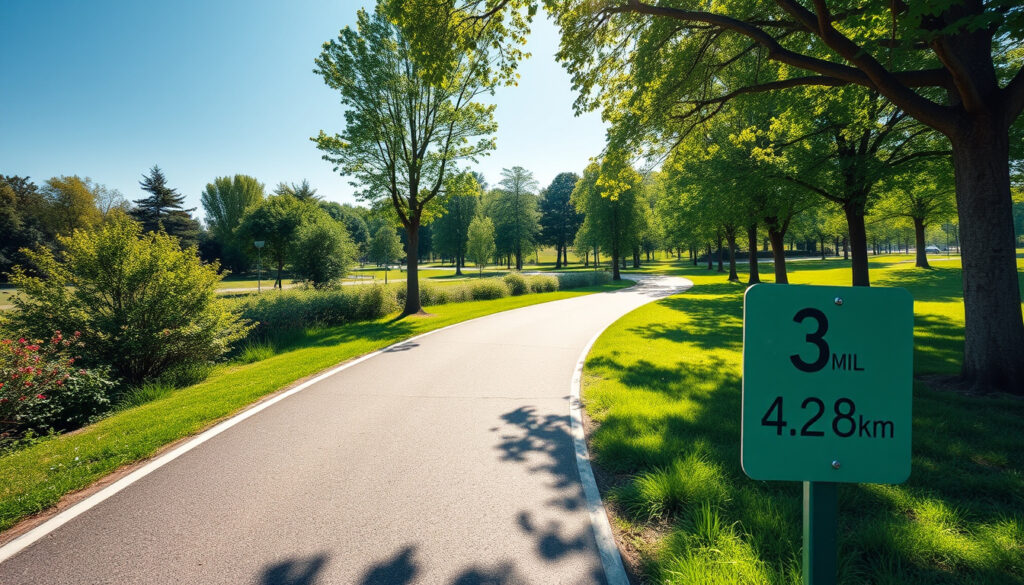
3 Miles in KM: Exact 4.828 km Conversion + Fitness Guide
Whether you’re training for a 5K or just trying to figure out what the treadmill is telling you, the metric-imperial divide keeps tripping up runners and walkers alike. Three miles sounds manageable until the race signs switch to kilometers and suddenly you’re doing math at mile two. This guide gives you the exact conversion, then puts it to work with real-world fitness benchmarks.
3 miles: 4.828 km · 1 mile: 1.609 km · 5K distance: 3.1 miles · 3 km: 1.864 miles
Quick snapshot
- 3 miles = 4.828032 km (CalculateMe.com)
- 1 mile = 1.609344 km (CalculateMe.com)
- 5K = 3.1 miles (ITV News)
- Walking speed varies individually
- Step count depends on stride length
- Calorie burn depends on weight and pace
- 5K races use 3.1 miles as the standard
- 10K equals 6.2 miles
- Half-marathon is 21 km; marathon is 42 km
- Use the quick mental formula for training
- Match your treadmill speed to outdoor pace
- Apply step targets to daily walking goals
| Label | Value |
|---|---|
| 3 miles in km | 4.828032 km |
| Conversion factor | 1.609344 |
| 5K in miles | 3.1 miles |
| 3 km in miles | 1.864 miles |
| 1 mile in feet | 5,280 feet |
What is 3 miles in kilometers?
Three miles equals 4.828032 kilometers. That number comes from multiplying by the conversion factor of 1.609344 — the official length of one mile in metric terms (CalculateMe.com, conversion reference). If you need a quick mental shortcut, 3 × 1.6 = 4.8 km works fine for estimating during a run.
Conversion formula
The formula is straightforward: multiply miles by 1.60934 for a precise result, or use 1.6 for a close estimate on the fly.
- Precise: 3 × 1.609344 = 4.828032 km
- Estimate: 3 × 1.6 = 4.8 km
- Reverse (km to miles): divide by 1.609344
Exact calculation
Working it out: 3 miles × 1.609344 = (3 × 1) + (3 × 0.609344) = 4.828032 km. Most running apps and GPS watches display this precision automatically, so you rarely need to calculate it yourself.
Is 5 kilometers 3 miles?
A 5K race is 3.1 miles, not exactly 3 miles — but the difference is only about 0.1 miles, or roughly 160 meters (ITV News, distance conversion reference). Most runners barely notice the gap when the adrenaline is flowing.
5K to miles breakdown
Five kilometers equals 3.107 miles when calculated precisely. The standard race distance rounds up to 3.1 miles, which is how it’s marked on most timing systems and race websites.
- 5K: 5 km = 3.1 miles (official race distance)
- 10K: 10 km = 6.2 miles
- Half-marathon: 21 km = 13.1 miles
- Marathon: 42 km = 26.2 miles
Close equivalents
For training purposes, thinking of a 5K as “about 3 miles” works fine. The 160-meter gap only matters if you’re chasing a personal best — and even then, it’s a mental edge rather than a physical one.
Is 3 miles a long walk?
For most people, walking 3 miles takes 45 to 60 minutes at a moderate pace — roughly 15 to 20 minutes per mile. That’s a solid workout, especially if you’re just building the habit. Experienced walkers often finish in under 45 minutes; beginners may need the full hour.
Average walking times
Walking pace varies based on fitness level and terrain. Easy walks land around 20 minutes per mile, while brisk walkers can hit 15 minutes per mile. Treadmill walking matches flat-ground times closely when you account for climate-controlled conditions.
- Easy walk: 20–24 min/mile
- Moderate pace: 15–20 min/mile
- Brisk walk: 13–15 min/mile
- 3 miles at moderate pace: 45–60 minutes
Health benefits
Walking 3 miles regularly strengthens the heart, builds leg endurance, and supports joint health without the impact stress of running. The CDC recommends 150 minutes of moderate activity weekly — three 45-minute walks get you there comfortably.
Three miles is a meaningful walking target — long enough to build fitness, short enough to fit into most schedules. Whether it “counts” as long depends entirely on where you’re starting from.
Will I lose weight if I walk 3 miles a day?
Walking 3 miles burns roughly 300 calories for an average adult, assuming a moderate pace and typical body weight. That deficit adds up: three to five walks per week can create a calorie deficit sufficient to lose about a pound of body fat per month. Consistency matters more than speed.
Calorie burn estimates
Actual calorie burn depends on body weight and walking speed. Heavier walkers burn more; faster walkers burn more. The 300-calorie estimate assumes a 155-pound person at a 3.5 mph pace — a reasonable middle-ground estimate.
- 155 lb person at 3 mph: ~280–320 calories
- 185 lb person at 3 mph: ~340–380 calories
- Faster pace (4 mph): adds 50–80 calories
Weekly results
Five walks of 3 miles per week burns roughly 1,500 calories — equivalent to about half a pound of body fat. Over a month, that’s 2 pounds lost; over a year, roughly 24 pounds — assuming diet stays constant. Most fitness trackers estimate this automatically based on your weight and pace.
Walking 3 miles daily won’t transform your body overnight, but it creates a sustainable calorie deficit that compounds over months. The key is showing up regularly — one missed walk won’t matter, but a habit of five per week absolutely will.
Does 3 miles equal 10,000 steps?
Three miles of walking typically produces around 6,000 steps, not 10,000. The 10,000-step goal popularized by fitness trackers doesn’t directly correspond to a specific distance — it came from a 1964 Japanese marketing campaign, not medical research. Most adults need 2,000 to 2,500 steps per mile depending on stride length.
Steps per mile
The math is simple: 5,280 feet per mile divided by your stride length. Taller people with longer strides take fewer steps; shorter people take more. Running cuts the per-mile step count to roughly 2,000–2,500 because of the longer stride length.
- Walking average: ~2,000–2,500 steps/mile
- Running average: ~2,000–2,500 steps/mile
- 3 miles walking: ~6,000–7,500 steps
- 10,000 steps: roughly 4–5 miles
Factors affecting count
Stride length varies with height, leg length, walking speed, and terrain. Running apps and fitness trackers estimate steps using accelerometer algorithms, which can overestimate or underestimate depending on how you move. Calibrating your device by counting actual steps for a known distance improves accuracy.
How to convert miles to kilometers
Converting miles to kilometers requires multiplication by 1.609344. To convert back, divide by the same number. Most runners do this mentally using 1.6 as a shortcut — the difference of 0.009344 per mile is small enough for training estimates, though precision matters for race day planning.
Race pace conversion charts (Run North West, pace conversion reference) let runners compare times across distances using these exact factors. Runners targeting a sub-25-minute 5K can use the conversion to project their 10K or half-marathon splits.
Quick formula
- Miles to km: multiply by 1.609344
- Km to miles: divide by 1.609344
- Mental shortcut: multiply by 1.6 for quick estimates
- Speed (mph to km/h): multiply by 1.609344
Practical applications
Treadmills display speed in both mph and km/h — use the conversion to match your outdoor pace exactly. Running watches show pace in minutes per kilometer or per mile; the ratio between the two is the same as the distance conversion. Race pace conversion charts (Runna, race calculator) apply these factors to predict finish times across 5K, 10K, half-marathon, and marathon distances.
The simpler 1.6 factor is fine for training estimates, but if you’re planning race goals or comparing performances across countries, use the full 1.609344 — those decimal points add up over 26.2 miles.
Summary
Three miles converts to 4.828032 kilometers using the standard factor of 1.609344. For runners, the closest practical benchmark is the 5K at 3.1 miles — only 0.1 miles off. For walkers, 3 miles takes 45 to 60 minutes and burns roughly 300 calories, making it a effective and sustainable workout for weight management and cardiovascular health. Step counters will log roughly 6,000 steps over that distance, so adjust daily targets accordingly rather than expecting 3 miles to equal the popular 10,000-step goal.
“To convert miles to kilometers, we multiply by 1.6. For higher accuracy, you can use the more precise conversion factor of 1.60934.”
“A mile is a unit of distance equal to 5,280 feet or exactly 1.609344 kilometers. It is commonly used to measure the distance between places in the United States and United Kingdom.”
Related reading: pounds to euro conversion · treadmill distance conversions
hillrunner.com, knightsofknee.com, miles-to-km.appspot.com, graduation.escoffier.edu, youtube.com, raceatyourpace.com, runbundle.com
For context in training, 3 miles closely mirrors the 5K race distance, about 3.1 miles, with comparable walking times around 45-60 minutes.
Frequently asked questions
How long is a 5K in miles?
A 5K race is 3.1 miles, covering exactly 5 kilometers or 5,000 meters. The 0.1-mile difference from 3 miles is negligible for most runners.
How far is 3K?
Three kilometers equals 1.864 miles. It’s roughly 1.2 miles shorter than a 5K, making it a common distance for beginner-friendly fun runs and warm-up events.
Is a 30 minute 5K okay?
A 30-minute 5K averages a 9:39 minute-per-mile pace. For recreational runners, this is a respectable finishing time that places you in the top half of most event fields.
What is a good 5K time?
“Good” depends on your background. Competitive runners target under 20 minutes; recreational runners commonly finish between 25 and 35 minutes. Your first 5K is always a win regardless of time.
Can you walk 5K in 1 hour?
Walking 5K (3.1 miles) in 1 hour requires a 19:21 minute-per-mile pace — brisk but achievable for most healthy adults. Most intermediate walkers finish in 45 to 60 minutes at a moderate pace.
Is 3 miles in 30 minutes slow?
Running 3 miles in 30 minutes means a 10:00 minute-per-mile pace. This is a moderate running speed suitable for intermediate runners building endurance — fast enough for fitness, sustainable enough for longer distances.
How long does it take to walk 3km in miles?
Three kilometers equals 1.864 miles. At a moderate walking pace of 3 mph, that’s roughly 37 minutes — a comfortable distance for most beginners building a walking habit.
More related posts
 HSE Civil Registration Service – Births Deaths Marriages Guide
 Waterford Regional Hospital Extension Numbers & Contacts
 Vehicle Recall Instrument Panel – What You Need to Know
 Bank of Ireland Share Chat – Forums, Prices and Analysis
 How to Start a Side Business – Step-by-Step Guide for 2025
 Cast of Bond 25: No Time to Die Full Actor List
 Carlingford Half Marathon 2026: Date, Route & Tips
 Galway County Council Planning – Applications, Fees, Portal Guide
