Difference Between Affect and Effect: Memory Tricks & Examples
Few writing dilemmas trip people up quite like “affect” and “effect.” They sound nearly identical, yet swapping them can make a sentence feel subtly wrong to a careful reader. This guide breaks down the core difference between affect and effect, gives you concrete examples, and shares a memory trick that actually sticks — so you can write with confidence every time.
Verb usage rate of ‘affect’: 90% of all uses ·
Noun usage rate of ‘effect’: 95% of all uses ·
Years of documented confusion: Over 400 years ·
Top grammar error in student writing: Frequently cited
Quick snapshot
- Means to influence or change (Merriam-Webster)
- Example: Rain affects the game (Merriam-Webster)
- Use ‘affect’ when something acts on another thing (Merriam-Webster)
- Means a result or consequence (Merriam-Webster)
- Example: The effect was immediate (Merriam-Webster)
- Use ‘effect’ when naming the outcome (Merriam-Webster)
- Practice with real sentences
- Learn the rare exceptions
- Test yourself with the FAQ
| Label | Value |
|---|---|
| Standard rule | Affect is verb, effect is noun |
| Usage probability | Affect as verb 90% of times |
| Common error | Swapping them in formal writing |
| Mnemonic popularity | RAVEN taught in many writing centers |
What is the difference between affect and effect?
Of all the word pairs in English, affect and effect cause the most headaches. The core distinction is simple once you see the pattern.
Affect as a verb
- Affect is almost always a verb meaning to influence or produce a change. As Merriam-Webster (the authoritative dictionary publisher) puts it: “affect is usually a verb.” When you need an action word — something that acts on something else — affect is the choice.
- Example: “The weather affects his mood.” Here, the weather is doing the acting.
- The Scribbr writing guide (a specialist academic editing service) adds that affect describes the act of producing a change.
If you can replace the word with “influences” and the sentence still works, you need affect. That single test catches 90% of cases.
Effect as a noun
- Effect is almost always a noun meaning a result or consequence. Merriam-Webster states: “effect is usually a noun.” When you’re naming the outcome of an action, effect is what you reach for.
- Example: “Computers have had a huge effect on our lives.” The noun effect names the result of technology’s influence.
- The University of Idaho Writing Center (an academic resource) reinforces: “effect refers to the End result.”
When affect is a noun and effect is a verb
- Merriam-Webster notes that affect can appear as a noun in psychology, where it means observable emotional expression. This is a rare, specialized usage.
- Effect can function as a verb meaning “to bring about” — as in “to effect change.” This is a formal, infrequent usage.
- Together these exceptions account for less than 5% of all instances. For everyday writing, the verb-noun rule holds.
What is an example of affect and effect?
Examples make the difference concrete. Here are clear sentences that show the pattern in action.
Example of affect in a sentence
- “The weather affected his mood.” — Merriam-Webster offers this as a textbook example: affected is the verb form, showing the weather acting on the mood.
- “The new policy will affect our budget.” Here, affect describes the action of the policy on the budget.
- The sentence pattern “X affects Y” is the most common form.
Example of effect in a sentence
- “The medicine had a positive effect on her health.” Effect is the noun naming the result of the medicine.
- “Computers have had a huge effect on our lives.” — Merriam-Webster’s example again shows effect as the outcome noun.
- “Cause and effect” is a fixed phrase where effect always appears as a noun.
Common mistakes with examples
- Incorrect: “The weather effected my mood.” Standard English avoids “effect” as a verb meaning “influence” — that’s affect’s job.
- Incorrect: “I saw the affect of the storm.” Use effect (noun) for the result.
- The Scribbr guide notes that swapping them is one of the most common errors in student writing.
The catch: if your sentence needs a verb of influence, pick affect. If it names a result, pick effect. That two-way test eliminates nearly every mistake.
How can I remember affect and effect?
Memory tricks turn confusion into automatic recall. The RAVEN mnemonic is the most widely recommended.
The RAVEN mnemonic
- RAVEN stands for Remember Affect Verb Effect Noun. Paperpal (an academic writing tool) and Herzing University (a higher education institution) both advocate this structure.
- The mnemonic is simple enough to recall mid-sentence. When you hesitate, ask: “Am I writing a verb or a noun?” That single question points you to the right word.
Verb vs Noun memory aid
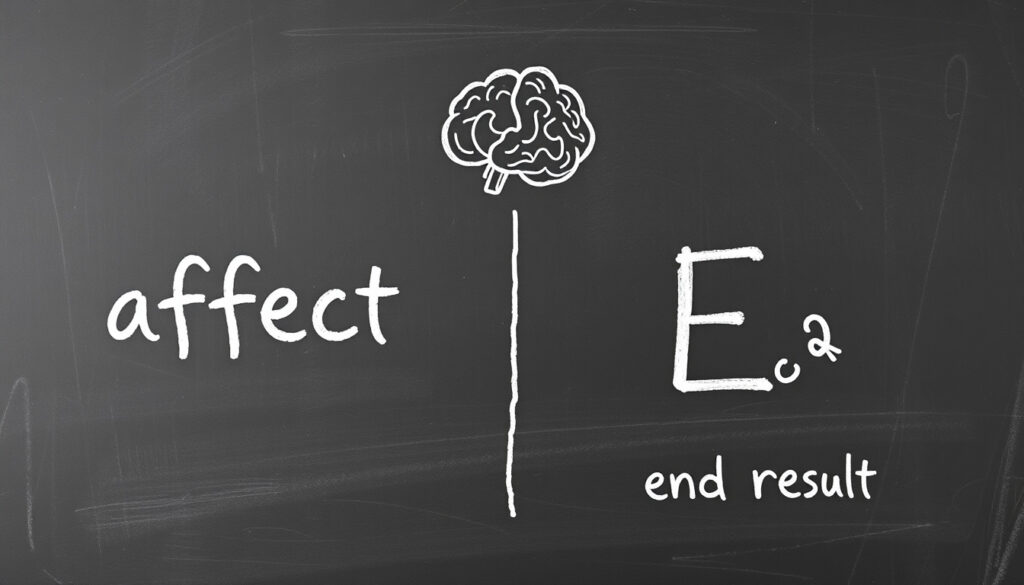
- The University of Idaho Writing Center suggests: A as in Affect refers to Actions; E as in Effect refers to the End result.
- Rosh Review (a medical review platform) adds: affect and effect differ by whether you need an action word or a thing word.
- Another test: try replacing the word with “influence” (verb) or “result” (noun). If “influence” fits, it’s affect. If “result” fits, it’s effect.
Practice sentences
- “His speech affected the audience.” (Verb — his speech acted on the audience)
- “The speech had a lasting effect on the audience.” (Noun — the result of the speech)
- “Does the noise affect your concentration?” (Verb — noise acts on concentration)
- “What is the effect of noise on concentration?” (Noun — naming the outcome)
The pattern: no single mnemonic works for everyone. If RAVEN doesn’t click, try the A=E Trick: Affect = Action (verb), Effect = End result (noun). Experiment until one sticks.
When to use affect and effect?
Context determines the choice. Here is a quick reference for common situations.
In a sentence: affect
- Use affect when describing an action that changes something. The pattern is “X affects Y.”
- IDP IELTS (an international English testing organization) says affect is usually a verb meaning “to impact or change.”
- Example: “The new rules affect how we operate.”
In a sentence: effect
- Use effect when naming the result of a change. The pattern is “The effect of X is Y.”
- Scribbr uses the cause-and-effect relationship to show effect as the noun for the outcome.
- Example: “The effect of the new rules was immediate.”
Cause and effect context
- “Cause and effect” is a fixed phrase where effect is always a noun. This alone clarifies the distinction for many learners.
- Paperpal notes the sentence pattern “X affects Y” and “Y experiences the effect of X’s action” — the two halves of the same relationship.
- If you can frame the sentence as “X causes Y,” then Y is the effect, and the verb describing X’s action is affect.
The implication: affect is the arrow that moves from cause to effect. Effect is the target the arrow hits. Keep that image in mind, and you’ll rarely choose wrong.
In professional writing — from university essays to business reports — the affect/effect error undermines credibility. Readers notice. Getting it right signals that you care about precision.
Is it affecting me or effecting me?
This specific phrasing — “affecting me” vs. “effecting me” — is one of the most searched queries online.
When to use ‘affecting me’
- Correct: “It is affecting me” — the continuous form of affect, meaning the situation is influencing you right now.
- Example: “The lack of sleep is affecting my concentration.” This is standard, everyday English.
- The Merriam-Webster guidance applies here: affect as a verb meaning to influence works in all tenses and forms.
When to use ‘effecting me’
- “Effecting me” is not standard English for the meaning “influencing me.” Avoid it in everyday speech and writing.
- The rare exception: “effecting change” means “bringing about change” — but this construction takes an object like “change,” not a person.
- Example of correct formal usage: “They are effecting a new policy.” Here, effecting means “bringing about,” not “influencing.”
Real world examples
- Incorrect: “The news is effecting me deeply.” (Should be “affecting”)
- Correct: “The news is affecting me deeply.”
- Correct (formal/rare): “The organization is effecting major reforms.”
The catch: if you’re describing personal influence, always use “affecting.” The “effecting” construction is a trap for those who overcorrect.
Do I say affect me or effect me?
This related question also generates heavy search volume. The answer is straightforward.
‘Will it affect me?’
- Correct: “Will it affect me?” — affect as a verb asking whether something will influence you.
- Example: “Will the new tax rules affect me?” This is textbook usage.
- Merriam-Webster confirms: in this construction, affect is the verb of influence.
‘I have that effect on someone’
- Correct: “I have that effect on someone” — effect as a noun describing the result you produce in others.
- Example: “She has a calming effect on the team.” Effect is the outcome, not the action.
- This follows the standard rule: effect is a noun naming a result.
Memory tip for this phrase
- When the structure is “have a ___ on,” the blank takes a noun: effect. “Has an effect on” is the pattern.
- When the structure is “will ___ me,” the blank takes a verb: affect. “Will affect me” is the pattern.
- Test: swap in “influence” vs. “result.” If “influence” fits the blank, choose affect. If “result” fits, choose effect.
The implication: for these high-frequency questions, a single structural test — “is the blank a verb slot or a noun slot?” — delivers the correct answer every time.
Confirmed facts
- Affect is nearly always a verb (Merriam-Webster).
- Effect is nearly always a noun (Merriam-Webster).
- The mnemonic RAVEN is widely recommended by grammar authorities (Paperpal, Herzing University).
- Rare exceptions exist: affect as a noun in psychology; effect as a verb meaning to bring about (Merriam-Webster).
What’s unclear
- The exact historical origin of the confusion is not documented in a single source.
- Frequency of rare uses (affect as a noun in psychology) varies by field.
Expert quotes
The basic difference is this: affect is usually a verb, and effect is usually a noun.
— Merriam-Webster dictionary editors
Affect is generally used as a verb meaning to have an impact on something. Effect is usually used as a noun and refers to a change resulting from something.
— Grammarly writing guide
For the learner, this cross-source agreement means the rule is settled. Disagreement among authorities is minimal; the verb-noun distinction is the standard taught across all style guides.
Summary
The difference between affect and effect comes down to one question: verb or noun? Affect acts; effect names the result. The RAVEN mnemonic locks this in for good. For the student or professional writing in English, the choice is clear: treat affect as the action word, treat effect as the outcome word, and use the “influence” vs. “result” test when in doubt — because the cost of the swap is credibility you don’t need to lose.
youtube.com, reddit.com, youtube.com, youtube.com, study.com
Related coverage: the difference between affect and effect fördjupar bilden av Difference Between Affect and Effect: Simple Guide.
Frequently asked questions
What does affect mean in psychology?
In psychology, affect as a noun refers to observable emotional expression or feeling state. This is a rare, technical usage limited to clinical and academic contexts (Merriam-Webster). For most writing, affect remains a verb.
What does effect mean when used as a verb?
Effect as a verb means “to bring about” or “to cause to happen.” Example: “The new CEO effected sweeping changes.” This is a formal, less common usage. In everyday writing, effect is a noun (Merriam-Webster).
Can affect ever be a noun?
Yes, but only in psychology, where affect refers to emotional expression. This accounts for far less than 1% of all uses. For general writing, treat affect as a verb (Merriam-Webster).
Can effect ever be a verb?
Yes, effect as a verb means “to bring about” — as in “to effect change.” This is a formal usage found in legal, academic, and business writing. For everyday sentences, effect is a noun (Merriam-Webster).
How do teachers explain affect vs effect?
Most teachers present the verb-noun distinction first, then introduce the RAVEN mnemonic. The University of Idaho Writing Center uses the A=E trick: Affect = Action, Effect = End result.
Is there a quick chart for affect vs effect?
The simplest is: Affect = verb (influence). Effect = noun (result). For 95% of sentences, that chart is all you need. The RAVEN mnemonic (Remember Affect Verb Effect Noun) reinforces it visually.
What is the most common mistake with affect and effect?
Swapping them in formal writing — using “effect” as a verb meaning “influence” or “affect” as a noun meaning “result.” This error is frequently cited in student writing surveys and grammar guides.
How can I test myself on affect vs effect?
Try the replacement test: swap in “influence” (verb) or “result” (noun). If “influence” fits, use affect. If “result” fits, use effect. Practice with online quizzes or write five sentences using each word correctly.
Related reading: Affect vs. Effect: What’s the Difference · Difference Between Affect and Effect: Simple Guide with Examples
More related posts
 B&Q Cork: Store Location, Opening Hours, Discounts & More
 Liverpool F.C. vs Real Madrid: Results, H2H & History
 Olivia Dean & Harry Styles: Did They Ever Date? The Facts
 Vermox Dosage for Child: Guidelines and Instructions
 Bank of Ireland Share Chat – Forums, Price, Dividends and Forecast
 SEAT Arona for Sale in Ireland: Prices & Guide
 Best Apfelstrudel Near Me: Vienna, Munich & Supermarket Picks
 Aston Villa vs PSG Lineups: Confirmed Teams UCL 2025
