OxyNorm 5 mg: Uses, Dosage, Side Effects, Morphine Comparison
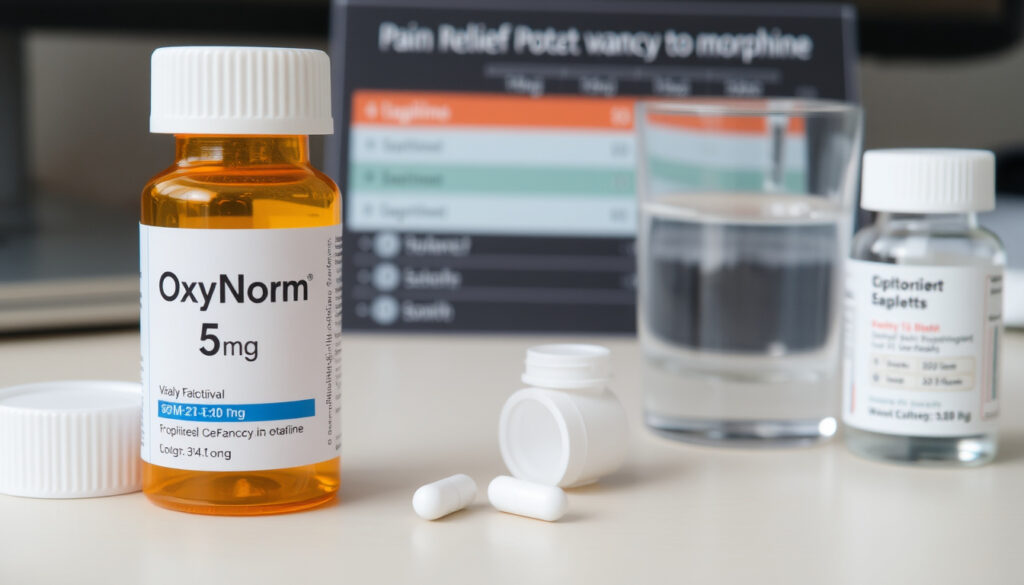
Few medications spark as many questions from patients as OxyNorm 5 mg — especially regarding its strength and comparison to morphine. According to the OxyNorm SmPC from the UK electronic Medicines Compendium (the official medicines database), the usual starting dose for opioid‑naive adults is 5 mg every 4 to 6 hours.
Active substance: Oxycodone hydrochloride ·
Strength: 5 mg per capsule ·
Drug class: Opioid analgesic ·
Indication: Moderate to severe pain (cancer, post‑operative) ·
Dosing interval: Every 4–6 hours ·
Prescription required: Yes (Schedule 8 controlled substance)
Quick snapshot
- OxyNorm 5 mg contains oxycodone hydrochloride (UK SmPC)
- Indicated for moderate to severe cancer and post‑operative pain (UK SmPC)
- Oral bioavailability of oxycodone is 60–87% (NCBI Bookshelf)
- Oxycodone is 1.5–2 times more potent than oral morphine (UK SmPC)
- Exact conversion ratio between oxycodone and morphine varies individually (UK SmPC)
- Long‑term efficacy data for OxyNorm 5 mg in non‑cancer pain is limited (West Midlands Palliative Care)
- Dosing interval: every 4–6 hours, maximum 6 doses per day (Belgian AFMPS leaflet)
- Analgesic effect peaks 1–2 hours after oral administration (UK SmPC)
- Patients should be monitored for analgesic response and side effects; dose titration may be needed (UK SmPC)
- If switching to another opioid, use equianalgesic conversion tables (West Midlands Palliative Care)
The following table summarizes the key specifications of OxyNorm 5 mg.
| Parameter | Value |
|---|---|
| Brand name | OxyNorm |
| Strength | 5 mg per capsule |
| Active ingredient | Oxycodone hydrochloride |
| Form | Capsule, immediate‑release |
| Prescription status | Prescription only (controlled substance) |
| Typical starting dose | 5 mg every 4–6 hours |
| Pregnancy category | D (risk to fetus) |
What is OxyNorm 5 mg?
Active ingredient overview
OxyNorm 5 mg is an immediate‑release capsule containing oxycodone hydrochloride. According to the OxyNorm SmPC from the UK electronic Medicines Compendium (the official medicines database), each capsule delivers 5 mg of oxycodone hydrochloride, equivalent to 4.48 mg of oxycodone base. The Swissmedic information page (the Swiss national medicines authority) confirms the same composition for both capsules and orodispersible tablets.
Opioid class and mechanism
Oxycodone is a strong opioid analgesic, classified as a Schedule 8 controlled substance in the UK and Australia. It works by binding to mu‑opioid receptors in the central nervous system, altering the perception of pain. The UK SmPC states that it is indicated for “the treatment of moderate to severe pain in patients with cancer and post‑operative pain.”
OxyNorm 5 mg is not a weak analgesic — it is a strong opioid that requires careful prescribing and monitoring. The 5 mg starting dose is the lowest marketed strength for opioid‑naive patients, but its potency relative to morphine means that even a small dose can produce significant relief.
The implication: Clinicians must recognize that 5 mg is a clinically meaningful opioid dose, not a subtherapeutic one.
How does OxyNorm work?
Mechanism of action of oxycodone
Oxycodone, like morphine, is a full mu‑opioid receptor agonist. Binding to these receptors in the brain and spinal cord reduces the transmission of pain signals. The MSD Manual (a standard clinical reference for professionals) lists oxycodone among the strong opioids with a defined equianalgesic dose.
Onset and duration of action
After oral administration, the analgesic effect of immediate‑release oxycodone peaks within 1–2 hours, and the duration of action is 4–6 hours. The UK SmPC recommends dosing every 4–6 hours as needed for pain. The Dutch patient leaflet (CBG‑MEB, the Netherlands Medicines Evaluation Board) states the same interval for the 5 mg instant formulation.
The pattern: The rapid onset and short duration fit the PRN (as‑needed) model for breakthrough pain.
Is OxyNorm 5 mg a strong painkiller?
Potency relative to other opioids
Yes, oxycodone is classified as a strong opioid by the World Health Organization (WHO) analgesic ladder. The UK SmPC notes that a common conversion used in clinical practice is 10 mg oral oxycodone equivalent to 20 mg oral morphine — making oxycodone roughly 1.5–2 times more potent by weight. The Dutch OxyNorm oral solution SmPC (from the Dutch Medicines Information Bank, the national regulatory database) repeats the same conversion ratio.
Clinical classification as a strong opioid
The 5 mg strength is a low starting dose for opioid‑naive patients, but it is not a weak dose. The West Midlands Palliative Care Professionals (a regional UK clinical guidance network) lists OxyNorm immediate‑release capsules in 5 mg, 10 mg, and 20 mg strengths for PRN (as‑needed) use, confirming that even the 5 mg capsule is a clinically relevant strong opioid dose.
The 1.5–2× potency advantage means that a patient switching from morphine to oxycodone needs a lower milligram dose to achieve the same pain relief. Forgetting this conversion can lead to overdosing or underdosing — a critical safety point for clinicians.
The catch: Potency comparisons are population averages; individual titration remains mandatory.
Is OxyNorm the same as morphine?
Chemical differences between oxycodone and morphine
No, they are distinct molecules. Oxycodone (C₁₈H₂₁NO₄) is a semi‑synthetic opioid derived from thebaine, while morphine (C₁₇H₁₉NO₃) is a natural alkaloid from opium. The NCBI Bookshelf (the U.S. National Library of Medicine’s clinical reference) provides equianalgesic tables that treat them as separate agents with different conversion factors.
Differences in pharmacokinetics and side effects
Oxycodone has higher oral bioavailability (60–87%) compared to morphine (20–40%), meaning a larger fraction of the oral dose reaches the bloodstream. The UK SmPC does not list morphine as an interchangeable equivalent; instead, it provides a specific conversion ratio. Side effect profiles also differ: oxycodone may cause less histamine release and pruritus than morphine, according to clinical experience.
The pattern: Chemical and pharmacokinetic differences justify separate prescribing guidelines and caution when switching.
Which is stronger: OxyNorm or morphine?
Equianalgesic dose conversion
Based on the conversion from the UK SmPC and confirmed by the Dutch SmPC, 10 mg oral oxycodone equals 20 mg oral morphine. Therefore, 5 mg oral oxycodone is approximately equivalent to 7.5–10 mg oral morphine. The exact ratio can vary between individuals, but the established clinical consensus is that oxycodone is 1.5–2 times more potent.
Clinical trial comparisons
The MSD Manual equianalgesic table lists oral morphine 30 mg as equivalent to parenteral morphine 10 mg, and oral oxycodone 20 mg as equivalent to oral morphine 30 mg — again supporting the 1.5× ratio. Individual response, however, can differ due to genetics, tolerance, and concurrent medications.
One pattern emerges from the regulatory data across Europe: the 1:2 ratio (oxycodone:morphine) is consistently used, but always with a note that individual titration is required.
| Attribute | OxyNorm 5 mg (oxycodone) | Oral morphine (equivalent dose) |
|---|---|---|
| Equianalgesic dose (5 mg oxycodone) | 5 mg | 7.5–10 mg |
| Oral bioavailability | 60–87% | 20–40% |
| Time to peak effect | 1–2 hours | 0.5–1.5 hours |
| Duration of action | 4–6 hours | 3–6 hours |
| Risk of dependence | High | High |
| Common conversion factor used in SmPCs | 10 mg oxycodone = 20 mg morphine | — |
Another set of specifications clarifies the exact formulation of OxyNorm 5 mg in different markets.
| Specification | Value |
|---|---|
| Active ingredient per capsule | 5.00 mg oxycodone hydrochloride (anhydrous) |
| Oxycodone base equivalent | 4.48 mg |
| Formulation type | Immediate‑release capsule |
| Available strengths (capsules) | 5 mg, 10 mg, 20 mg |
| Oral solution concentration | 1 mg/ml (standard), 10 mg/ml (concentrated) |
| Orodispersible tablet strength | 5 mg, 10 mg, 20 mg |
| Prescription classification | Controlled drug (Schedule 8 in UK, equivalent in EU) |
| Pregnancy category | D (risk to fetus) |
The implication: Any switch between oxycodone and morphine must use the 1:2 ratio as a starting point, with close monitoring.
What are the side effects of OxyNorm 5 mg?
Common side effects
The most frequently reported side effects include nausea, constipation, dizziness, somnolence, and headache. The UK SmPC lists these as very common (≥1/10). Constipation is particularly common and often requires prophylactic laxative use.
Serious risks (dependence, respiratory depression)
As with all opioids, OxyNorm carries a risk of dependence, addiction, and respiratory depression. The Belgian AFMPS/FAGG patient leaflet (the Belgian Federal Agency for Medicines and Health Products) warns: “This medicine contains oxycodone, which is an opioid. It can cause dependence and/or addiction.” Respiratory depression is dose‑dependent and is more likely in the elderly, debilitated, or those with pre‑existing respiratory conditions.
The pattern: Side effects are typical of strong opioids; constipation and dependence require proactive management.
What is the recommended dosage for OxyNorm 5 mg?
Starting dose for opioid‑naive adults
The UK SmPC states: “The usual starting dose for opioid‑naive adults is 5 mg every 4 to 6 hours.” The Dutch patient leaflet (CBG‑MEB) and the Belgian leaflet (AFMPS/FAGG) both mirror this recommendation, with the Belgian leaflet adding that the interval may be reduced to 4 hours if necessary, but not to take more than six doses per day.
Dosing adjustments and maximum daily dose
Titration should be guided by pain severity and response. The maximum daily dose for immediate‑release oxycodone is generally 400 mg, but this is rarely reached in clinical practice. Patients should not exceed the prescribed dose without consulting their doctor. The Northern Cancer Alliance NHS palliative care guidelines use immediate‑release oral morphine 2.5–5 mg PRN for breakthrough pain, highlighting that even lower doses can be effective in certain populations.
Confirmed facts
- OxyNorm 5 mg contains oxycodone hydrochloride (UK SmPC)
- Indicated for moderate to severe cancer and post‑operative pain (UK SmPC)
- Oral bioavailability of oxycodone is 60–87% (NCBI Bookshelf)
- Oxycodone is 1.5–2 times more potent than oral morphine (UK SmPC)
What’s unclear
- Exact conversion ratio between oxycodone and morphine varies individually (UK SmPC)
- Long‑term efficacy data for OxyNorm 5 mg in non‑cancer pain is limited (West Midlands Palliative Care)
- Conversion ratio may vary based on patient genetics, renal function, and concomitant medications
- Maximum daily dose of 400 mg is a general guideline and individual tolerance may differ
The catch: Despite clear guidelines, individual response variability means that the 5 mg starting dose may need adjustment upward or downward based on age, comorbidities, and prior opioid exposure.
“For the treatment of moderate to severe pain in patients with cancer and post‑operative pain.”
— Medicines.org.uk OxyNorm SmPC (official UK prescribing information)
“This medicine contains oxycodone, which is an opioid. It can cause dependence and/or addiction.”
— HPRA patient information leaflet from the Belgian AFMPS/FAGG (national medicines agency)
For patients with moderate to severe cancer pain, the choice between OxyNorm and morphine is often guided by individual response and tolerability. The data show that OxyNorm 5 mg is a potent option, but it requires careful titration and monitoring for dependence. For prescribers, the implication is clear: start low, go slow, and always use an equianalgesic conversion when switching opioids — or risk under‑ or overdosing.
geneesmiddeleninformatiebank.nl, rejestrymedyczne.ezdrowie.gov.pl, northerncanceralliance.nhs.uk, pro.medicin.dk, drugs.com, db.cbg-meb.nl
Frequently asked questions
Can I break or crush OxyNorm capsules?
No. The UK SmPC advises that capsules should be swallowed whole with water. Crushing or chewing can lead to rapid release of the entire dose, increasing the risk of overdose.
How long does OxyNorm 5 mg stay in your system?
The elimination half‑life of oxycodone is approximately 3–5 hours. It can be detected in urine for 1–2 days after the last dose, depending on the test sensitivity.
Can I take OxyNorm with paracetamol?
Yes, but only under medical supervision. Paracetamol is not an opioid and does not interact directly, but combination products should be monitored to avoid exceeding the maximum daily paracetamol dose.
Does OxyNorm cause constipation?
Yes, constipation is one of the most common side effects of all opioids, including OxyNorm. The UK SmPC lists it as very common (≥1 in 10 patients). Prophylactic laxatives are often recommended.
Can I drink alcohol while taking OxyNorm?
No. Alcohol can enhance the central nervous system depressant effects of oxycodone, increasing the risk of respiratory depression, sedation, and overdose.
Is OxyNorm safe for elderly patients?
Elderly patients may be more sensitive to the effects of oxycodone. The UK SmPC recommends a lower starting dose and careful titration in this population.
How do I stop taking OxyNorm safely?
Do not stop abruptly. Gradual dose reduction under medical supervision is required to avoid withdrawal symptoms. The UK SmPC contains guidance on tapering.
More related posts
 Liverpool F.C. vs Real Madrid: Results, H2H & History
 Codes for Grow a Garden 2: Active Codes (July 2026)
 Sam Rivers Cause of Death: Limp Bizkit Bassist Dies at 48
 Love Holidays Cancellation Policy: Fees, Refunds & How to Cancel
 Bank of Ireland Share Chat – Investor Forums and Stock Analysis
 Stir Fry Sauce Recipe: Basic, 3-Ingredient, and More
 Law Society of Ireland: Complaint , Co t & Key Rule
