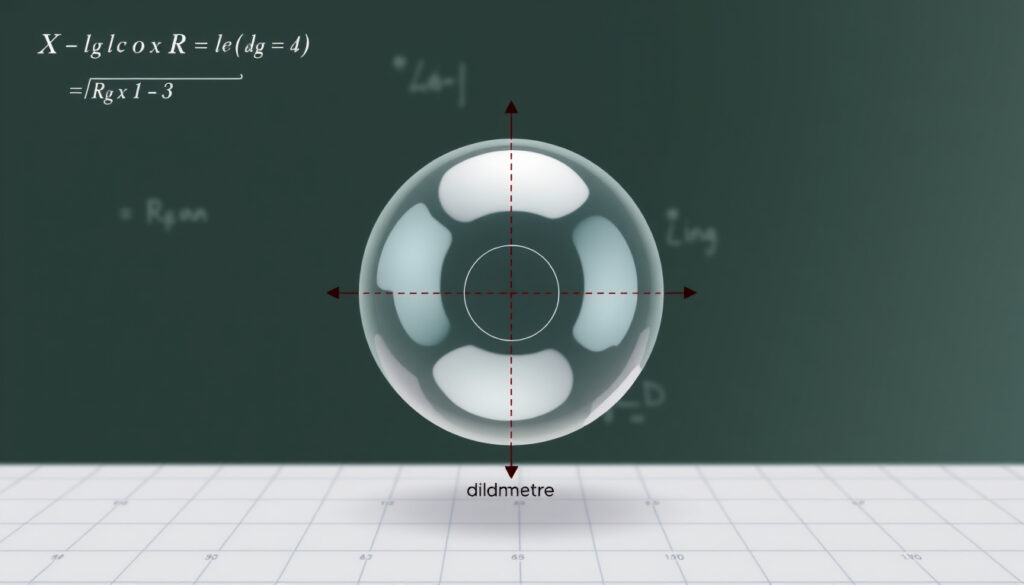
Volume of a Sphere: Formula, Derivation, and Examples
Few formulas in math feel as satisfying as the one for a sphere’s volume — neat, elegant, and surprisingly old. Whether you’re sizing up a basketball or calculating tank capacity, V = 4/3 π r³ is the key, and the radius does all the heavy lifting.
Formula: V = 4/3 π r³ ·
Inventor: Archimedes (c. 250 BCE) ·
Earth’s volume: ≈ 1.083 × 10¹² km³ ·
Relation to cylinder: Sphere volume = 2/3 of circumscribed cylinder ·
Dimension: 3-dimensional (3D)
Quick snapshot
- V = 4/3 π r³ BYJU’S (Indian educational platform)
- Only the radius is needed Khan Academy (free online learning platform)
- Works for any perfect sphere Omni Calculator (online mathematics tool)
- Calculus integration of disk cross-sections BYJU’S
- Alternative using diameter: V = (1/6) π d³ Omni Calculator
- Archimedes’ original proof (c. 250 BCE) Wikipedia (open encyclopedia)
- Soccer ball (r=4.4″) volume ≈ 357 in³ Omni Calculator
- Radius=10 in gives V ≈ 4188.79 in³ YouTube (math tutorial channel)
- Cell biology: volume affects diffusion rates Khan Academy
- Water displacement with a sphere model Khan Academy
- Relate to cylinder volume BYJU’S
- Use online calculators for exploration Calculator Soup (free online calculators)
The following table summarizes key facts about sphere volume.
| Label | Value |
|---|---|
| Standard Formula | V = (4/3)πr³ BYJU’S |
| Archimedes’ Discovery | c. 250 BCE Wikipedia |
| Dimension | 3D (three-dimensional) Omni Calculator |
| Symbol | π (pi ≈ 3.14159) – universal constant |
How do you find the volume of a sphere?
Step-by-step calculation
- Identify the radius r (if diameter is given, halve it) YouTube (Calculate Volume of Sphere)
- Cube the radius: r³
- Multiply by (4/3)π BYJU’S
For example, a sphere with radius 10 inches:
- Cube: 10³ = 1000
- Multiply: (4/3)π × 1000 ≈ 4188.79 cubic inches YouTube (Volume of a Sphere)
Example problems
- Size 5 soccer ball (r = 4.4 in): V ≈ 357 in³ Omni Calculator
- Circumference given (c = 10): r = c/(2π) ≈ 1.59, V ≈ 16.89 cubic units Omni Calculator
- Diameter 18: r = 9, V = (4/3)π(729) ≈ 3053.63 YouTube
The implication: just two numbers – the radius and π – unlock any sphere’s interior space.
What is the volume of the sphere?
Understanding the formula
The volume of a sphere is the total three-dimensional space enclosed by its surface. It depends on the cube of the radius – double the radius, and the volume multiplies by eight. The formula is dimensionally consistent: volume always comes out in cubic units BYJU’S.
Units of volume
- Cubic metres (m³), cubic centimetres (cm³), litres (L)
- Example: a sphere of radius 1 m has volume (4/3)π ≈ 4.19 m³, about 4190 litres
- Cell biology uses µm³ (micrometres cubed) Khan Academy
What this means: the formula works across all scales, from microscopic cells to planetary spheres.
Why is 4:3 used in the volume of a sphere?
Derivation using integration
The constant 4/3 comes from integrating circular cross-sections. Consider a sphere of radius R; the area of a horizontal slice at height y is π(R² − y²). Summing these from −R to R gives V = ∫_{-R}^{R} π(R² − y²) dy = (4/3)πR³ BYJU’S.
Archimedes’ proof
Archimedes (c. 250 BCE) showed that a sphere’s volume is exactly 2/3 the volume of its circumscribed cylinder – a result he considered his greatest achievement Wikipedia. That ratio, 2/3, translates to 4/3 in the final formula when expressed in terms of the radius.
The pattern: the 4 in the numerator and the 3 in the denominator are not arbitrary – they are a direct consequence of geometry and calculus.
How do you find the volume of a hollow sphere?
Hollow sphere formula
A hollow sphere (spherical shell) has volume V = (4/3)π(R³ − r³), where R is the outer radius and r is the inner radius Wikipedia (Spherical shell). This is simply the solid sphere volume minus the inner cavity volume.
Practical example
- Outer radius 10 cm, inner radius 8 cm: V = (4/3)π(1000 − 512) = (4/3)π(488) ≈ 645.9 cm³
- Used in tank design, piping, and lightweight construction
The catch: hollow spheres are everywhere – from soccer balls to gas tanks – and the formula accounts for the material used, not the empty space.
How did Archimedes calculate the volume of a sphere?
The method of mechanical theorems
Archimedes used a thought experiment: he imagined balancing a sphere, a cone, and a cylinder on a lever. By comparing areas and using his principle of leverage, he derived the relationship Wikipedia (The Method of Mechanical Theorems). This method, described in his lost work “The Method,” anticipated integral calculus by nearly 2000 years.
Relation to cone and cylinder
He proved that the volume of a sphere is 2/3 of the volume of a cylinder that exactly encloses it, and that the cone with the same base and height fills the remaining 1/3 Wikipedia. This elegant ratio was found without any algebra as we know it today.
Why this matters: Archimedes didn’t just find the answer – he built a logical framework that mathematicians would rely on for centuries.
How to teach volume of sphere?
Hands-on activities
- Fill a hollow sphere with water and pour into a cylinder to compare volumes Khan Academy
- Use 3D-printed models that nest inside cylinders
- Show that doubling the radius multiplies volume by 8 – visible with stacking cubes
Visual aids and models
- Interactive online calculators let students change radius and see volume instantly Calculator Soup
- Compare sphere, hemisphere, and cylinder with same radius BYJU’S
- Derive the formula step by step using calculus integration – for advanced students
The trade-off: hands-on activities take time but build intuition that lasts far longer than rote memorisation.
For unit conversions related to volume calculations, see our guide on 3 Miles in KM: Exact 4.828 km Conversion + Fitness Guide.
Clarity Check
Confirmed facts
- Volume formula is exact for perfect spheres BYJU’S
- Archimedes first derived it rigorously (c. 250 BCE) Wikipedia
- Formula is dimensionally consistent (cubic units) BYJU’S
What’s unclear
- Exact method Archimedes used in “The Method” (lost then rediscovered)
- Whether the formula was independently discovered earlier in other cultures
- Whether the formula was known in earlier civilizations like Babylon or India
The sphere volume formula is not just a mathematical curiosity – it’s a practical tool used by engineers, biologists, and physicists every day. Understanding its derivation turns a memorised equation into an insightful tool.
Quotes & Perspectives
“The sphere is the most perfect of all solids – it has the greatest volume for a given surface area.”
– Archimedes (as recorded by Plutarch, Wikipedia)
“Only the radius is needed for volume calculation using V = 4/3 π r³.”
– Khan Academy (free online learning platform)
Frequently Asked Questions
What is the volume of a sphere with radius 5?
V = (4/3)π(125) ≈ 523.6 cubic units. Omni Calculator
How do you find the volume of a sphere using diameter?
Halve the diameter to get radius, then apply V = (4/3)πr³. Alternatively, V = (1/6)πd³. Omni Calculator
What is the volume of a sphere in liters?
Convert cubic meters to liters (1 m³ = 1000 L). For example, radius 1 m yields about 4190 L.
Can you find the volume of a sphere without calculus?
Yes, through Archimedes’ mechanical method or by using the relationship with a cylinder. Wikipedia
What is the difference between volume and surface area of a sphere?
Volume measures the interior space (cubic units), while surface area measures the outer shell (square units). Formula for surface area is A = 4πr². Calculator Soup
How do you calculate the volume of a sphere in terms of pi?
Keep π in the answer. Example: radius 3 → V = (4/3)π(27) = 36π cubic units.
What is the volume of a hemisphere?
Half the volume of a sphere: V_hemisphere = (2/3)πr³. BYJU’S
Students who engage with these methods gain a lasting understanding of the formula and its derivation.
More related posts
 Father’s Day Gift Ideas: What Irish Dads Want in 2026
 William, Prince of Wales: Facts vs Health Rumors
 Dara Calleary Welfare Payment Delay and Budget 2026: Key Changes
 How to Write a Cover Letter for Your CV: Examples & Tips
 Generators for Sale Ireland: A Complete Guide to Sizing & Buying
 Technological University of the Shannon: Rankings & Facts
 Sky TV Channel Changes 2026: New Channels & Sky Q Phase-Out
 Brentford vs Man City Timeline: Head to Head Results
