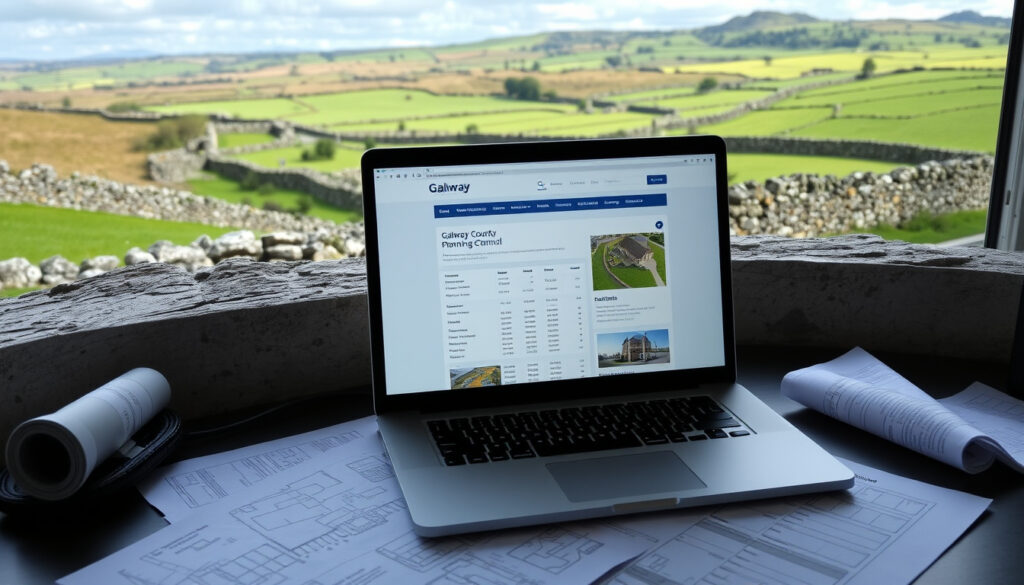
Galway County Council Planning – Applications, Fees, Portal Guide
Galway County Council manages planning permission applications through a standardized process established under Irish planning regulations. Applicants submit proposals to the Planning Department at Áras an Chontae, Prospect Hill, where officials review valid submissions against local development plans and national guidelines. The council typically reaches decisions within 12 weeks of receiving a complete application, though complexity and public interest can influence timelines.
Property owners, developers, and residents throughout County Galway can access planning services through the council’s online portal at galway.ie. The system accommodates various development types, from domestic extensions to commercial constructions, with fees calculated according to the scale and nature of each project.
Those considering a project should understand that planning requirements extend beyond the application itself. Public consultation periods allow neighbours and interested parties to submit observations, and appeals to An Bord Pleanála remain available for applicants or objectors who disagree with council decisions. The process rewards careful preparation and familiarity with relevant regulations.
How Do I Apply for Planning Permission with Galway County Council?
The application process begins with completing the official planning application form and assembling required documentation. Applicants must submit detailed plans, drawings, and site maps alongside newspaper and site notices confirming public awareness of the proposal. The appropriate fee, calculated based on development classification, accompanies the application package.
Applications proceed through distinct assessment stages once received. The Planning Department first validates submissions to ensure all required materials and fees are present. Public notice follows validation, providing community members opportunity to review proposals. Council planners may request further information if deficiencies emerge, and applicants must respond within specified deadlines to avoid application invalidation. A final decision grants or refuses permission based on the evidence and planning policy.
- Valid applications typically receive decisions within 12 weeks under standard processing
- Fees range from €34 minimum for minor domestic works to maximum €38,000 for large-scale developments
- Outline applications require three-quarters of the full fee at initial submission
- Third-party objections incur a €20 submission fee during the five-week consultation window
- Retention fees for unauthorised developments apply at three times the standard rate
- Section 5 declarations for exempted development queries cost €80, with decisions issued within four weeks
- Appeals to An Bord Pleanála require €210 fees for Section 5 decisions
| Element | Details |
|---|---|
| Portal URL | www.galway.ie |
| Contact Address | Áras an Chontae, Prospect Hill, Galway H91 H6KX |
| Standard Timeline | Up to 12 weeks from valid application |
| Minimum Fee | €34 (domestic extensions) |
Where Can I View Current Planning Applications in Galway?
Galway County Council maintains accessible records of planning applications and decisions through its online platforms. The primary portal at galway.ie allows users to search current and historical applications by location, type, or status. The site displays application details, submitted documents, officer reports, and final determinations.
The separate consultation portal at galwaycountyppn.ie provides additional public consultation materials, including newspaper notices and planning briefs for significant developments. Weekly application lists can be purchased for €10, while annual subscriptions cost €100 for those requiring regular monitoring of new submissions.
Understanding Planning Decision Categories
Planning decisions fall into several categories that affect what permissions allow. Grant decisions permit the proposed development subject to conditions, which developers must follow during implementation. Refusal decisions prevent the development unless successfully appealed to An Bord Pleanála. Some permissions include specific expiry dates requiring development to commence within a defined period, typically five years.
Checking Application Status
Applicants and interested parties can track application progress through the online portal. Status updates reflect each stage of assessment, from initial validation through any requests for further information through to final determination. All observations submitted by third parties appear alongside applications, providing transparency about community responses to proposals.
Approved decisions and associated conditions remain publicly accessible through the planning portal. Weekly and monthly application lists are available for purchase, with annual subscription options offering better value for regular users such as agents, developers, and community groups.
How Long Does the Planning Permission Process Take in Galway County?
Galway County Council commits to deciding valid planning applications within 12 weeks of receipt. This timeline applies from the moment the Planning Department confirms an application contains all required materials, fees, and notices. Incomplete submissions delay the process until deficiencies are remedied, as applications cannot proceed to assessment while missing elements remain outstanding.
Galway City Council, operating under separate administration, targets an eight-week decision timeframe for standard applications. Applicants should verify which authority serves their location, as boundary definitions affect which council processes proposals. The county and city operate distinct planning departments with separate online presences despite serving adjacent areas.
Fees for Galway County Council Planning Applications
Planning fees follow Schedule 9 of the Planning and Development Regulations 2001, with amounts determined by development classification. The minimum fee of €34 applies to domestic extensions, while dwelling applications cost €65 per unit. Commercial and office developments require €80 per building or €3.60 per square metre of gross floor space, whichever produces the higher amount.
| Development Class | Type | Standard Fee | Retention Fee |
|---|---|---|---|
| Class 1 | Dwelling | €65 per unit | €195 or €2.50/m² |
| Class 2 | Domestic extension | €34 per unit | €102 or €2.50/m² |
| Class 4 | Offices/commercial | €80 or €3.60/m² | €240 or €10.80/m² |
| Class 5 | Agriculture/forestry | €5 per hectare | €15 per hectare |
| Class 9 | Advertising | €80 or €20/m² | €240 or €60/m² |
| Class 13 | Other works | €80 or €10/0.1ha | €240 or €30/0.1ha |
Gross floor space for fee calculation purposes is measured inside external walls. For developments involving both standard and retention components, fees accumulate separately. Applications requiring amendment after decision incur additional charges if significant changes necessitate fresh assessment.
How to Object to a Planning Application in Galway?
Third parties wishing to object to planning applications submit observations during a dedicated consultation period. This window opens when the council validates an application and publishes its details through the planning portal. Interested parties have five weeks from application notice to file formal objections, with submissions requiring a €20 fee per observation.
Objections must be submitted in writing, either electronically through the planning portal or by post to the Planning Department. All observations become part of the public record and appear alongside the application materials. Council planners consider these submissions when preparing recommendations to elected members or, for certain application types, when reaching decisions under delegated authority.
Grounds for Objection and Policy Considerations
Valid planning objections typically address issues related to local development plans, national planning guidance, or material impacts on neighbours and surroundings. Common grounds include concerns about traffic generation, visual impact, noise or disturbance, flooding risk, and consistency with the character of an area. Objections based on personal disputes or matters outside planning remit generally carry less weight in assessments.
Those considering objections should review the development plan for their area, examining policies relevant to the proposal type and location. The Planning and Development Act 2001 and associated regulations provide the legislative framework within which objections are evaluated. Supporting evidence, including photographs, technical assessments, or expert reports, strengthens objections considerably.
Appealing Decisions to An Bord Pleanála
Both applicants refused permission and objectors dissatisfied with grant decisions may appeal to An Bord Pleanála, the national planning appeals board. Appeals must be lodged within four weeks of the council decision and require the relevant fee. The board reviews the original application, council reasoning, and any third-party observations before reaching an independent determination.
Strict deadlines apply throughout the planning process. Applications missing required information may be deemed invalid. Responses to requests for further information must arrive within specified timeframes or the application lapses. Objections submitted after the five-week window closes are generally not accepted.
How to Access the Galway County Council Planning Portal and Contacts?
The main planning portal at galway.ie provides the primary interface for submitting applications, searching records, and checking status. Users create accounts to track submissions, receive updates on application progress, and manage documentation. The site also hosts application forms, fee schedules, and guidance documents.
Physical submissions remain possible by post or delivery to the Planning Department at Áras an Chontae, Prospect Hill, Galway H91 H6KX. Staff can be contacted through the general planning email for queries about specific applications or procedural questions. For those applying through certain grant schemes, pre-planning consultation meetings with council officers provide valuable guidance before formal submission.
- Online portal: galway.ie
- Address: Áras an Chontae, Prospect Hill, Galway H91 H6KX
- Consultation portal: galwaycountyppn.ie
- Additional contact options include local authority offices and planning agents
Key Stages in the Planning Timeline
Understanding the sequence of planning assessment helps applicants anticipate next steps and prepare accordingly. Each stage carries specific requirements and time allowances that affect overall duration.
- Pre-application preparation — Assemble required documents, confirm development type, calculate appropriate fee
- Application submission — Submit form, plans, notices, and fee to Planning Department
- Validation — Council confirms application completeness within days of receipt
- Public consultation — Five-week window for third-party observations
- Assessment and RFI — Planners review and may request further information
- Decision — Grant or refusal issued within 12-week target period
- Appeal period — Four weeks for appeals to An Bord Pleanála
Developers pursuing larger projects may benefit from pre-planning consultations with council officers, particularly for controversial or complex proposals. These meetings identify potential issues early, allowing redesign before formal submission incurs fees and starts statutory timelines.
What Is Certain and What Remains Unclear About Galway Planning
The planning process operates within established legal frameworks, though practical outcomes involve variables outside council control. Applicants benefit from understanding what is fixed versus what depends on circumstances.
| Established Information | Variables and Uncertainties |
|---|---|
| 12-week decision target for valid applications | Actual processing time may exceed target for complex cases |
| Fee structure per Schedule 9 regulations | Final fees may increase if application requires amendment |
| Five-week objection period from notice | Number and nature of objections cannot be predicted |
| Right to appeal to An Bord Pleanála | Appeal outcomes depend on board assessment |
| Section 5 decisions within 4 weeks | 2025 policy updates not confirmed in available sources |
Fees listed in official schedules remain current, with the council’s scale of fees document confirming amounts effective from April 2023. Annual service delivery plans reference standard processes without announcing major changes to procedure or fees.
The Role of Irish Planning Law in Galway Applications
Galway County Council operates within the national planning framework established by the Planning and Development Act 2001 and associated regulations. This legislation sets core requirements for application submission, public consultation, decision-making criteria, and appeal mechanisms. County-level development plans, prepared under the Act, establish local policies that guide assessments of individual proposals.
The Galway County Development Plan 2022-2028 outlines strategic objectives for the county, including housing provision, economic development, environmental protection, and infrastructure investment. Planning applications are assessed against these policies alongside national guidance from the Department of Housing and the National Planning Framework. Consistency with development plan policies strengthens applications considerably.
Proposals that align with stated development plan policies and national planning objectives generally face smoother assessment. Applicants uncertain about policy requirements can request pre-application consultations or review the development plan before submitting proposals.
Information Sources and Official References
Galway County Council publishes planning information through its official website, with forms, fee schedules, and guidance documents available for download. The gov.ie platform provides additional procedural guidance for those navigating the application process. The national planning portal offers searchable databases of applications across all local authorities.
Applications are assessed in stages: validation, public notice, further information requests if needed, and decision. Valid applications are decided within 12 weeks.
— Galway County Council Planning Guidance
The Planning and Development Regulations 2001 (as amended) govern fee structures and procedural requirements. Schedule 9 specifically details fee calculations by development class, with amounts updated periodically through statutory instruments. Applicants should verify current fees against official schedules, as charges may change following legislative amendments.
An Bord Pleanála serves as the national appellate body for planning decisions, with its own guidance documents and application procedures available at anbordpleanala.ie. The board’s decisions establish precedent that influences how local authorities approach similar cases.
Summary: Navigating Galway County Council Planning
Planning permission with Galway County Council involves submitting a complete application package through the official portal or by post to the Planning Department. Applications undergo validation, public consultation, assessment, and determination within a 12-week target period. Fees vary according to development classification, ranging from €34 for domestic extensions to significantly higher amounts for large commercial projects.
Third parties may object during a five-week consultation window, with appeals to An Bord Pleanála available for dissatisfied applicants or objectors. Access to application records, status checking, and submission facilities occurs through galway.ie, where guidance documents and forms support applicants through each stage. Those seeking additional local services may find relevant information through the Today Death Notices Galway – 7 New Tributes April 10 section or the HSE Civil Registration Service – Births Deaths Marriages Guide for related administrative needs.
Frequently Asked Questions
What documents are needed for a planning application?
Required documents typically include the official planning application form, site plans, architectural drawings, newspaper and site notices, and the appropriate fee. Additional materials may include ecological assessments, traffic impact studies, or drainage proposals depending on development scale and location.
Can I appeal a planning refusal in Galway?
Yes. Applicants refused permission may appeal to An Bord Pleanála within four weeks of the decision. Objectors who believe a grant was inappropriate may also appeal. The appeals board conducts an independent review and can uphold, vary, or reverse the original decision.
Are there exemptions from planning permission?
Certain minor developments fall outside planning control under exempted development provisions. Homeowners undertaking small domestic extensions, sheds, or boundary works may qualify. A Section 5 declaration from the council confirms whether works are exempt, with the €80 fee applicable.
How do I check the status of my planning application?
The online planning portal at galway.ie provides real-time status updates for submitted applications. Search by application reference number or address to view current stage, any outstanding requirements, and final determinations once issued.
What happens if my planning permission expires?
Permissions typically include an expiry date, commonly five years from grant date. Development must commence before this deadline or a fresh application becomes necessary. Changes to approved plans may also require new applications.
Can I submit planning applications online?
Yes. Galway County Council accepts applications through its online portal, where users create accounts, upload documentation, and pay fees electronically. Physical submissions by post or delivery remain available for those preferring paper applications.
What are the fees for planning objections?
Third parties submitting objections or observations pay €20 per submission. This fee is non-refundable regardless of the objection outcome. All observations become part of the public record accessible through the planning portal.
More related posts
 Galaxy Note 20 to Buy: Prices, Support & S22 Comparison in 2025
 How Great Thou Art Lyrics: Origin, Story, and Full Text
 Ireland to Scotland Ferry: Routes, Prices, Timetables & Tips
 Home Insurance Quotes Ireland 2025: Compare Prices
 Claire Cullen Dominican Republic: Hit-and-Run Tragedy
 Bank of Ireland Share Chat – Price, News and Investor Forums
 Stephen’s Green Shopping Centre: Dublin’s €100m Revamp
 How to Upload Contacts to Gmail: Step-by-Step Guide
