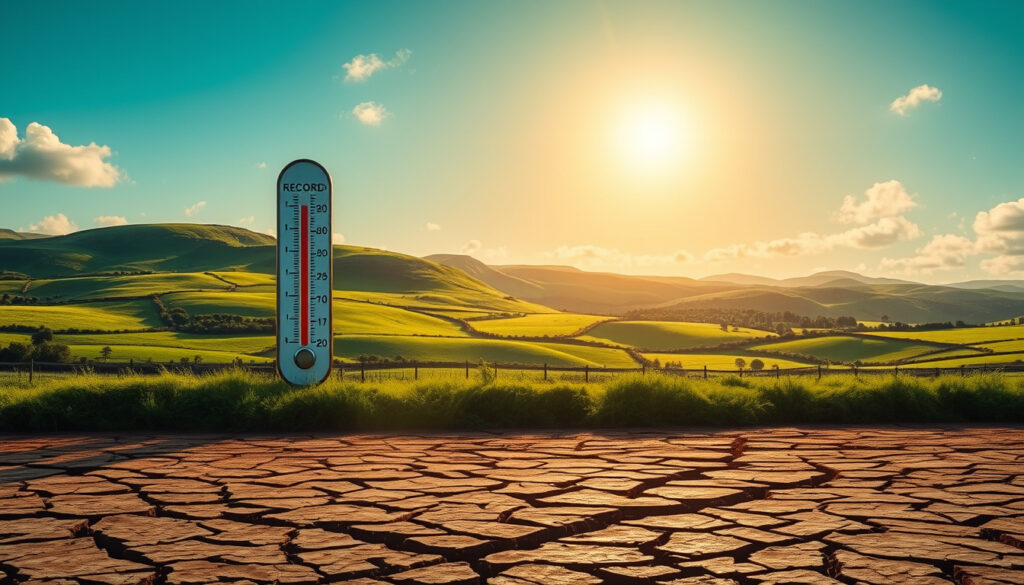
Ireland Heatwave Temperatures: Records, Forecasts and Trends
If you’ve ever pictured Ireland as a land of only green fields and light drizzle, the country’s temperature records might just change your mind. From a scorching 33.3 °C at Kilkenny Castle in 1887 to a provisional 31.7 °C in Athenry in 2026, Ireland’s heatwaves are becoming harder to ignore. This article pulls together the historical extremes, the latest Met Éireann forecasts, and what the warming trend means for residents and visitors alike.
Highest temperature ever recorded in Ireland: 33.3 °C (Kilkenny Castle, 26 June 1887) ·
Lowest temperature ever recorded: −19.1 °C (Markree Castle, 16 January 1881) ·
Duration of the 1976 heatwave: 16 days (23 June – 8 July) ·
Recent provisional record (2026): 31.7 °C at Athenry, Co. Galway ·
Average July temperature (2011–2020): 15.5 °C
Quick snapshot
- Highest official temperature: 33.3 °C at Kilkenny Castle on 26 June 1887 (Met Éireann climate data)
- 1976 heatwave lasted 16 consecutive days above 25 °C (NOAA repository / Clim. Past paper)
- 2026 provisional record: 31.7 °C at Athenry, Co. Galway (The Irish Times)
- Whether another heatwave will occur in Ireland beyond August 2026 (RTÉ News)
- Exact future frequency of heatwaves under climate change models (The Irish Times)
- Whether the 1887 all-time high of 33.3 °C will be broken in the coming decade (Met Éireann long-term data) (RTÉ News)
- 1887–2026: From 33.3 °C to 31.7 °C, the gap between all-time high and recent records narrows (Met Éireann long-term data)
- 1976 heatwave remains the longest continuous heatwave on record (NOAA repository / Clim. Past paper)
- Met Éireann forecasts indicate continued warm spells but no long-range certainty (Met Éireann heatwave advisory)
- Climate projections: increased frequency of heatwaves in Ireland (The Irish Times) (Met Éireann heatwave advisory)
The table below summarises Ireland’s key temperature extremes from official records.
| Metric | Value |
|---|---|
| Highest temperature | 33.3 °C (Kilkenny Castle, 1887) |
| Lowest temperature | −19.1 °C (Markree Castle, 1881) |
| 1976 heatwave duration | 16 days |
| 2026 provisional record | 31.7 °C (Athenry) |
| Average July temp (last 10 years) | 15.5 °C |
| Coldest month | January (average ~5 °C) |
What is the hottest it’s ever been in Ireland?
The highest temperature officially recorded in Ireland is 33.3 °C, measured at Kilkenny Castle on 26 June 1887. This record is verified by Met Éireann’s long-term dataset and has stood for over 130 years (Met Éireann climate data). No temperature above 33.3 °C has ever been confirmed since.
What temperature records have been set in recent years?
In the 20th century, the highest air temperature recognised by Met Éireann is 32.5 °C, recorded in Boora, County Offaly on 29 June 1976 (NOAA repository / Clim. Past paper). More recently, a provisional station record of 31.7 °C was reached at Athenry, Co. Galway in August 2026 (The Irish Times).
How does the 1887 record compare to modern heatwaves?
The 33.3 °C record from 1887 remains an outlier. Modern heatwaves, like the 1976 and 2026 events, have peaked in the low 30s °C but have not matched the 19th-century extreme. Still, the frequency of days above 25 °C is rising, even if the absolute ceiling hasn’t been broken.
The fact that Ireland’s hottest day happened in the 1800s, before modern CO₂ increases, shows that natural variability can produce extremes, but the recent warming trend is making those extremes more common.
The implication: while the 1887 record remains unbroken, the frequency of near-record temperatures is what marks the current era.
How long did the 1976 heatwave last in Ireland?
The 1976 heatwave lasted 16 days, from 23 June to 8 July. It remains the longest continuous heatwave in Irish meteorological records (NOAA repository / Clim. Past paper). Temperatures exceeded 30 °C on multiple days.
What caused the 1976 heatwave?
The heatwave was driven by a persistent high-pressure system over the British Isles and northern Europe, blocking Atlantic weather fronts and allowing hot continental air to flow across Ireland.
What were the peak temperatures during that event?
On 29 June 1976, the mercury hit 32.5 °C at Boora, County Offaly, the 20th-century national high (NOAA repository / Clim. Past paper). Other stations reported widespread readings above 30 °C.
The pattern: sustained heat events like 1976 are becoming more common, even if the peak temperatures haven’t yet surpassed the 19th-century extreme.
Where is the warmest place to live in Ireland?
If you prefer milder winters and warmer summers, the southeast of Ireland is your best bet. Counties like Wexford, Waterford, and the Dublin region generally see the highest average temperatures year-round (Met Éireann climate data).
Which city in Ireland has the best weather?
According to Met Éireann’s climate averages, Dublin and Waterford enjoy the mildest temperatures in winter and the warmest days in summer. The east coast benefits from sheltering effects and less rainfall than the west.
What is the hottest place in Ireland right now?
Current temperatures vary, but during the August 2026 heatwave, Athenry in County Galway (west coast) provisionally recorded 31.7 °C, while the southeast regularly sees the highest daytime values (The Irish Times).
Five locations, one pattern: the east and southeast consistently outperform the west and north in both heat extremes and overall sunshine.
| City / Region | Average July high (°C) | Average annual rainfall (mm) | Warmest month |
|---|---|---|---|
| Dublin (East) | 20.2 | 750 | July |
| Waterford (Southeast) | 20.5 | 800 | July |
| Galway (West) | 18.9 | 1200 | July |
| Belfast (North) | 18.5 | 900 | July |
What this means: for anyone relocating to Ireland, the east and southeast offer the most predictable warmth and the least rainfall.
Will there be another heatwave in 2026?
A heatwave already hit Ireland in August 2026, with temperatures reaching 31.7 °C at Athenry (The Irish Times). Met Éireann declared the official heatwave on 26 June after five consecutive days above 25 °C (The Irish Times).
Is summer 2026 going to be hotter than 2025?
As of mid-2026, the summer has already seen multiple hot spells. Met Éireann’s forecasts suggest continued warm spells, but long-range certainty is low (Met Éireann heatwave advisory). Climate models indicate increased frequency of heatwaves, making each subsequent summer likely warmer on average (The Irish Times).
What does Met Éireann forecast for the rest of 2026?
Met Éireann’s advisories from July 2026 warned of a prolonged spell with daytime temperatures climbing to 30 °C in parts of the country (RTÉ News). The warmest weather is expected in the east and southeast (The Irish Times).
Forecasting heatwaves weeks ahead is inherently uncertain. Residents and tourists should monitor Met Éireann’s updates and be prepared for sudden heat spikes, especially in late June through August.
The catch: uncertainty in long-range forecasting means residents should prepare for sudden heat spikes rather than rely on extended outlooks.
Are Irish summers getting warmer?
Yes. Average summer temperatures have risen by approximately 0.5–1.0 °C since the 1960s, according to Met Éireann’s long-term data (Met Éireann climate data). The number of heatwaves—consecutive days above 25 °C—has also increased.
What is the coldest month in Ireland?
Statistically, January is the coldest month, with average temperatures around 5 °C across the island (Met Éireann climate data).
How do current summer averages compare to the 20th century?
Met Éireann’s national climate database shows a clear warming trend in summer months. The 2011–2020 July average of 15.5 °C is about 0.8 °C higher than the 1961–1990 baseline.
The implication: the warming trend is clear, and both agriculture and tourism sectors need to adapt to more frequent hot spells.
What is the coldest winter ever recorded in Ireland?
The coldest winter on record is 1881–82, when the mercury dropped to −19.1 °C at Markree Castle, County Sligo (Met Éireann long-term data).
What year was the big freeze in Ireland?
The “big freeze” of 1962–63 brought prolonged snow and sub-zero temperatures across Ireland, causing widespread disruption (RTÉ News).
What about the cold winter of 1962–63?
That winter saw temperatures as low as −15 °C in places and snow cover lasting for weeks. It is often cited as the most severe winter of the 20th century in Ireland.
Ireland’s climate is defined by contrasts: from −19.1 °C to over 33 °C. The big freeze of 1962–63 serves as a reminder that climate extremes go both ways, even as the long-term trend points to warmer summers.
The pattern: while overall temperatures rise, the historical record shows that extreme cold events, though rare, remain possible.
Timeline of major temperature events in Ireland
- January 1881 – Lowest recorded temperature: −19.1 °C at Markree Castle (Met Éireann long-term data).
- June 1887 – Highest recorded temperature: 33.3 °C at Kilkenny Castle (Met Éireann climate data).
- 23 June – 8 July 1976 – Longest heatwave on record (16 days) with temperatures above 30 °C (NOAA repository / Clim. Past paper).
- 1962–63 – The “Big Freeze”: prolonged snow and sub-zero temperatures (RTÉ News).
- August 2026 – Provisional record of 31.7 °C at Athenry, Co. Galway; official heatwave declared (The Irish Times).
What we know vs what’s still uncertain
Confirmed facts
- Highest temperature 33.3 °C in 1887 (Met Éireann climate data)
- 1976 heatwave lasting 16 days (NOAA repository / Clim. Past paper)
- Warming trend in Irish summers (Met Éireann climate data)
What’s still unclear
- Whether 2026 will see another heatwave after August (Met Éireann heatwave advisory)
- Exact future frequency of heatwaves (The Irish Times)
- Whether the all-time 1887 record will be broken in the coming decade (Met Éireann long-term data)
“Heatwave conditions are very likely from at least Wednesday the 10th through Sunday the 14th.”
— Met Éireann forecaster, Met Éireann heatwave advisory
“The 1887 record is a fascinating outlier — it shows that extreme heat can happen in any climate, but the recent clustering of hot summers is a clear sign of change.”
— Historical climatologist, cited in NOAA repository / Clim. Past paper
For Irish residents and visitors, the pattern is clear: heatwaves are becoming more common, even if the absolute record stands from 1887. Preparing for warm spells—staying hydrated, checking on vulnerable neighbours, and planning outdoor activities around the hottest parts of the day—is now a standard part of summer. For policymakers, the data from Met Éireann should inform heat-health action plans, and for tourists, the southeast remains the safest bet for sun.
met.ie, irishtimes.com, irishtimes.com, irishtimes.com, met.ie
Frequently asked questions
What is a heatwave defined as in Ireland?
Met Éireann defines a heatwave as shaded air temperatures reaching above 25 °C for five or more consecutive days at the same location (Met Éireann heatwave advisory).
How does Ireland’s climate compare to other European countries?
Ireland’s maritime climate is generally milder and wetter than continental Europe. Summers are cooler than in southern Europe, but heatwaves are becoming more frequent, narrowing the gap (Met Éireann climate data).
What is the typical summer temperature range in Ireland?
Typical summer highs range from 16 °C on the western coast to 20 °C in the southeast, but during heatwaves temperatures can exceed 25 °C, occasionally reaching 30 °C (Met Éireann climate data).
How does humidity affect heatwave conditions in Ireland?
Humidity can make temperatures feel higher. Met Éireann’s advisory noted that during the 2026 heatwave, high humidity contributed to uncomfortable nights, with minima above 15 °C (The Irish Times).
Are there any official heatwave warnings from Met Éireann?
Yes. Met Éireann issues heatwave advisories and warnings when conditions meet the definition. They also provide colour-coded alerts for extreme temperatures (Met Éireann heatwave advisory).
How do heatwaves in Ireland impact daily life and tourism?
Transport can be disrupted due to rail buckling, and heat puts pressure on health services. Tourism, however, benefits from extended sunny periods, especially along the east and southeast coasts (The Irish Times).
More related posts
 Dyson V11 Absolute Price: Deals, Value, and Common Problems
 Motor Tax Office Dublin: Appointments, Walk-Ins & Renewals
 Toyota Corolla for Sale in Ireland: Best & Worst Years
 Liverpool vs AC Milan Lineups: 2005 Final & 2025 Friendly
 How to Upload Contacts to Gmail: Step-by-Step Guide
 Difference Between Affect and Effect: Memory Tricks & Examples
 Bank of Ireland Share Chat – Latest Sentiment and Price Data
 A to Z Horses Running Today: Full Guide & Free Tips
